Samsung has announced a set of advances in its solid state drive (SSD) technology that could dramatically extend the lifespan of its storage devices.
Touted as industry-leading innovations, Samsung’s cutting-edge SSD software includes a new feature dubbed “fail-in-place (FIP)” technology, which is where the supposed immortality comes in. The feature claims to have solved the perennial chip burnout problem that plagues flash memory.
 Normally, the insulating layer that protects the individual storage units in a sector degrades over time as it is exposed to electricity. This is just a natural consequence of using the SSD, since information is transmitted using an electrical signal. Over time, enough current hitting the insulating layer will cause the mechanism to fail, which means no more data can be overwritten to that sector.
It can, however, still be read. That’s the key to Samsung’s new feature. The FIP trick that Samsung unveiled would theoretically be able to detect the failure of individual NAND chips and allow the SSD’s built-in software to copy out data to a different sector with a fresh NAND chip. The idea is that all this would be done on the fly while you happily retain your data.
The other technologies on display may not command as much attention as the FIP technology for consumers tired of replacing weatherbeaten SSDs, but the strides that SSD virtualization and V-NAND machine learning make could be just as significant in actual practice for the enterprise market that this software is targeting.
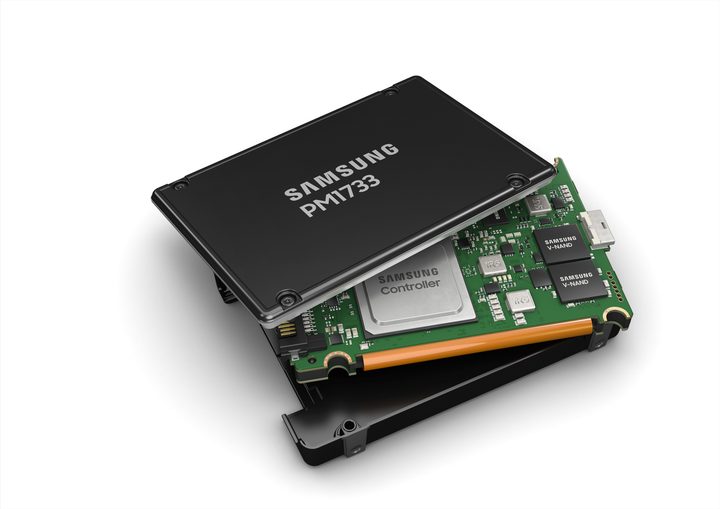
For now, the advertised software improvements will only roll out to Samsung’s server-grade PCIe 4 SSD models, specifically the PM1733 series and PM1735 series, which are far too hefty to be inserted into something like a laptop. Both lines will, however, offer models in the PCI express half-height, half-length (HHHL) form factor that could conceivably fit in a desktop chassis.
No pricing has been announced yet, but if prior comparable models are any indication, these new models will cost somewhere in the thousands of dollars. Basically, all but the highest-rollers eager to get their hands on this bleeding-edge data integrity technology will get priced out until Samsung starts shipping SSDs preloaded with this software.