From drones to four-legged robots like Boston Dynamics’ Spot to fish-inspired swimming robots, there’s no shortage of interesting approaches being taken to robotics locomotion in 2019. But one of the biggest potential leaps forward is the development of machines that are able to transition from one kind of movement to another. That’s something researchers from Imperial College London and the Swiss Federal Laboratories for Materials Science and Technology have been working on. They have developed a new bio-inspired robot that’s able to both swim and, when necessary, propel itself out of the water to glide.
Impressively, it does this without any of the pistons or valves you’d expect to find in an internal combustion engine. Instead, it pumps water through a chamber containing calcium carbide powder to create acetylene gas. This gas is then ignited, propelling the robot upward. With just a tiny fraction of a calcium carbide and minimal water, the glider is able to propel itself into the air for some 26 meters (85 feet).
“This robot is all about a high-powered propulsion system that allows it to transition from water to air,” Mirko Kovac, director of the Aerial Robotics Laboratory at Imperial College London, told Digital Trends. “To make this transition effective, we need a very high-powered system that allows it to clear the water and enter gliding flight. As a locomotion principle, this aquatic jump-gliding is also used by flying fish. That’s partially where the inspiration comes from.”
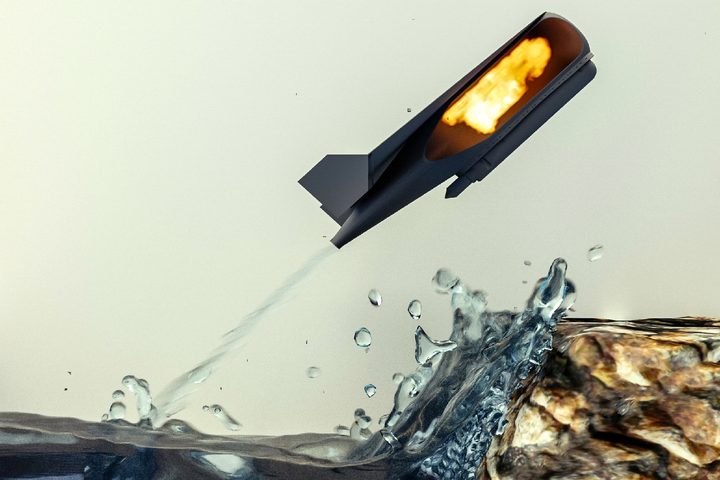
Kovac said that the tether-free robot could be useful as a monitoring tool. “[You can imagine this being used] for reef monitoring or arctic sea monitoring, for example,” he saicontinued. “Often there are obstacles in the water, such as rocks, coral, or floating ice, that make it difficult to gain access using a traditional aquatic vehicle. The method we presented here would allow a variety of aquatic vehicles to temporarily transition out of [that modality] to enter the aerial space. It would let them operate in more complex environments.”
It’s still relatively early in the robot’s development. The team has created a proof of concept, although there is still more work to be done. For instance, they have not yet carried out studies about the potential efficiency sacrifices (or even gains) compared to other swimming robots. “This work was more focused on the propulsion and the transition dynamics,” Kovac said.
Next up, the researchers are planning to explore new materials that could be implemented to make the robot more efficient and effective. They are also seeking out partners working in ecology and environmental sciences who may be interested in deploying the robot in the field.
A paper describing the work was recently published in the journal Science Robotics.