1. Home
  2. Space
  3. Emerging Tech
  4. News

Curiosity rover discovers a puzzling oxygen mystery on Mars

Add as a preferred source on Google

NASA’s Curiosity rover continues to make discoveries that challenge our understanding of the Martian environment. The latest strange puzzle taxing scientists is the variation of oxygen levels on the planet’s surface, as detected Curiosity’s portable chemistry lab, Sample Analysis at Mars (SAM).

In its journey around the Gale Crater, Curiosity discovered the Martian atmosphere has a composition at the surface of 95% by volume of carbon dioxide (CO2), 2.6% molecular nitrogen (N2), 1.9% argon (Ar), 0.16% molecular oxygen (O2), and 0.06% carbon monoxide (CO). The nitrogen and argon levels follow a predictable seasonal pattern, changing relative to the amount of carbon dioxide. The levels of oxygen, however, didn’t conform to expected patterns, rising by as much as 30% over spring and summer.
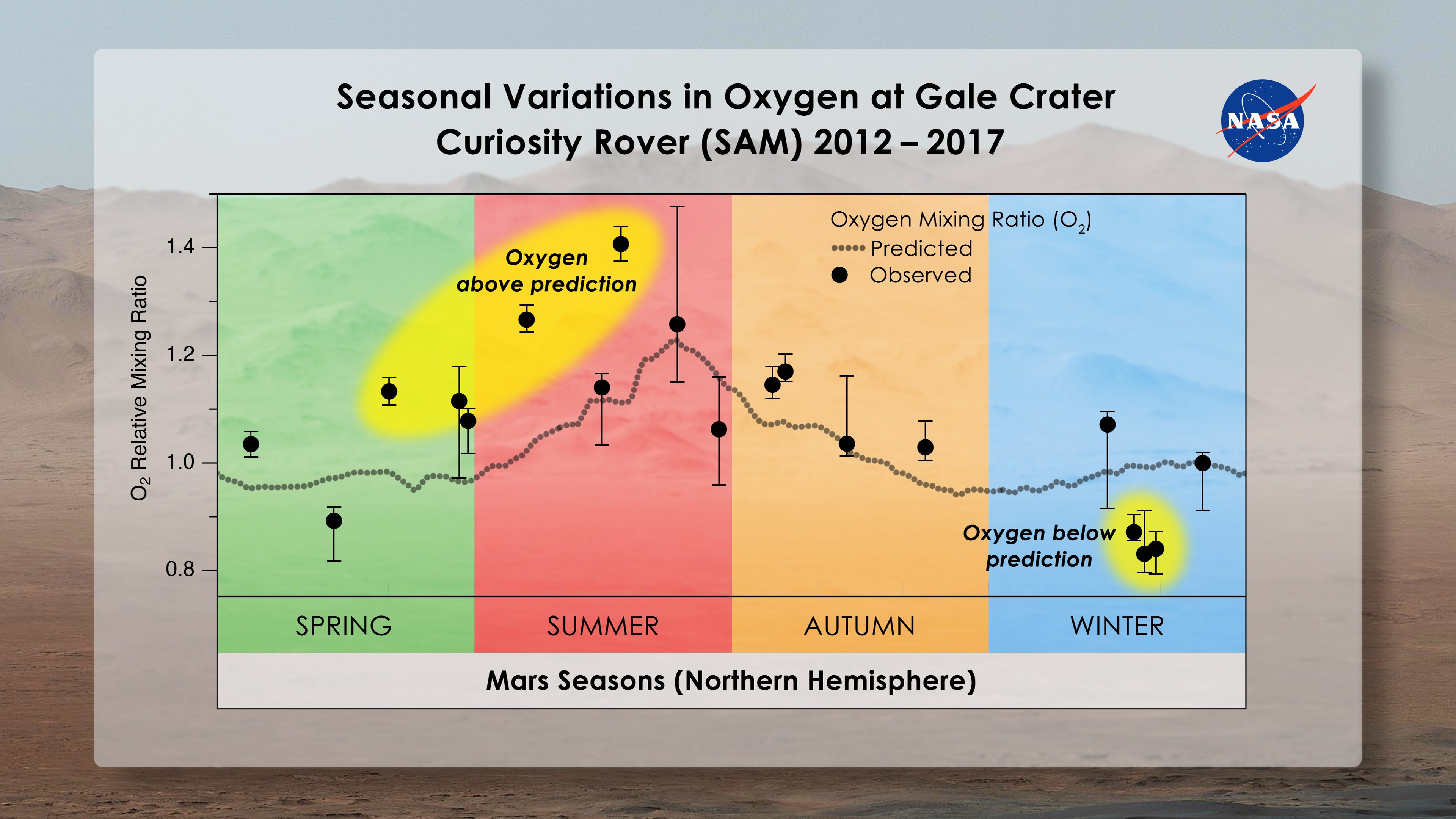
Melissa Trainer/Dan Gallagher/NASA Goddard

The varying oxygen levels have scientists perplexed. “The first time we saw that, it was just mind-boggling,” Sushil Atreya, professor of climate and space sciences at the University of Michigan, said in a statement.

Recommended Videos

The scientists tried various hypotheses to explain the oxygen variation. They checked whether the SAM instrument was functioning correctly and looked at whether carbon dioxide molecules could be breaking apart in the atmosphere to create oxygen, but neither approach yielded results.

“We’re struggling to explain this,” Melissa Trainer, a planetary scientist at NASA’s Goddard Space Flight Center and leader of the research, said in the statement. “The fact that the oxygen behavior isn’t perfectly repeatable every season makes us think that it’s not an issue that has to do with atmospheric dynamics. It has to be some chemical source and sink that we can’t yet account for.”

NASA/JPL-Caltech/MSSS

One possibility is that the oxygen levels are related to another Martian puzzle: The fluctuating levels of methane on the planet. As well as expected seasonal variations in methane levels, Curiosity has detected spikes of methane of up to 60% at some times. Scientists still can’t explain this finding either, but they may have found a link between methane and oxygen levels: It seems like the two gases fluctuate together at certain times.

“We’re beginning to see this tantalizing correlation between methane and oxygen for a good part of the Mars year,” Atreya said. “I think there’s something to it. I just don’t have the answers yet. Nobody does.”

Although both oxygen and methane can be produced biologically, their presence doesn’t necessarily indicate life on the planet. They can also be produced chemically, by water and rocks. Curiosity can only detect the levels of the gases, not their origin, so the source of this mystery remains unknown for now.

The research is published in the Journal of Geophysical Research: Planets.

Georgina Torbet
Georgina has been the space writer at Digital Trends space writer for six years, covering human space exploration, planetary…
Space is becoming Bezos and Musk’s next data center site, and we have every reason to worry
The AI boom is coming for the night sky
How Vast's space station will look in orbit.

AI data centers already consume vast amounts of electricity and water on Earth, so Silicon Valley has begun looking somewhere considerably more spacious... literally.

Elon Musk's SpaceX and Jeff Bezos' Blue Origin, along with several other companies, have proposed enormous constellations of satellites designed to operate as orbital data centers. However, environmental groups and former space officials are now warning that putting them into orbit at the proposed scale could have severe consequences for Earth's atmosphere and the night sky.

Read more
The first possible exomoon is here, and it makes our Moon look hilariously tiny
Scientists may have found the first exomoon, except this one is the size of Jupiter
This artist’s concept depicts a potential volcanic moon between the exoplanet WASP-49 b, left, and its parent star. New evidence indicating that a massive sodium cloud observed near WASP-49 b is produced by neither the planet nor the star has prompted researchers to ask if its origin could be an exomoon.

We have already discovered more than 6,000 planets outside of our immediate neighborhood. Yet, finding a moon orbiting one of those distant worlds has proved considerably harder. Astronomers may finally have something close to the real deal, but this particular object stretches the word “moon” almost beyond recognition.

Using the European Southern Observatory’s Very Large Telescope in Chile, researchers detected strong evidence for a moon-like object in the CD-35 2722 system. Further observations are still necessary to confirm the discovery, but it could become the first confidently detected natural satellite outside our solar system. There is still one tiny complication though. This moon is apparently massive.

Read more
China’s answer to SpaceX’s reusable rockets literally catches boosters in a net
SpaceX catches boosters on legs. China just used a net.
Ammunition, Missile, Weapon

SpaceX's playbook for recovering a rocket booster generally involves legs, a precisely controlled vertical landing, and either a concrete pad or a drone ship. 

China just managed to pull off something similar, but in a slightly different way, and on July 10, it tested the method as well.

Read more