  1. Home
  2. Emerging Tech
  3. News

Mars’s strange equatorial terrain could have formed under an ice sheet

Add as a preferred source on Google

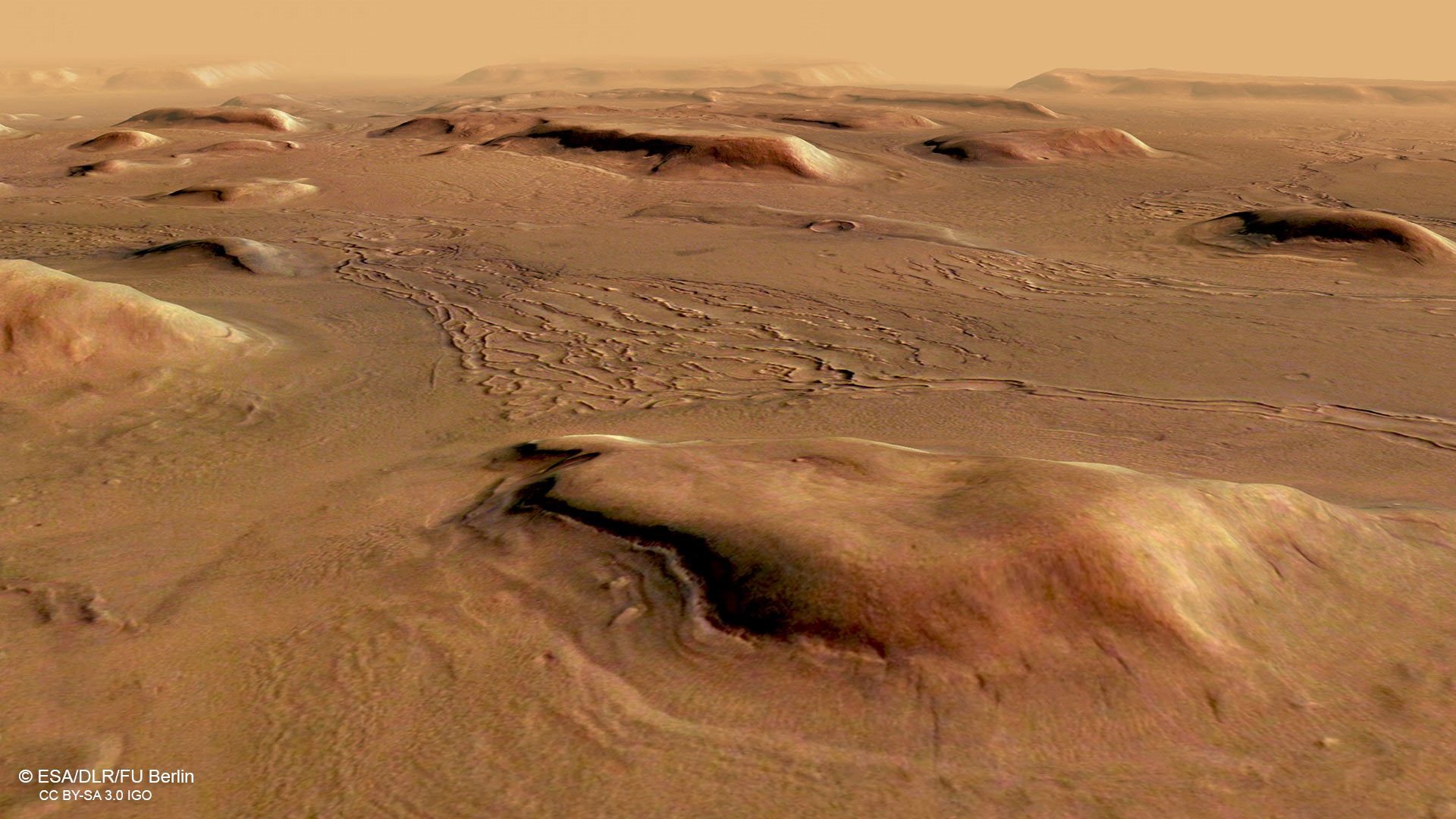
This image shows a region of Mars named Deuteronilus Mensae. The oblique perspective view was generated using a digital terrain model and Mars Express data gathered on February 25, 2018. ESA / DLR / FU Berlin / CC BY-SA 3.0 IGO

Mars is a mysterious place in many ways — not least because its two hemispheres are drastically different. The northern hemisphere of the planet has low plains, with few impact craters, while the southern hemisphere is mountainous and pockmarked by craters. And scientists still aren’t sure why the two halves of the planet are so different.

Recommended Videos

In between the two hemispheres is a transitional region with unusual geological features called fretted terrain. Areas of fretted terrain contain a strange mix of canyons, cliffs, mounds, ridges, and more, and the European Space Agency’s Mars Express spacecraft has been investigating one such area called Deuteronilus Mensae for clues about how these features developed. The Mars Express craft has been in orbit around Mars since 2003, collecting data about the surface with instruments including its High Resolution Stereo Camera (HRSC).

The image above shows a part of the Deuteronilus Mensae region, and scientists believe that it looks the way that it does due to ancient flowing ice. Millions of years ago, glaciers moved through the area, eroding rock and carving out channels that can still be seen today. The plains and plateaus that would have been there before were gradually flattened by the progress of the glaciers, leaving behind only mounds of rock.

The idea that glaciers were present in Deuteronilus Mensae is supported by data from NASA’s Mars Reconnaissance Orbiter (MRO), which also orbits around Mars and captures high-definition images of the surface. The MRO found that up to 90% of the glacial features of the region could have contained water ice. This suggests that there was not just the odd pocket of ice or glacial activity in the area — rather, the whole region could have been covered by an ice sheet. As Mars slowly warmed and lost its atmosphere, the ice sheet melted away to reveal the rock formations beneath.

Further studies have shown that it’s not just this region that has evidence of glacial activity. There could have been glaciers both above and below the equator, so there are many more areas of Mars which may have been under ice at some point in the past.

Georgina Torbet
Georgina has been the space writer at Digital Trends space writer for six years, covering human space exploration, planetary…
Anti-surveillance clothing is getting cheaper, but don’t expect an invisibility cloak
Affordable shirts now claim to confuse facial recognition, although their protection depends heavily on the camera and software watching you
Chart, Plot, Adult

Anti-surveillance clothing is starting to look less like an art-school experiment and more like something you could actually wear outside. Shirts designed to confuse facial recognition systems now cost about as much as ordinary streetwear, although buying one won’t make you disappear.

The Guardian reports that designers are using face-like prints, unusual cuts and infrared lights to interfere with computer vision. These techniques target specific weaknesses, so their success depends on what happens to be watching you.

Read more
This spinning drone hides in plain sight using a visual illusion
This drone doesn't turn invisible. It tricks your brain into thinking it has.
Phantom Twist

For decades, engineers have chased the dream of an invisible drone. The usual approaches have involved transparent materials, camouflage coatings, or complex optical systems that bend light around an object. Researchers at Northwestern University decided to take a completely different route. Instead of hiding the drone itself, they chose to fool the human eye.

The result is Phantom Twist, an experimental drone that spins so rapidly it almost disappears into the background. It's not technically invisible, but to anyone watching, it looks more like a faint blur than a flying machine.

Read more
This smart knitted fabric can flip switches, count your steps, and even change shape
Grandma's knitting just entered its Iron Man era
Representative Image

For most of us, knitting brings to mind sweaters, scarves, and perhaps an ambitious grandmother determined to make winter more fashionable. Researchers at Harvard University, however, have a far more futuristic vision. They've transformed ordinary knitted fabric into a programmable material capable of changing shape, acting as an electrical switch, sensing movement, and potentially forming the foundation of tomorrow's wearable technology.

The research, published in Advanced Functional Materials by scientists at the Harvard John A. Paulson School of Engineering and Applied Sciences (SEAS), demonstrates how machine-knitted textiles can "snap" between multiple stable shapes without relying on motors or rigid mechanical parts.

Read more