  1. Home
  2. Emerging Tech
  3. News

Spitzer Space Telescope uses infrared light to image a stellar playground

Add as a preferred source on Google

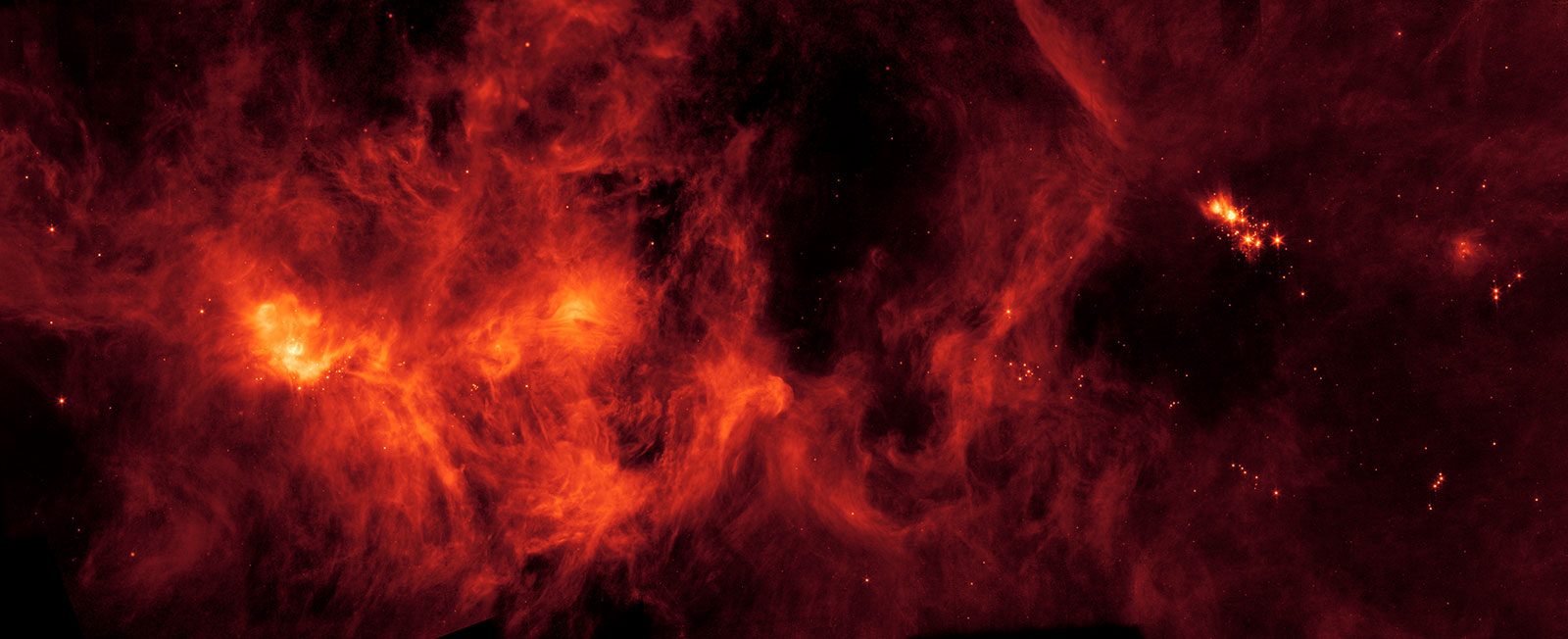
A collection of gas and dust over 500 light-years across, the Perseus Molecular Cloud hosts an abundance of young stars. It was imaged here by NASA’s Spitzer Space Telescope. NASA/JPL-Caltech

NASA’s Spitzer Space Telescope has captured this beautiful image of the Perseus Molecular Cloud by observing infrared radiation which makes the cloud glow. The cloud is over 500 light-years across and is located relatively nearby to Earth, at around 1000 light-years away. In total, the cloud has a mass equivalent to 10,000 times that of our sun.

Recommended Videos

The Spitzer Space Telescope is an infrared telescope that has captured a number of stunning space images over its 16-year career. This particular image was captured using an instrument on Spitzer called the Multiband Imaging Photometer (MIPS), which is an imaging camera which operates in three far-infrared wavelengths of 24, 70, and 160 microns.

By looking in infrared wavelengths, Spitzer is able to peer through clouds of dust which would be opaque to visible light telescopes. Clouds like the Perseus Molecular Cloud contain large amounts of dust which do not emit visible light, but which are illuminated in the infrared wavelength by clusters of stars.

Molecular clouds are regions of space with significant amounts of dust and gas, primarily hydrogen molecules. Their density means that new molecular hydrogen can form. Within molecular clouds are regions with a higher density of dust and gas, called clumps. These clumps can eventually coalesce to form stars. Hence why molecular clouds can also be called stellar nurseries.

The Perseus Molecular Cloud contains an oddity in terms of star formation, however. Within the cloud, near to the NGC 1333 nebula, is a cluster of stars that includes new-born stars, adolescent stars, and mature stars. This is unusual as stars generally form in tight clusters and spread away from each other as they age. But in this region, astronomers observe an unexpected mix of star ages.

“This region is telling astronomers that there’s something we don’t understand about star formation,” Luisa Rebull, an astrophysicist at NASA’s Infrared Science Archive at Caltech-IPAC who has studied this region, said in a statement. It is this puzzle that makes the area such an intriguing target for research: “It’s one of my favorite regions to study,” she added.


Georgina Torbet
Georgina has been the space writer at Digital Trends space writer for six years, covering human space exploration, planetary…
Researchers hid a prompt injection inside a PNG, and AI fell for it
Hacker

AI coding assistants like Claude are becoming every developer's favorite coworker. They can review code, explain confusing functions, and even write entire features with a single prompt. But new research suggests that this growing trust could also become their biggest weakness.

A team of security researchers (professor Sudipta Chattopadhyay and researcher Murali Ediga) has demonstrated an unusual attack that doesn't target the AI model directly. Instead, it targets what the AI doesn't pay enough attention to during code reviews. Rather than hiding malicious instructions in lines of code, the researchers tucked them inside an image file. Since many AI review tools treat images as decorative assets rather than as something worth inspecting, the pull request can appear perfectly harmless and sail through the review.

Read more
AI has already fallen into the wrong hands and they’re using it to make bombs
Logo, Text

Artificial intelligence has quickly become the go-to tool for everything from writing emails and summarizing meetings to helping students study or developers debug code. But the same technology that saves people time can also be misused, and a new report suggests that terrorist organizations are finding ways to do exactly that.

According to a research paper shared with The New York Times ahead of its publication, researchers found evidence that members of Boko Haram have been using popular AI chatbots to support both day-to-day activities and combat-related tasks. Interviews with 27 former members conducted in Nigeria over the past two years suggest that tools such as ChatGPT, Gemini, Claude, Grok, Meta AI, and DeepSeek were used to gather technical information, troubleshoot weapons, and even assist with planning attacks.

Read more
Claude Code can now browse the web without opening Chrome
The desktop app now includes an in-app browser that can read websites, click links, and interact with web apps.
Claude Code Featured

Developers spend a surprising amount of time bouncing between their code editor, browser tabs, API documentation, GitHub issues, and design files. Anthropic thinks Claude Code should simply do all of that without constantly asking users to switch windows. The company has announced a new in-app browser for Claude Code on desktop, allowing its AI coding assistant to open websites, read documentation, inspect designs, and interact with web pages directly from within the application.

A browser built into Claude Code

Read more