1. Home
  2. Emerging Tech
  3. News

DARPA tests drones that can be dropped from planes and collected in midair

Add as a preferred source on Google
Gremlins X-61A Maiden Test Flight

Whether it’s drones that can be “grown” using chemistry in large-scale labs or dissolving drones designed to fly over enemy lines, there’s no shortage of unmanned aerial vehicle (UAV) innovation in military research. An ongoing project involving the U.S. Defense Advanced Research Projects Agency (DARPA) adds one more item to the list. DARPA has been testing a new drone that can be launched from a plane, then later recovered in midair once it’s completed a mission. This is done by having the drone return to the plane and winched back on board via a special line, similar to a midair refueling.

Recommended Videos

The X-61A Gremlins Air Vehicle (GAV) drone, developed by U.S.-based company Dynetics, looks more like a winged missile than the kind of quadcopter most of us picture when we think of a drone. However, one of the abilities this gives it is an impressive flight time. In a test carried out in Utah in November 2019 (although only announced recently), the drone was deployed from a military transport in midair, and flew for 1 hour, 41 minutes. The dry run showed off the drone’s impressive capabilities, including its cold engine start and rapid wing deployment, alongside data link performance and the deployment of a special docking arm.
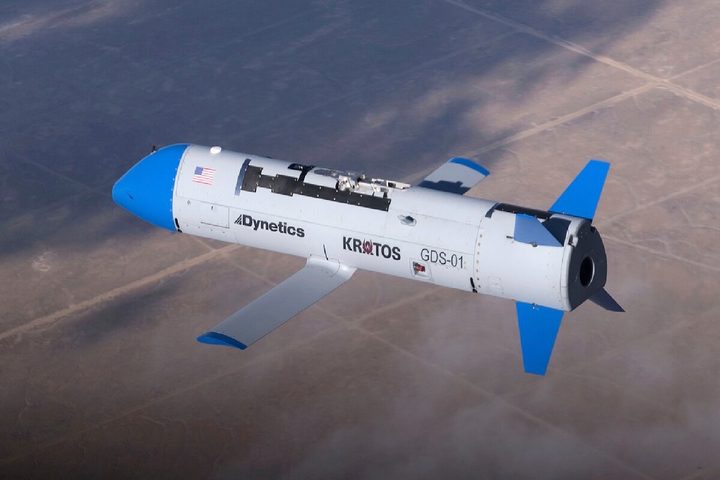
DARPA Gremlin drone 1
DARPA

Not everything went according to plan, however. “Mechanical issues” at the end of the test stopped its parachute from deploying correctly, causing it to crash-land.

Nonetheless, DARPA’s enthusiasm seems to be far from dimmed. It will test out a deployment of four drones sometime this spring. If that goes according to plan, it could suggest how these drones might be used. They may be deployed in a group from a bomber, then sent into action — either working together to pursue one mission or pursuing separate targets. Because they are dropped from a plane, it gives them a wider range than they would ordinarily have if they had to be launched from an air base. The fact that they are reusable would also reduces the cost of deployment.

“This flight marks a historic milestone for Dynetics and the Gremlins program,” Tim Keeter, Gremlins program manager for Dynetics, said in a statement. “The GAV flew beautifully, and our command and control system kept us in total control of the GAV for the entire flight. The loss of our vehicle validates our decision to build five GAVs [for testing]; we still have four remaining.”

Luke Dormehl
I'm a UK-based tech writer covering Cool Tech at Digital Trends. I've also written for Fast Company, Wired, the Guardian…
China’s UBTech unveils eerily lifelike companion robots, and yes, they want to move in with you
UBTech's new humanoid robots are built for companionship, using emotion-aware AI, long-term memory, and humanlike expressions to become part of your everyday life.
UBTech Uworld U1 series robot launch

A humanoid robot designed to live in your house, learn your habits, and pick up on your mood without being prompted is no longer science fiction. Shenzhen-based UBTech Robotics unveiled its Uworld U1 series this week, introducing three robots built for companionship rather than factory work or household chores.

A body that moves like yours, and a brain that reads how you feel

Read more
This $249 LED sign wants to fix your work-life balance
My productivity isn't worth $249... or is it?
Flipper Busy Bar

Flipper Devices has built a reputation among hackers and hardware enthusiasts with the Flipper Zero, a pocket-sized gadget capable of interacting with RFID, NFC, Bluetooth, and other wireless protocols. Now, the London-based company is taking a very different approach.

Its latest product, the Busy Bar, is a desktop productivity display designed to help users stay focused, signal their availability, and automate parts of their workflow. After being teased last year, the device is finally going on sale on July 14. While the concept is genuinely clever, its starting price of up to $249 may make many buyers think twice.

Read more
FAA clears the runway for Mach flights that could cut travel times nearly in half
New regulations could dramatically reduce travel times while keeping sonic booms under control.
Supersonic Flight Time

The dream of flying faster than the speed of sound just took a major step forward. The Federal Aviation Administration (FAA) has announced a proposed rule that would create the first noise-based certification standards for a new generation of supersonic passenger aircraft, removing one of the biggest regulatory hurdles standing in the way of commercial Mach 1+ flights.

The goal is simple: fly faster without the boom

Read more