  1. Home
  2. Emerging Tech
  3. News

The Very Large Array will search for evidence of extraterrestrial life

Add as a preferred source on Google

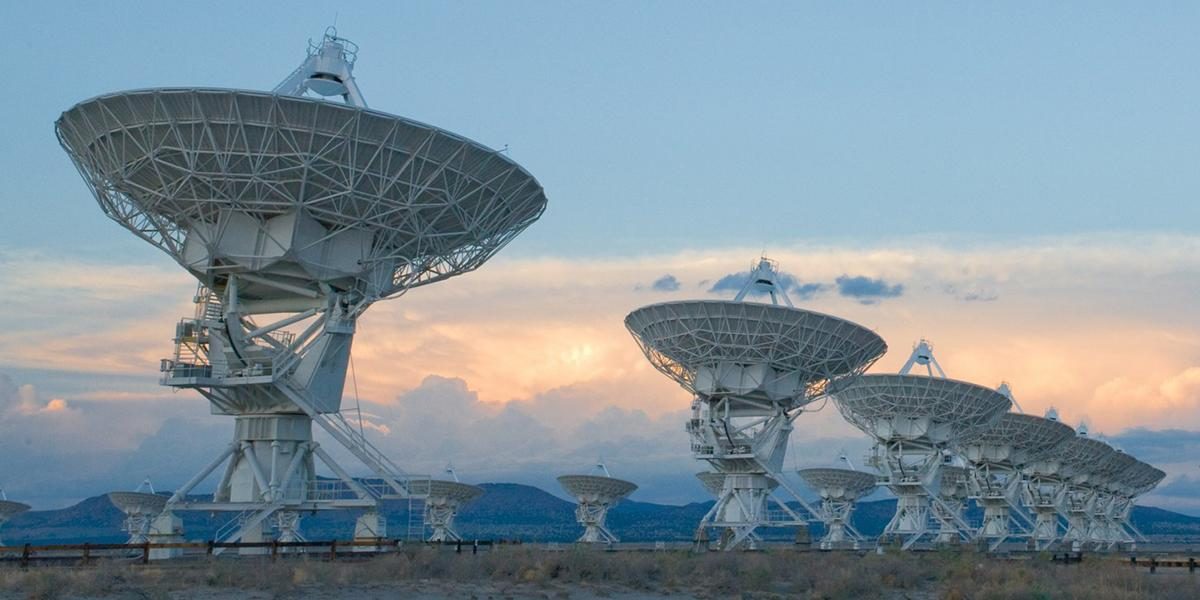
The Very Large Array (VLA) is a collection of 27 radio antennas located at the NRAO site in Socorro, New Mexico. Each antenna in the array measures 25 meters (82 feet) in diameter and weighs about 230 tons.
The Very Large Array (VLA) is a collection of 27 radio antennas located at the NRAO site in Socorro, New Mexico. Each antenna in the array measures 25 meters (82 feet) in diameter and weighs about 230 tons. Alex Savello/NRAO

The search for extraterrestrial intelligence (SETI) is getting a boost through a collaboration that will use existing radio telescopes to search for indicators of life elsewhere in the universe.

Recommended Videos

A new collaboration has been announced between the National Radio Astronomy Observatory (NRAO) and the SETI Institute, to add SETI capabilities to the NRAO’s radio telescopes. To begin the project, an interface will be added to the NRAO’s Very Large Array (VLA) in New Mexico to search for events or structures which could indicate the presence of life, such as laser beams, structures built around stars, indications of constructed satellites, or atmospheric chemicals produced by industry.

“The SETI Institute will develop and install an interface on the VLA permitting unprecedented access to the rich data stream continuously produced by the telescope as it scans the sky,“ Andrew Siemion, Bernard M. Oliver Chair for SETI at the SETI Institute and Principal Investigator for the Breakthrough Listen Initiative at the University of California, Berkeley, said in a statement. “This interface will allow us to conduct a powerful, wide-area SETI survey that will be vastly more complete than any previous such search.”

As well as adding the new interface, the data collected by the VLA will be analyzed for signs of life. “As the VLA conducts standard observations, this new system will allow for an additional and important use for the data we’re already collecting,” NRAO Director Tony Beasley said in the statement. “Determining whether we are alone in the universe as technologically capable life is among the most compelling questions in science, and NRAO telescopes can play a major role in answering it.”

With the discovery of more and more exoplanets, having access to a powerful instrument like the VLA gives researchers the opportunity to search further than ever before. “Having access to the most sensitive radio telescope in the northern hemisphere for SETI observations is perhaps the most transformative opportunity yet in the history of SETI programs,” said Bill Diamond, President and CEO of the SETI Institute. “We are delighted to have this opportunity to partner with NRAO, especially as we now understand the candidate pool of relevant planets numbers in the billions.”


Georgina Torbet
Georgina has been the space writer at Digital Trends space writer for six years, covering human space exploration, planetary…
AI agent reportedly carried out an entire ransomware attack on its own
AI didn't just write malware. It apparently clocked in for work.
Cybersecurity

Cybersecurity researchers say they have documented what could be the first ransomware attack carried out almost entirely by an autonomous AI agent, marking a significant shift in how cyberattacks could be conducted in the future. According to cloud security firm Sysdig, they have uncovered a ransomware operation dubbed JadePuffer that appears to have relied on a large language model (LLM) agent to perform nearly every stage of the attack without continuous human intervention.

If confirmed, the incident suggests AI is moving beyond writing malicious code and into actively planning, adapting, and executing cyberattacks in real time.

Read more
The Washington Post predicted how tech will advance 50 years ago and the success rate is humbling
The Washington Post predicted 2026 tech in 1976. It got a lot right.
Representative Image

Fifty years ago, when floppy disks were cutting-edge and the personal computer revolution had barely begun, The Washington Post attempted a remarkably ambitious exercise: predict what life in 2026 would look like. Some of those predictions now read like science fiction. Others feel surprisingly ordinary because they have become part of everyday life.

In a retrospective published for America's 250th anniversary, the newspaper revisited science editor Thomas O'Toole's 1976 article Inventing the Future, comparing its forecasts with today's technological reality. The results reveal that while predicting exact timelines is nearly impossible, identifying long-term scientific trends can be remarkably accurate.

Read more
Australian government warns doctors over AI scribing tools as privacy and safety concerns grow
AI medical scribes face regulatory scrutiny in Australia amid safety concerns
Representative Image

The Australian government is urging healthcare professionals to exercise caution when using AI-powered medical scribing tools, as regulators examine whether stronger safeguards are needed around one of healthcare's fastest-growing technologies, according to a report by The Guardian.

AI scribes have rapidly gained popularity by recording, transcribing, and summarising doctor-patient conversations into clinical notes, reducing the administrative burden on healthcare workers. However, government officials now warn that the technology's rapid adoption has outpaced oversight, raising questions around patient privacy, informed consent, and the accuracy of medical records.

Read more