  1. Home
  2. Emerging Tech
  3. News

A year on this Jupiter-like planet lasts 18 hours and it’s about to be destroyed

Add as a preferred source on Google

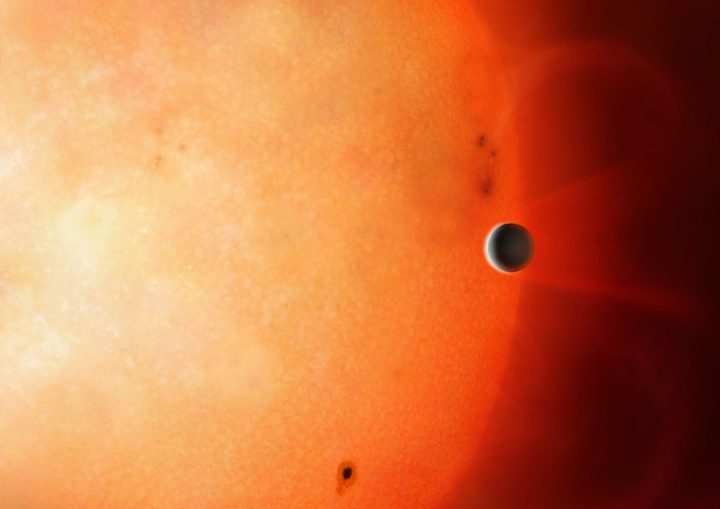
Artist’s impression of a hot Jupiter orbiting close to a star
Artist’s impression of a hot Jupiter orbiting close to a star. University of Warwick/Mark Garlick

Astronomers have located a planet similar to Jupiter that orbits its host star so closely that its year lasts just 18 hours. Planet NGTS-10b is 27 times closer to its star than Mercury is to the sun, and according to the researchers who discovered it, it is “perilously close” to being torn apart.

Recommended Videos

Located 1,000 light-years away from Earth, this is the shortest-ever orbital period discovered for this type of planet, called a hot Jupiter. The astronomers were able to locate the planet using what is called the transit method, in which they measure the brightness of distant stars and look for regular dips in brightness which indicate a planet is passing between the star and Earth.

“Although in theory hot Jupiters with short orbital periods (less than 24 hours) are the easiest to detect due to their large size and frequent transits, they have proven to be extremely rare,” lead author Dr. James McCormac from the University of Warwick Department of Physics said in a statement. “Of the hundreds of hot Jupiters currently known there are only seven that have an orbital period of less than one day.”

The planet is also tidally locked, which means one side of it always faces toward its star. This contributes to blistering surface temperatures which are estimated to be more than 1,000 degrees Celsius.

The astronomers are curious as to how the planet came to be located so close to a star, and they assume it must have formed elsewhere and migrated inward. “It’s thought that these ultra-short planets migrate in from the outer reaches of their solar systems and are eventually consumed or disrupted by the star,” co-author Dr. David Brown explained. “We are either very lucky to catch them in this short period orbit, or the processes by which the planet migrates into the star are less efficient than we imagine, in which case it can live in this configuration for a longer period of time.”

The long-term outlook for the hot planet is not looking good, as the researchers believe it will eventually be destroyed. “Over the next ten years, it might be possible to see this planet spiraling in,” co-author Dr. Daniel Bayliss said. “The best model that we’ve got suggests that the star is about ten billion years old and we’d assume that the planet is too. Either we are seeing it in the last stages of its life, or somehow it’s able to live here longer than it should.”

Georgina Torbet
Georgina has been the space writer at Digital Trends space writer for six years, covering human space exploration, planetary…
That Claude chat you shared? Google may have seen it too
Public chat links were indexed by Google, potentially exposing sensitive information shared with the AI.
Claude AI on an iPhone.

If you've ever shared a Claude conversation using a public link, it might be worth checking your privacy settings. Over the weekend, users discovered that publicly shared Claude chats and Artifacts were appearing in Google Search and other search engines through queries such as site:claude.ai/share. The indexed pages reportedly included everything from resumes and business documents to API keys, health information, and other sensitive conversations that users likely never expected to become searchable.

How did this happen?

Read more
The AI-hooked younger generation is sourcing chatbot help even for in-person talks
From pickup lines to angry emails, here's how young adults are using AI to script their social lives, and why psychologists say it's a risky habit.
Person using ChatGPT on a MacBook.

I've definitely rehearsed a text message in my head before hitting send, especially when it's a long email with dozens of jargon and diplomatic language. However, when it comes to in-person talks, I’ve never even thought about outsourcing them to an AI chatbot.

Turns out an entire generation has handed the whole script to AI instead (via The Wall Street Journal).

Read more
Google Flow Music Spaces is becoming an all-in-one AI music studio
The latest update brings song editing, stem splitting, image generation, lyrics, and video creation into a single workspace.
Google Flow Music Featured

The company has announced a major update for Flow Music Spaces, bringing a suite of new AI-powered creative tools directly into collaborative workspaces. Instead of jumping between different apps or sessions, users can now generate and edit songs, split audio stems, create images, write lyrics, and even generate videos without leaving a Space.

What's new in Flow Music Spaces?

Read more