  1. Home
  2. Emerging Tech
  3. News

ISS gets a new research platform, Bartolomeo, attached to its exterior

Add as a preferred source on Google

The International Space Station (ISS) will soon be receiving a new research platform, Bartolomeo, which will play host to both scientific and commercial projects. Created by Airbus and hosted by the European Space Agency (ESA), the platform is heading to the ISS aboard a SpaceX Dragon cargo spacecraft this weekend.

The platform provides an unpressurized environment with a good view of the Earth, not blocked by the ISS’s solar cells. It will draw power from the station’s Columbus module which is then distributed across the platform via 12 interfaces, providing power to the experiments or equipment on the platform. One interface can be operated by robot, similar to the Columbus module.

Recommended Videos

“Bartolomeo is the first European commercial facility outside the International Space Station, offering a high-speed data feed and a unique view of Earth and deep space,” ESA’s Bernhard Hufenbach, leader of the strategy and innovation team for human and robotic exploration, said in a statement. “The versatile Bartolomeo service provides easy access to space at competitive pricing and will expand the use of Europe’s assets on the International Space Station for many years to come.”
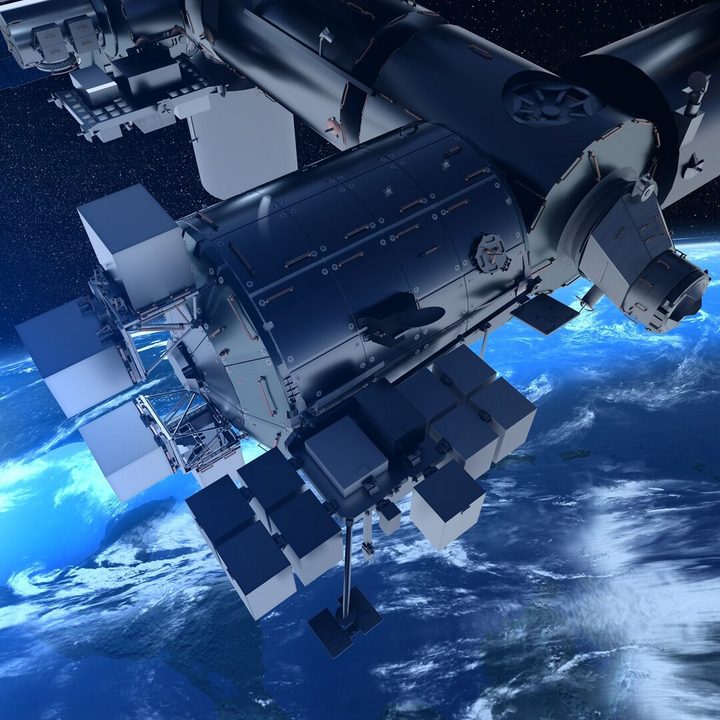
A visualization of the Bartolomeo platform attached to the International Space Station.
A visualization of the Bartolomeo platform attached to the International Space Station. Airbus

Measuring plasma to predict space weather

The first experiment which will be placed on the platform is a Langmuir probe, a device that measures electron temperature and density more accurately than other methods. By measuring the electron qualities of plasma in the space environment, researchers can understand more about how signals from satellites are distorted as they pass through the plasma in the Earth’s atmosphere. This could help to develop more accurate space weather forecasting and to provide information about what kind of disruptions to GPS and other satellite signals are to be expected due to space weather events.

Preparing the station for its new addition

Astronauts on board the ISS have already prepared the station for its latest addition, with spacewalks performed to prepare the outside of the station with new support pins. Astronaut Jessica Mier also set up the internal hardware which will connect to the module two weeks ago.

The Bartolomeo platform is being carried aboard the external cargo hold of a SpaceX Dragon spacecraft which launched on Friday and is scheduled to arrive at the ISS early on Monday, March 9. Once it arrives, Bartolomeo will be removed from the cargo hold and placed into position on the Columbus module using the station’s robotic arm.

The final step is to actually install the module, which will be done on a spacewalk within the next few months.

Georgina Torbet
Georgina has been the space writer at Digital Trends space writer for six years, covering human space exploration, planetary…
AI security cameras may soon recognize your walk before they recognize your face
A new AI gait system tracks body motion through skeletal keypoints, aiming at long-range identity checks where face scans and fingerprints fall short.
Security cam

Security cameras are built to look for faces. New research suggests they may soon have another target, the small habits buried in the way someone walks.

A paper published in the International Journal of Reasoning-based Intelligent Systems describes SKDMap-Net as a gait recognition system designed to identify people from walking video, even when the camera doesn’t get a clean look at their face. Instead of relying on a close-up scan, it studies how a body moves from frame to frame.

Read more
A 20-second 3D printer breakthrough comes with exactly the kind of catch science loves
The process can create complex microstructures far faster than some laser-based methods, but full 3D control is still a work in progress.
Aluminium, Smoke Pipe

A 3D printer that can make a structure in about 20 seconds sounds like a lab claim wearing a cape. The clever bit is real. The catch arrives before anyone starts dreaming about instant replacement parts.

University of Utah researchers have demonstrated a holographic 3D printing technique that hardens tiny structures in one exposure instead of building them layer by layer. That one-shot approach could avoid the weak, leaky seams that stacked printing can leave behind. For now, though, this is a tool for microstructures, not a shortcut to printing whatever object pops into your head.

Read more
Amazon is full of copycats and shady brands. This Chrome extension lets you avoid them.
Advertisement, Poster, Text

Shopping on Amazon used to be simple. You searched for a product, compared a few familiar brands, and checked out. These days, it often feels like you're scrolling through an endless parade of names that look like someone leaned on a keyboard before hitting publish. That's exactly the problem Knockoff is trying to solve.

Created by developer Josh Pigford, the Chrome extension doesn't promise to expose counterfeit products or magically tell you what's good. Instead, it tackles something arguably more annoying: the flood of unfamiliar, mass-produced brands that dominate Amazon search results.

Read more