The cool thing about balloon animals is that, using the same basic inflatable building blocks, a skilled person can create just about anything you could ask for. That same methodology is what’s at the heart of a recent Stanford University and University of California, Santa Barbara, soft robotics project. Described by its creators as a “large-scale isoperimetric soft robot,” it’s a human-scale robot created from a series of identical robot roller modules that are mounted onto inflatable fabric tubes. Just like the balloon animals you remember, this leads to some impressive shape-shifting inventiveness.
“When you make a balloon animal, you start with a long straight tube and add joints in it by twisting the balloon,” Zack Michael Hammond, a researcher on the project, told Digital Trends. “You can then fold up the balloon at these joints to form shapes like a dog or a hat. That’s exactly how this robot works. A collective of simple robots creates a number of pinch points in the tube allowing the tube to fold into a 3D structure. These robots can then drive along the tube to move these pinch points, which causes the shape of the structure to change.”
The robot has a truss structure, meaning that it’s assembled with beams, usually in triangular units, like the Eiffel Tower. This is what gives it its ability to change shape where required. By connecting the sub-unit robots together in different ways, or by adding additional ones, the researchers can create a variety of structures with different topologies, each suited for a particular task.
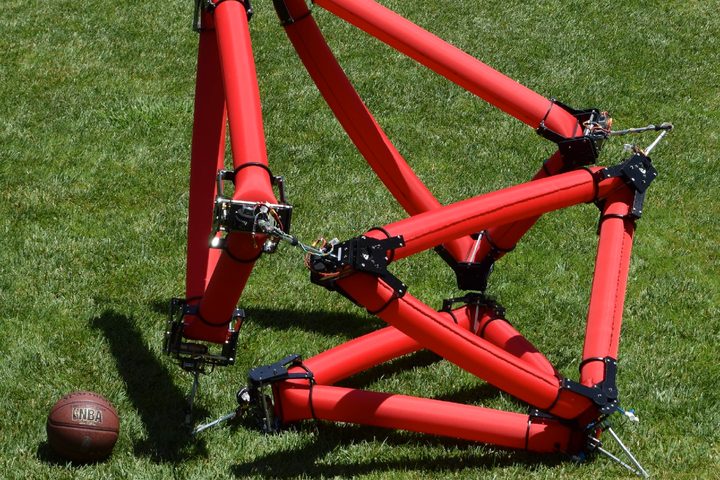
Because it is a soft robot, it is inherently more human-safe, as well as being more tolerant to traveling on uncertain terrain. Unlike many soft robots, it can work without physical connection to an external source of energy. This is a difficult and necessary hurdle for many soft robotic technologies.
“One potential application that we are excited about is using this type of robot for space exploration,” Nathan Scot Usevitch, another researcher on the project, told Digital Trends. “Most of the robot structure is just inflated fabric tubing, so it could deflate and pack into a very small volume for transport. Once it arrived on another planet or moon it could inflate, and then begin exploring without a tether. It could use its large shape-changing ability to travel over varied terrain, getting long and skinny to squeeze through gaps, or stretching out to brace against the walls as it climbs.”
A paper describing the robot was recently published in the journal Science Robotics.