1. Home
  2. Emerging Tech
  3. News

NASA’s Perseverance rover’s new wheels can grip and better withstand rocks

Add as a preferred source on Google

NASA’s new Mars rover, Perseverance, nears completion as it is fitted with new wheels and a massive air brake parachute.

The rover had its wheels fitted for the first time last year, but those were engineering model wheels which are used for fitting and testing, such as checking whether the rover could stand on its own wheels and take its own weight. With that testing now complete, the NASA team could remove the model wheels and replace them with the real wheels that the rover will run on when it reaches Mars.
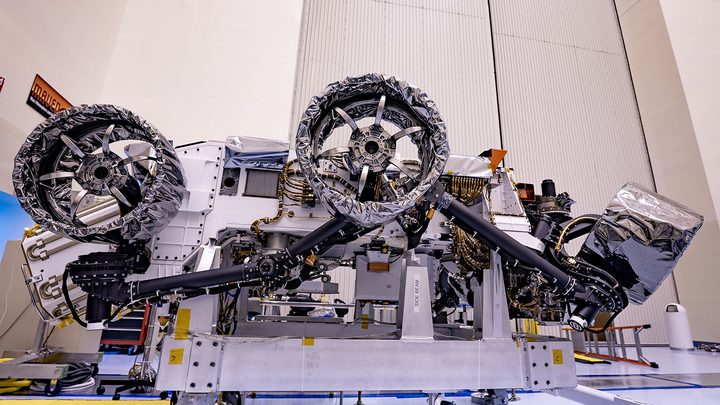
 Three of the six flight wheels that will travel to Mars can be seen attached to NASA's Perseverance rover (which is inverted on a handling fixture) on March 30, 2020 at the Kennedy Space Center in Florida. The protective antistatic foil covering the wheels will be removed before launch this summer.
Three of the six flight wheels that will travel to Mars can be seen attached to NASA’s Perseverance rover (which is inverted on a handling fixture) on March 30, 2020 at the Kennedy Space Center in Florida. The protective antistatic foil covering the wheels will be removed before launch this summer. NASA

Perseverance has slightly different wheels than NASA’s other Mars rover, Curiosity. Perseverance’s wheels are slightly larger in diameter, at 52.6 centimeters (20.7 inches) versus 50.8 centimeters, and are also slightly narrower. Curiosity’s wheels have 24 widely spaced treads in a chevron pattern, which prevents the rover from slipping sideways as it moves across unstable surfaces like sand as it climbs up the winding path of Mount Sharp.

Recommended Videos

Perseverance, on the other hand, has wheels with 48 gently curved treads that are spaced closely together, which NASA engineers have found give the same amount of grip as the chevron pattern but can better withstand pressure from sharp rocks. Curiosity has had issues with small breaks in some of its wheels, and although the wheels should still work for the lifetime of the rover, the newer design should prevent this kind of wear and tear.

A new parachute

In addition to the wheels, the rover has also had another vital component integrated: Its parachute, which will slow the rover’s descent onto Mars and help it touch down onto the planet’s surface gently without damaging any of the delicate components. The Perseverance rover will be the heaviest payload ever deployed on Mars, so the parachute canopy made of nylon, Technora, and Kevlar fiber needs to be very large — 70.5 feet wide — to slow the full weight of 2260 pounds of the rover from Mach 1.7 to 200 mph.

Launch of the rover is scheduled for between July 17 and August 5 this year.

Georgina Torbet
Georgina has been the space writer at Digital Trends space writer for six years, covering human space exploration, planetary…
Claude Code can now browse the web without opening Chrome
The desktop app now includes an in-app browser that can read websites, click links, and interact with web apps.
Claude Code Featured

Developers spend a surprising amount of time bouncing between their code editor, browser tabs, API documentation, GitHub issues, and design files. Anthropic thinks Claude Code should simply do all of that without constantly asking users to switch windows. The company has announced a new in-app browser for Claude Code on desktop, allowing its AI coding assistant to open websites, read documentation, inspect designs, and interact with web pages directly from within the application.

A browser built into Claude Code

Read more
Apple is suing OpenAI over theft of trade secrets in blockbuster lawsuit
The lawsuit claims OpenAI recruited Apple employees and obtained confidential information about unreleased products.
Apple store Apple Building Apple Logo

For the past two years, Apple and OpenAI have been presented as close AI partners. ChatGPT powers key Apple Intelligence features, Siri can hand complex queries over to OpenAI, and together the two companies helped bring generative AI to millions of Apple devices. Now, that partnership has taken a dramatic turn.

What is Apple accusing OpenAI of?

Read more
Home robots can already walk. The hard part is stopping them from crushing your glassware
1X’s NEO uses tactile sensing and force control to handle fragile objects, aiming at the kind of household work humanoids still struggle to do.
Baby, Person, Electronics

A robot can look convincing while walking across a stage and still be useless in a kitchen. Picking up a wet glass demands precision, quick corrections, and enough restraint to avoid squeezing too hard. 1X is tackling that problem with new tendon-driven hands for NEO, its humanoid home robot.

1X says each hand has 25 degrees of freedom, with 22 across the fingers and palm and another three in the wrist. Its joints can yield when pushed instead of staying rigid, giving NEO a better chance of handling household objects without treating every collision like a wrestling match.

Read more