One of the several mysteries central to the plot of Sir Arthur Conan Doyle’s Sherlock Holmes novel The Hound of the Baskervilles involves mysterious lights that appear on the moor, a stretch of wilderness upon which Baskerville Hall is located. These lights are, in fact, coded messages from a man hiding out on the moorland, signaling to his sister in the manor house.
Leap forward more than a century after that novel was written, and the concept of conveying information through light remains as fascinating as ever — albeit on a level that even Sherlock Holmes would have struggled to foresee.
The technology in question is Li-Fi, a form of wireless communication that uses very rapid pulses of light to transmit data between devices. Introduced to the world by the German physicist and Li-Fi pioneer Harald Haas during a 2011 TEDGlobal talk, the technology’s sales pitch is compelling: Imagine if a light bulb could be used as a wireless router.
There are several advantages to this, but the big one is the extraordinary amount of data it can be used to transmit. An early demonstration, carried out by researchers at the Heinrich Hertz Institute in Berlin, Germany, showcased data rates of more than 500 megabytes per second using only a standard-issue white-light LED. Things have come on significantly since then.
However, people are still waiting for Li-Fi to become the mainstream technology its proponents believe it should be.
Flashing lights
At its most basic, Li-Fi works by turning the zeros and ones that classical computers speak into two light states, on or off. If an LED light is switched on, it’s transmitting a digital one. If it’s off, it’s transmitting a digital zero. By switching these lights on and off extremely quickly, it’s possible to send messages at astonishingly rapid speeds, much like the characters in The Hound of the Baskervilles signaled to one another in the night. Only a whole lot faster.
So fast, in fact, that what is technically a flickering light appears, to the human eye, to be constant. This is similar to the way that the human eye does not detect the break between movie frames when watching a projected film. This fast speed doesn’t just stop the Li-Fi light bulbs from appearing to flicker, though. By flickering at the speed that they do, they also allow enormous quantities of data to be transferred.
“[Li-Fi] can utilize huge bandwidth in the optical spectrum,” Harald Haas, Chair of Communications at the University of Strathclyde in Glasgow, told Digital Trends. “This is three orders of magnitude larger than the entire radio frequency spectrum, which means you can send and receive a lot of data. LiFi offers a massive data pipe in comparison to the restricted data pipe of RF.”
“Because light cannot penetrate through opaque objects such as walls and doors, unlike radio signals, Li-Fi could also be used for building more secure wireless systems.”
This is only one potential benefit of Li-Fi, however. Unlike radio, Haas also points out that, with Li-Fi, the available spectrum that it transmits across is unregulated and free. That could allow the same spectrum to be used in every country without limitation, making for simpler global standardization that could cut cost and complexity. In addition, it’s resilient to electromagnetic interference (EMI), so that both RF and Li-Fi systems could be used in close proximity without interfering with one another. This would be particularly useful in dense urban environments where there are lots of mobile devices in need of high-speed data connections, all interfering with one another. With the rise of Internet of Things (IoT) devices, this problem is only going to get worse.
Because light cannot penetrate through opaque objects such as walls and doors, unlike radio signals, Li-Fi could also be used for building more secure wireless systems. Finally, its lack of a need for antennae means that it might be useful in scenarios such as chemical or nuclear power plants where the slightest spark could conceivably trigger an explosion.
Technical barriers
So why the use of weasel words like “may,” “might,” “could,” and an assortment of others? Because, right now, Li-Fi is still not mainstream. A decade after it was first unveiled, it remains a work in progress. A flickering light in your house is far more likely to be a faulty connection than a hyperspeed data connection that lets you download an entire series of a Netflix show in under a minute.
“The technical barriers are primarily in the optical to electrical conversion efficiency,” Haas said. “This means in order to fully exploit the available spectrum, we need advanced transmitter and receiver devices.”
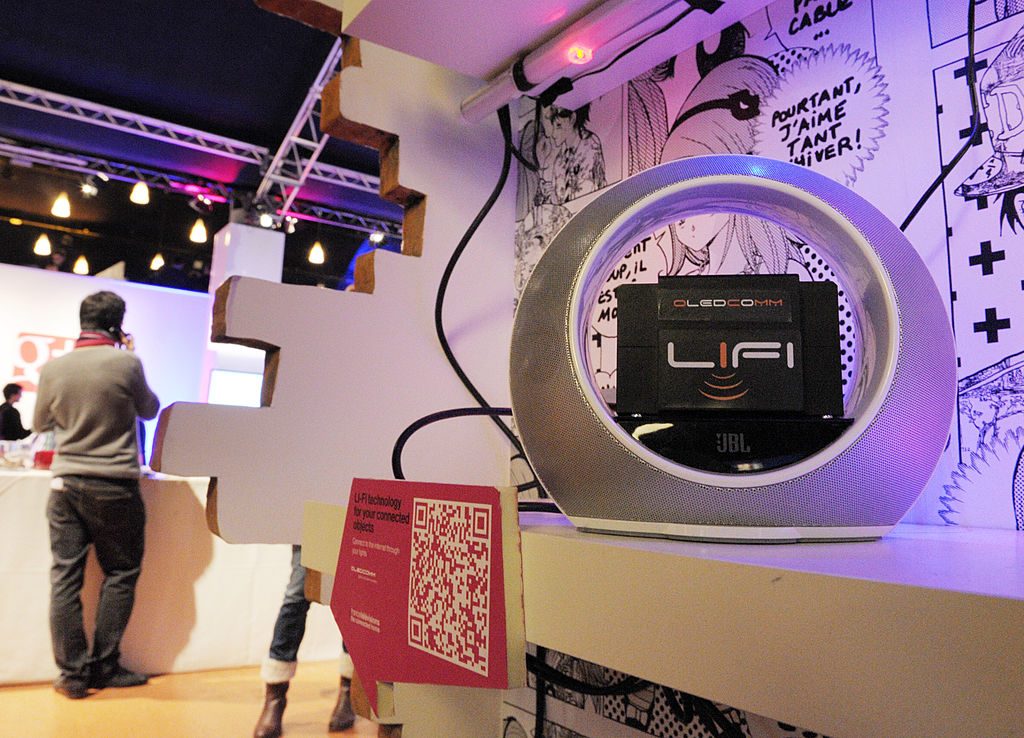
There are, it should be noted, one or two other potential pain points. Coverage is closer to 10 meters, compared to regular Wi-Fi’s 32 meters. It also can’t, for obvious reasons, be deployed in bright sunlight, although it could be baked into street lamps to provide nighttime public Wi-Fi, along with illumination. But Haas remains confident that Li-Fi is, indeed, on the way. “I can see a world where Li-Fi is integrated into a smartphone alongside all the other RF technologies,” he said.
He points to the significant progress Li-Fi has made over the past 20 years. In the early 2000s, the data rate from white LEDs was around one solitary megabyte per second. Today, that number is closer to a gigabyte per second.
“In the past, LEDs were primarily designed to improve the electrical-to-optical power conversion efficiency,” he said. “Now we see that LEDs are also designed to improve the electrical bandwidth, which is a key parameter to achieve high-speed data communication. There are also new white-light sources based on lasers that deliver 10Gbps. This is a factor of 10,000 improvement within the past 20 years. This trend will be continuing.”
Will it become a mainstream technology?
Despite its failure to yet become a mainstream technology, Li-Fi does not fall into the sad niche of Laserdisc, lossless Digital Audio Tapes (DAT), or other provably superior technologies that went to their grave (at least in the eyes of the general public) without convincing the masses that they were as great as they, in fact, were. Development continues and, if the likes of Haas have their way, it’s only a matter of waiting before it (no pun intended) shines.
“Of course, this will happen,” he said. “Li-Fi will become a mainstream technology. There is no doubt in my mind. I think people have to understand that this technology is fundamentally different from all existing wireless technologies. [That] means that the ecosystem for this technology is still maturing. This is developing while we educate the markets about the great benefits of this technology. It takes time to build the ecosystem, and to secure the wider support that is required to make Li-Fi mainstream.”
Reece Williams, a Li-Fi expert for the website LiFi.co, said that he believes Li-Fi will have a definite role to play in the future. “While [it] may not, and probably will not, fully replace Wi-Fi, it will most likely be used as a complementary technology,” Williams told Digital Trends. “Li-Fi and Wi-Fi could greatly complement each other, and release the full potential of technologies such as the Internet of Things, and virtual reality and augmented reality.”
Now the rest of the world just needs to see the light, too.