

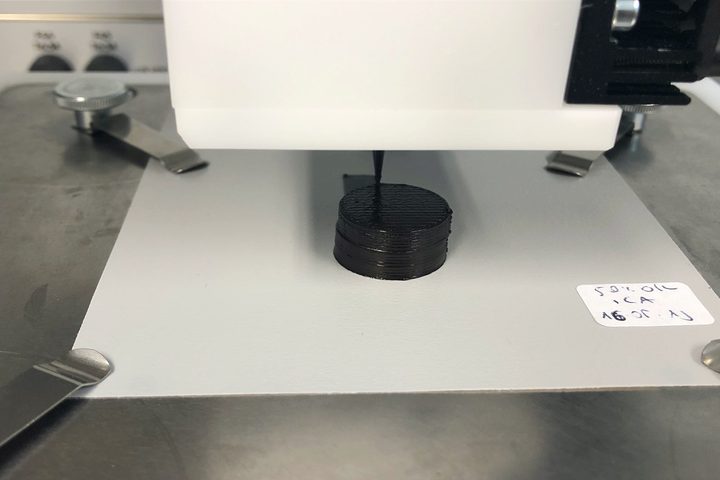
Researchers at Germany’s University of Freiburg may have found a way to make 3D printing a bit more environmentally friendly — by printing with a new material best described as a wood-based biopaste. After all, who needs boring, unsustainable plastics when you’ve got an alternative that works impressively well, made out of wood biopolymers cellulose and lignin?
Marie-Pierre Laborie, the lead researcher on the project, told Digital Trends that creating the printable material is straightforward. “We put each component, a cellulose-based derivative and lignin, into [a] solution and blend the two … to form a sort of paste of high-solid content,” Laborie said. “At [a] particular solid content and composition, we retain the lyotropic liquid crystalline behavior of the cellulose derivative. This facilitates the processing of the paste. The paste then solidifies thanks to the stabilizing effect of the lignin upon 3D printing.”
Lignin, for those unfamiliar with it, is a class of complex organic polymer which strengthens the cell walls of plants and causes them to become woody (or “lignify,” to use the proper terminology). This mechanism helps plants to protect themselves against everything from wind to pests. However, as important as this polymer is to plants, it’s left by the wayside during the paper manufacturing process as a waste product. It could therefore be turned into a biopaste without too much trouble.
So far in the project, the researchers have used lignin that comes from beech trees to create their biopaste. They have found that it is possible to modify the characteristics of the finished product, either making it more rigid or flexible depending on changes like the ratio of materials used in the paste. But they note that a bigger change could result from obtaining the lignin from other plants, which possess their own properties. This research is ongoing.
Laborie said that the researchers are currently “in the process of investigating various properties of the printed objects, such as biodegradability, mechanical performance, et cetera, to assess possible applications.” To do this, they are collaborating with a research team based in France.
Will you be replacing your existing 3D printer with a more sustainable one in the next couple of months? Probably not. But as 3D printing is increasingly widely used in areas like construction, more ecologically friendly solutions like this will become more important than ever.
A paper describing this research was recently published in the journal Applied Bio Materials.


