
Regular layer-by-layer 3D printing is old news compared to a new additive manufacturing technique developed by an international team of engineers. They recently demonstrated an innovative method for printing 3D metal objects by firing a powder that’s composed of tiny titanium particles, at supersonic speed, so that they fuse together in any interesting way.
This “cold spray” approach takes place below the melting temperature of the metal. When the particles hit the substrate at high enough velocity, they deform and adhere to it. The efficiency of this adhesion increases as the particle velocity increases. Without the high-speed impact, metal powders would simply not adhere well.
Cold spray printing has been tested before. But what makes this different is that it was purposely carried out with particle speeds that didn’t exceed a certain limit (even if that limit was the dazzlingly fast 1,969 feet per second mark). This resulted in metal parts with a porous, rather than maximally dense, microstructure. Why would you want to create something without maximum density? As it turns out it’s all about the potential applications.
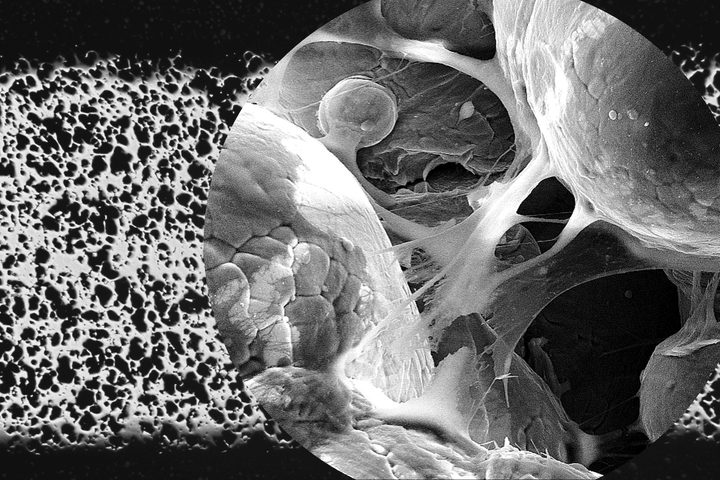
“Conventionally, achieving full density in prints is desirable to avoid the deterioration of mechanical properties associated with pores such as reduced strength,” Atieh Moridi, an assistant professor of Mechanical and Aerospace Engineering at Cornell University, told Digital Trends. “However, in this study, porosity was intentionally induced by working within a lower particle velocity range called the subcritical velocity regime, where the material deposition efficiency is below 100 percent.”
As the researchers point out, a porous structure is useful in achieving higher biocompatibility of metal implants for biomedical purposes. The porous structure is helpful in this context because it both decreases the stiffness of the metal to match that of the surrounding bones, and also allows for better bone-implant integration by letting bone ingrowth inside the pores.
We [next] plan to further investigate and optimize the printing process of the porous structure in relation to biocompatibility,” Ming Dao, director of the Nanomechanics Laboratory at MIT, told Digital Trends. “As the final step, we are interested in collaborating with companies to speed up the commercialization process of the technology.”
A paper describing the work, titled “Solid-state additive manufacturing of porous Ti-6Al-4V by supersonic impact,” was recently published in the journal Applied Materials Today.


