
Researchers from Massachusetts Institute of Technology’s Computer Science & Artificial Intelligence Laboratory might not seem like the folks most likely to help you improve your hoop-shooting basketball skills. But that’s exactly what a new MIT CSAIL project sets out to do with a quirky basketball-training machine featuring a basketball hoop that shrinks and raises when you make shots, thereby shape-shifting to help improve the various facets of your game.
For example, to begin with, the basket can be positioned at a lower height with wider hoop diameter, which gradually shrinks down and also raises to reach regulation proportions as you score more and more baskets. It’s an unusual project from a lab that’s more used to working with the latest cutting-edge artificial intelligence algorithms — but, as it turns out, it fits perfectly with CSAIL’s areas of expertise.
“We’re seeking to explore different ways that we can develop technologies that would allow people to train their motor skills at what’s called the ‘optimal challenge point,’ that sweet spot where a task isn’t boringly easy, but also isn’t frustratingly hard,” Dishita Turakhia, a Ph.D. student at MIT CSAIL, told Digital Trends.
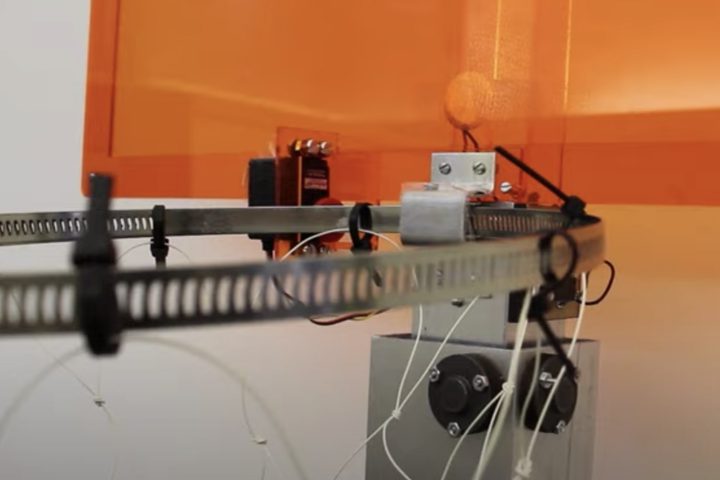
The smart basketball hoop uses a special piezo sensor in the backboard and a switch sensor on the rim that’s able to detect when the ball goes in the basket. Over time, as the user starts shooting more consistently, an algorithm automatically shrinks the rim, while raising the hoop, essentially transforming a regular basketball hoop into a game with various levels that get more difficult over time.
Right now, the work is a proof-of-concept prototype with no commercialization on the horizon. When (or if) it is commercialized, don’t expect the tech to necessarily be limited solely to basketball. It could have far broader applications than that.
“I’m particularly proud of the algorithm we developed because it takes the theoretical idea of training at optimal challenge point, and generalizes over a wide variety of application examples,” Turakhia said. “For example, it could also be used for a bike with adaptive training wheels that can teach learners how to ride it by automatically raising or lowering the training wheels based on the learner’s balancing skills.”


