  1. Home
  2. Trash
  3. News

How robotic exoskeletons can help paraplegic patients heal from injuries

Add as a preferred source on Google
Promotional image for Tech For Change. Person standing on solar panel looking at sunset.
This story is part of Tech for Change: an ongoing series in which we shine a spotlight on positive uses of technology, and showcase how they're helping to make the world a better place.

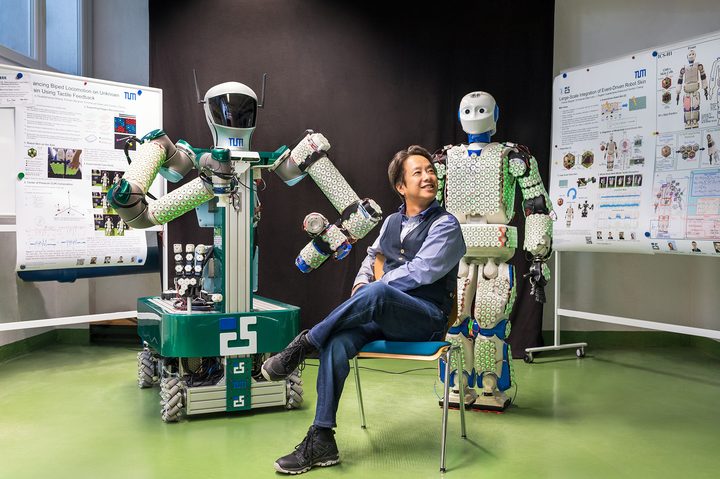
Gordon Cheng, Professor for Cognitive Systems, wants to dig deeper in understanding how the brain works.
Gordon Cheng, Professor for Cognitive Systems, wants to dig deeper in understanding how the brain works. Astrid Eckert / TUM

When a team of neuroscientists fitted paraplegic patients with exoskeletons, they hoped the patients could use the robotic assistance to walk. They found something even more remarkable: Using the exoskeleton helped their healing, with patients regaining some control over their legs.

But even several years later, none of these patients is walking unaided yet. The team, lead by Gordon Cheng from the Technical University of Munich (TUM), wants to find new ways to use robotics to help in rehabilitation. In a new paper in Science Robotics, Cheng and his colleagues consider what the next steps are in the integration of neuroscience and robotics.

One area of interest is to improve the hardware used for exoskeletons, to make it more comfortable and familiar for the users. “The exoskeleton that we were using for our research so far is actually just a big chunk of metal and thus rather cumbersome for the wearer,” Cheng said in an interview.

“I want to develop a ‘soft’ exoskeleton — something that you can just wear like a piece of clothing that can both sense the user’s movement intentions and provide instantaneous feedback. Integrating this with recent advances in brain-machine interfaces that allow real-time measurement of brain responses enables the seamless adaptation of such exoskeletons to the needs of individual users.”

The idea behind this approach is to create a machine that can be used more naturally as an extension of the body, so actions can be performed without conscious thought about the use of the machine. Cheng gives the example of driving a car, when you control the vehicle without thinking about the way that your hands move on the wheel or your feet move on the pedals.

Researchers still aren’t sure exactly how this kind of adaptation to a machine works, but Cheng says he theorizes that the brain adapts to treat the car as if it is a part of the body. If something similar could be achieved with exoskeletons, it could help people move with them more freely.

As well as making machines more usable for humans, researchers are also looking at making robots that behave in a more human way. Developing robots that can mimic human features, such as robots that use artificial muscles, can help researchers model the relationship between brain and body more accurately. This could help to develop better brain-machine interfaces in the future.

Georgina Torbet
Georgina has been the space writer at Digital Trends space writer for six years, covering human space exploration, planetary…
The Digital Trends App Bundle is yours to try for a whole week, free
Digital Trends App Bundle

Recently, we've entered an exciting collaboration with Maple Media, creating a bundle of 17 apps worth having on your phone. From relaxed fun to serious productivity boosts, these apps cover all your bases and provide a fun boost to your phone. Normally, the bundle is $9.99 per month (far lower than the cost of using the apps individually), but for your first 7 days you can get access to the bundle for free. View the full Digital Trends App Bundle for a complete list of the apps, or read on for a summarized take.

Start your free trial

Read more
The Galaxy S26 Ultra might not see much of a battery upgrade after all
It looks like it will stay the same as the last five years.
The back of the Samsung Galaxy S25 Ultra.

What's happened? This week, China's Quality Certification Center released information about a battery (EB-BS04898ABY) with a maximum capacity of 4,855mAh. That's the same capacity as was previously seen in the Samsung Galaxy S25 Ultra, and fans have taken this certification to mean the Galaxy S26 Ultra will not see a capacity increase after all.

The Samsung Galaxy Ultra models have had the same battery capacity for the last five years.

Read more
The Galaxy Tab S10 Lite is official, and it’ll be here sooner than you think
Galaxy Tab S10 Lite

What's happened? Samsung has officially announced the Galaxy Tab S10 Lite, a budget-friendly alternative to the Galaxy Tab S10. The device has been rumored for months, but this is the first time Samsung has officially acknowledged its existence.

The Galaxy Tab S10 Lite will have a 10.9-inch display and a peak brightness of 600 nits — a bit on the lower side, versus the iPad Pro's maximum brightness of 1,600 nits.

Read more