
The groundwork is being laid for the quantum internet — up in the air. Recently, researchers from Nanjing University in China demonstrated that it is possible to send entangled photons between a pair of drones, called Alice and Bob, hovering one kilometer apart.
This was done by using an onboard laser and crystal to split a single photon into a pair of entangled photons, with one sent to a ground station and the other to the other drone. Motorized devices on the drones made sure that the receivers and transmitters were in alignment with one another.
Distance quantum communication, which could make for more quantum secure networks built on quantum encryption, has been demonstrated before, between satellites and ground stations. However, this demo showed that it can also work using comparatively cheap hardware between shorter distances. As New Scientist pointed out, this is the first time that such photon entanglement has been shown to work between two moving objects.
“This work demonstrates the optical relayed link between mobile nodes, which we believe is an enabling technology for future free-space quantum communication with longer distance, lower loss, and broader coverage range,” Zhenda Xie, a professor in the School of Electronic Science at Nanjing University told Digital Trends. “Meanwhile, it provides a cost-effective new platform with extraordinary flexibility and configurability. It can be a good compensation to fill the gap between fiber and satellite quantum communication to realize a practical full-coverage quantum network in the future.”
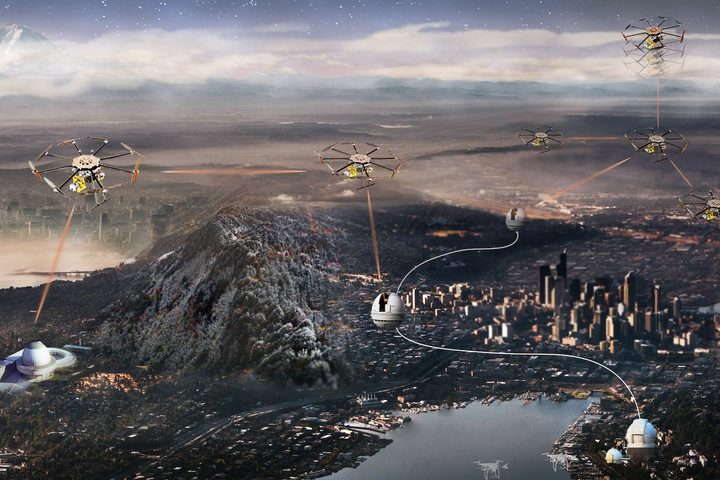
While Xie said that quantum communication is the most obvious use for a quantum network, it’s far from the only one. It could also be used for large-size distributed quantum computation, more accurate timekeeping, fundamental physics experiments such as quantum non-locality, and more.
“On the one hand, with the optical relay demonstrated here, we are planning to enlarge the scale of the mobile quantum connections, towards a quantum network with complex topologies,” said Xie, regarding the next step of the research. “In local area network size similar to this work, we can pack the quantum node in smaller and more [cost-effective] drones for multi-user coverage, while it is also interesting to establish broad-area quantum links using high-altitude UAVs, which is free from scattering loss in the low-altitude dusty air. In the longer term, we also expect to connect this drone system with the existing fiber and satellites systems, for more extensive coverage in the global area.”
A paper describing the work was recently published in the journal Physical Review Letters.


