
The use of wind and water as sources of renewable energy is well-documented. But an innovative project, taking place off the coast of a remote Tasmanian island, aims to showcase a new approach that combines the best of both worlds.
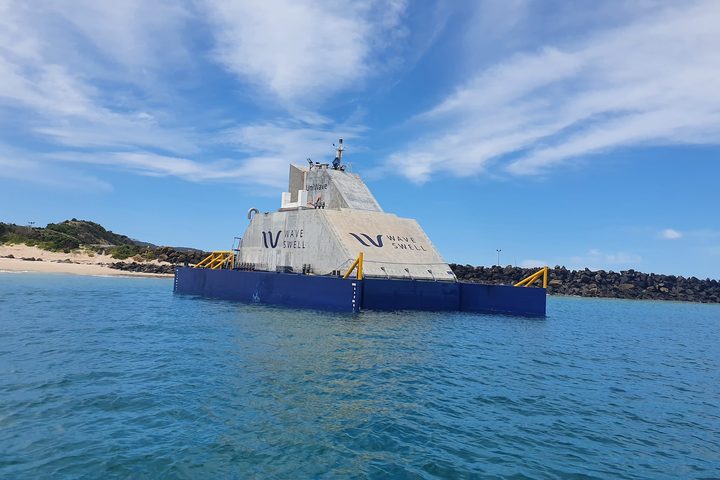
Created by an organization called Wave Swell Energy, it’s an experimental means of generating renewable power by harvesting wave energy pushed through an oscillating water column (OWC), or artificial “blowhole.” The movement of the air created during this process spins a turbine that produces electricity. Should the test on King Island go as planned, this approach could be used to produce energy along Australia’s southern coastline — and maybe even the United States.
“An OWC is a form of artificial blowhole: A chamber with an underwater opening to the waves, an air cavern above the water in the chamber, and a small opening to [the] atmosphere,” Wave Swell Energy co-founder Tom Denniss told Digital Trends. “However, the WSE OWC is unique in that it functions unidirectionally, rather than bidirectionally like all previous OWCs. We incorporate very simple flap valves into the OWC that vent the pressurized air to the atmosphere as the water level in the chamber is rising. Then. when the water level falls as the wave recedes, the valves close naturally, and air is sucked back into the chamber via the opening, in which a turbine is housed. This generates the electricity.”
A ‘very significant’ development
Denniss said that the deployment on King Island is “very significant” to Wave Swell Energy. It will validate the tech, and allow the team to predict the performance of similar setups installed elsewhere, provided that they have the necessary wave data.
“A robust renewable energy grid will require many types of renewables spread over a range of locations,” Denniss explained. “Wave energy will make up part of this mix … Waves are more consistent and predictable than other renewables, allowing it to better complement existing fossil fuel baseload during the transition to a fully renewable grid. [The WSE technology can also] double as a form of coastal protection against erosion. This is a very important additional application, allowing new breakwaters and seawalls to be constructed as renewable energy facilities that generate revenue, rather than as a sunk cost.”
The current setup is able to generate up to 200 kilowatts of power. But a recent report from The Guardian said that there are plans for larger 1,000kW models.
Denniss told Digital Trends that the U.S. Department of Energy has taken a keen interest in this project, and is collaborating with Wave Swell Energy regarding the project’s results and data. This collaboration, funded by the DOE, will take place through its research facility, Pacific Northwest National Laboratory. The goal of this is to assess the possible use of the technology in North American waters.


