The standard set of concerns that most 3D printing enthusiasts have during a project are things like bed adhesion, over-extrusion, and warping. Alessio Lorusso is different. He’s worried about how well his prints will hold up against magnetic storms.
Lorusso is not necessarily your average 3D printing fan, whatever that may be. He’s the founder of a company called Roboze, which carries out industrial 3D-printing technology for extreme end-use applications. How extreme? Try space: The place where no one can hear you scream, let alone respect the integrity of your additive manufacturing.
This week, Roboze was officially selected by the University of Colorado Boulder as a partner to help it realize its goal of optimizing the design for, and 3D-printing of, a CubeSat that will be sent into orbit to measure the electromagnetic waves emitted by lightning discharges on the Earth’s surface. This CubeSat, a type of nanosatellite the size of a shoebox, will enable remote analysis of the Earth and surrounding space environment. This will help scientists better understand the health of the planet, and how humans are affecting the delicate balance of nature.
The mission will spend at least six months in orbit gathering readings — provided, of course, that Roboze is able to help create a CubeSat that’s rugged enough to survive the challenging conditions it will need to deal with.
One of the most extreme environments imaginable
“Space is one of the most extreme environments imaginable,” Lorusso told Digital Trends. “When a CubeSat is launched into space, it will undergo accelerations of many g-forces and extreme vibration, so it must be mechanically strong to withstand these conditions. Materials must be chemically inert and resistant to both radiation and thermal expansion and contraction.”


The challenges don’t end there, either. The temperature on a spacecraft in low-Earth orbit can range greatly, causing materials to expand and contract in a way that’s not exactly conducive to longevity. Add to that issues related to pressure, chemical attacks from atomic oxygen, which is plentiful in low-Earth orbit, and high levels of radiation. In all, it’s not exactly hospitable.
This is where 3D printing comes into play. CubeSats have become increasingly popular as exploratory satellite platforms in recent years due to their being smaller, cheaper, and easier to build and launch than traditional satellites. Roboze adds to this by utilizing new manufacturing processes that could prove a game-changer in settings like low-Earth orbit. Its breakthrough material comprises plastic, mixed with different materials that can be used to tailor properties as necessary, enabling them to be custom-printed for whatever space will throw at them.
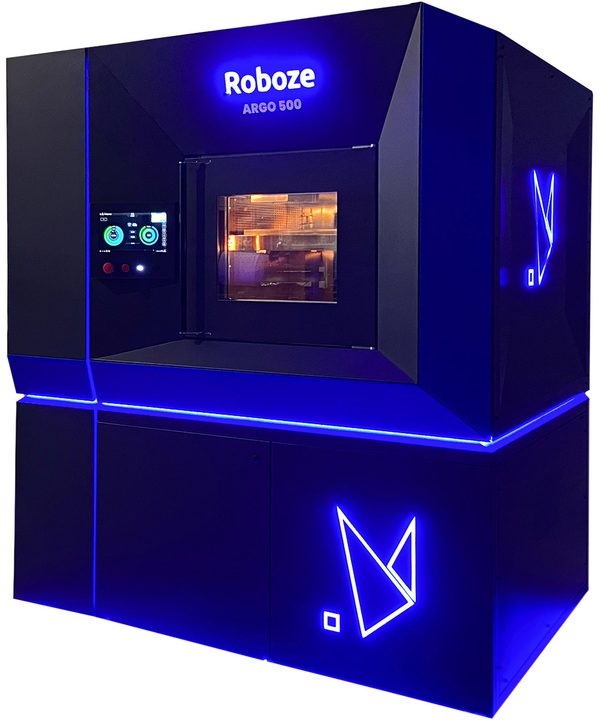
“Our project with the University of Colorado Boulder is to advance the use of additive manufacturing in the space sector to prove that Roboze’s super-plastic polymer components can survive the harsh space environment,” said Lorusso. “The magnetic field sensor holders for the CubeSat will be manufactured with Roboze’s high-performance polymer, polyether ether ketone (PEEK). For space applications, PEEK was chosen due to its mechanically strong properties, which can respect tight geometrical tolerances to measure the electromagnetic waves emitted by lightning discharges on the Earth’s surface. Tracking incidences of solar flares and storms is more important than ever, as astrophysicists predict stronger and more frequent solar activity in the near future.”
Now, 3D printing in space is not entirely without precedent. In 2014, NASA hauled its first 3D printer, developed by a company called Made in Space, into space to extrude a 3D-printed ratchet wrench for use on the International Space Station, using designs transmitted from Earth. On long-haul space missions, the aim is to use 3D printing as a way to create tools that are required in space without having to transport them directly from Earth.
Changing the face of space missions
Projects like the University of Colorado Boulder’s collaboration with Roboze show that 3D printing isn’t just reserved for the NASA end of the space spectrum. It is also helping lower the barrier to entry for others wanting to do space research, including launching their own satellites.
“Right now, hardware is being assembled and tested [for the project,]” Lorusso said. “This includes vibration tests to simulate launch, in addition to further testing in a thermal-vacuum chamber to simulate a vacuum and the temperature changes in orbit. If everything goes well, another CubeSat will be built for launch. The launch-ready spacecraft will then be stored until the launch date, which will likely be in 2023.”
It just goes to show that it’s not only on Earth where 3D printing is making a big difference. It’s 1,200 miles above Earth’s surface, as well.