1. Home
  2. Computing
  3. Apple
  4. News

Intel again tries to diss Apple but hurts itself in its confusion

Add as a preferred source on Google

Intel has been on a rampage when it comes to attacking Apple recently, but like a lot of rampages, it seems to have done as much damage to itself as to Tim Cook and friends. Not content to sit on its snafu laurels, Intel has done it again with its latest attempt to throw shade on the Mac.

PCGamer reports that in a recent call with Ryan Shrout, chief performance strategist at Intel, Shrout extolled the virtues of Intel chips when it comes to gaming. This is a familiar criticism of Macs, and a fair one at that (they suck at gaming), but Shrout apparently got a little carried away and did not realize he was essentially attacking his own company.

Recommended Videos

You see, Shrout produced a slide comparing the performance of an Intel i5-equipped laptop against that of a MacBook Pro 16. The problem? The MacBook in his comparison was kitted out with an Intel i9 chip. Oops.
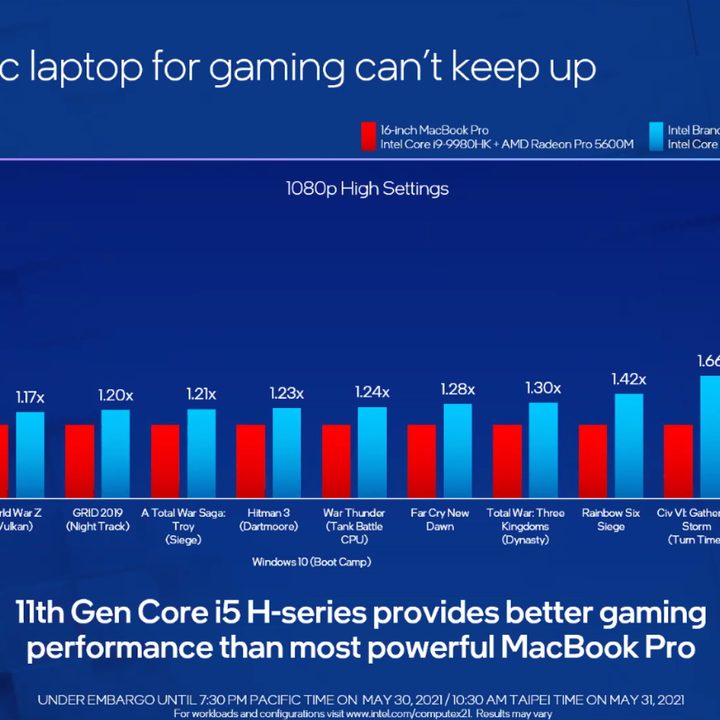
A slide from Intel attacking Apple's MacBook Pro gaming performance
Image used with permission by copyright holder

“But wait,” you say, “that is all irrelevant because GPUs are the true measure of gaming performance, not CPUs.” And you would be right! Except that Shrout’s slide featured this prominent line: “11th Gen Core i5 H-series provides better gaming performance than most powerful MacBook Pro.” In other words, Intel wanted the comparison to focus on processors … which meant attacking its own handiwork.

This is hardly the first time Intel has embarrassed itself when trying to shame Apple’s latest chips. In April 2021 it produced an ad with the slogan “The world’s best processor on a thin and light laptop” that accidentally depicted a MacBook Pro. I’m sure Apple was flattered.

And before that, it hired “I’m a Mac” actor Justin Long to this time take aim at the Mac, yet shortly afterward Intel CEO Pat Gelsinger said he hoped his firm would be able to manufacture Apple chips in the future. It’s an unconventional way to court a client, sure, but my word does it, erm, get results…

Intel and Apple used to be best buds, with Steve Jobs even going so far as to invite a bunny-suit-wearing Paul Otellini, then Intel CEO, onto the stage at Macworld Expo 2006. But ever since Apple announced it was ditching Intel chips and working on its own Mac processors, Intel has been on a sore streak. It is not surprising given how fantastically well Apple Silicon chips perform, but you would have thought Intel’s marketing division was a bit savvier than this. Apparently not.


Alex Blake
Alex Blake has been working with Digital Trends since 2019, where he spends most of his time writing about Mac computers…
New open-weight AI from China is toppling the best of OpenAI and Claude Fable
Moonshot’s 2.8-trillion-parameter Kimi K3 beats Fable 5 and GPT 5.6 Sol in select benchmarks
Art, Drawing, Plant

China's Moonshot AI has launched Kimi K3, a massive 2.8-trillion-parameter model built for coding, research, reasoning, and visual tasks. Moonshot admits K3 still trails Claude Fable 5 and GPT 5.6 Sol overall. Even so, its benchmark results put it surprisingly close to both, and it finishes ahead in several tests.

How close is Kimi K3 to the best closed models?

Read more
Gemini could finally let you choose how friendly it sounds
Finally, you can stop Gemini from sounding like your HR manager
Google Gemini

Google has spent the past few months making Gemini sound more natural, expressive, and conversational. Now, it appears the company is preparing to give users far more control over how the AI speaks.

Code spotted by Android Authority's APK Insights - the latest beta version of the Google app suggests Gemini may soon allow users to customise its voice across four separate parameters: Energy, Formality, Warmth, and Speed. Instead of choosing from a fixed list of personalities, users could tweak these characteristics to create a voice that better suits their preferences.

Read more
ChatGPT will now remind teens to take breaks and give parents more controls
New parental controls include Quiet Hours, Study Mode defaults, and alerts for serious account violations.
chatgpt-teen-safety-features

OpenAI wants to make ChatGPT safer for teens, and the changes go well beyond a simple content filter. In a new update, the company laid out its stance on why teens should have access to AI in the first place, arguing that keeping them away from it entirely would leave them unprepared for one of the defining technologies of their generation.

Nearly 90% of teens already use ChatGPT weekly for learning, research, or getting organized, which is why OpenAI says access needs to come paired with real protections built for their age.

Read more