
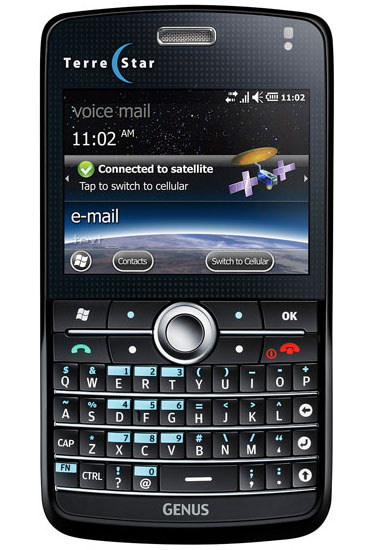
For three years AT&T has been criticized for their network availability and capacity, particularly from smartphone and AT&T-exclusive iPhone customers. Now, AT&T is offering something of a solution…at least for folks who aren’t looking for an iPhone or Android device and for whom money is no object. AT&T is now offering the TerreStar Genus smartphone, which is a dual mode cellular and satellite phone. When within range of AT&T’s voice and data network, the unit operates like a typical smartphone; outside AT&T’s service area, the device becomes a satellite phone, hooking up with the largest satellite in orbit around the earth to handle voice, messaging, and data needs.
“We understand the importance to stay connected in remote locations and especially in emergency situations, and today’s announcement is the latest example of AT&T’s commitment to delivering the highest levels of service, quality, and reliability for customers,” said AT&T’s president of advanced enterprise mobility solutions Michael Antieri, in a statement.
The TerreStar Genus runs Windows Mobile 6.5, sports Wi-Fi and Bluetooth wireless connectivity, and offers a QWERTY keypad for messaging needs. Of course, Windows Mobile’s built-in functionality provides email and Web browsing capability, along with mobile versions of Microsoft’s Office application suite. The phone also has an integrated camera and GPS receiver.
AT&T is pitching the phone as a solution for corporations, enterprise, and government types rather than consumers—after all, consumers have shown remarkably little tolerance for Windows Mobile. The TerreStar Genus enables users to have a single phone number that, in theory, is reachable from anywhere in the United States, Puerto Rico, U.S. Virgin Island, and nearby areas.
The TerreStar Genus’s satellite communications rely on the world’s largest communications satellite (owned and operated by TerreStar), which deployed an enormous 60-foot wide antenna when it got into orbit. The size of the satellite’s antenna means the TerreStar Genus can be smaller than previous satellite phones. However, the TerreStar Genus still suffers other downsides of satellite phones—it almost certainly won’t work indoors—and TerreStar’s single satellite means there’s no global coverage: customers who stray outside the North American service area will just have a Windows Mobile phone.
AT&T says the TerreStar Genus is available now for $799 without a two-year service contract. The phone requires standard AT&T service and data plans, and the option to switch over to satellite communications costs $25 a month. Satellite communications won’t be cheap either: voice calls will be 65 cents per minute, data service will be $5 per megabyte (and don’t expect to play games with 22,000 miles of one-way network latency), and text messages will run $0.40 each. The costs probably put the phone out of reach of most consumers, but for emergency responders and some corporate types, the TerreStar Genus may be appealing. However, satellite phones have a lackluster business history, with most satellite phone operations ending in bankruptcy. However, the TerreStar Genus’s dual mode, single phone number approach may make it more appealing to corporate customers.


