  1. Home
  2. Audio / Video
  3. Legacy Archives

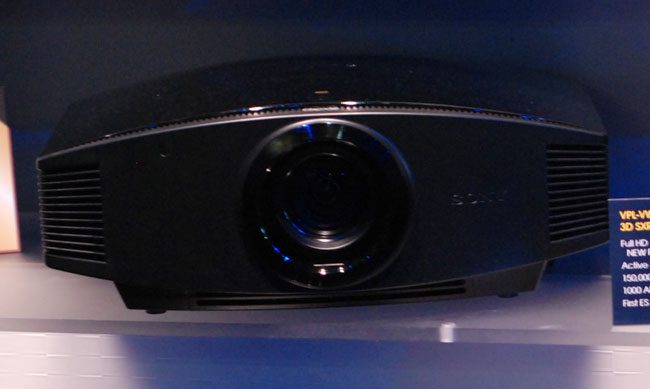
Sony brings 3D to the big screen with VW90ES 3d projector

Add as a preferred source on Google
Image used with permission by copyright holder

You already watch 3D movies on Sony projectors in theaters, now you can watch them at home on Sony gear at home as well. That seems to be the driving message on Thurday as Sony reemphasized its foothold in 3D content creation, distribution, and display with the introduction of Sony’s first 3D projector on Thursday.

In case you didn’t catch a glimpse of Sony’s first home-theater projector at IFA this year, Sony trotted it out yet for the North American crowd again at CEDIA 2010 in Atlanta, where we had a chance to try it out for ourselves.

Recommended Videos

The VW90ES uses the same SXRD technology found in many of Sony’s other projectors, but paired with a fast-refreshing 240Hz panel and the same 3D glasses used on its Bravia 3D televisions. Specs include brightness of 1,000 ANSI lumens and a dynamic contrast ratio of 150,000.


The challenge, as with all 3D projectors, will be overcoming the brightness limitations inherent with active-shutter glasses, which diminish on-screen brightness significantly. Even in Sony’s perfectly dark presentation room, the VW90ES left a 3D football game looking slightly overcast. With an extra 300 ANSI lumens on tap, JVC’s pricier X9 3D projector seemed to do a better job preserving the sunshine and lighter feel in Despicable Me. Both projectors use liquid-crystal-on-silicon (LCOS) designs, Sony’s branded as SXRD and JVC’s as D-ILA. Other content, including a reel of upcoming 3D PS3 games and a trailer for the upcoming Green Hornet, seemed significantly happier on the VW90ES, and 2D trailers suffered from no lack of on-screen sizzle. Like Sony’s Bravia TVs, the VW90ES will convert 2D content to 3D, although Sony didn’t demonstrate it at CEDIA.

Sony will debut the VW90ES for “around $10,000” this November, with two pairs of 3D glasses and the necessary IR transmitter included.

Nick Mokey
As Digital Trends’ Editor in Chief, Nick Mokey oversees an editorial team covering every gadget under the sun, along with…
Spotify finally lets you pin more than four items in your library, and it only took a few years
Spotify's most embarrassingly overdue fix just happened, and it's available for free users too.
The atlantic article playing on spotify

Spotify has raised the limit on pinned items in Your Library from four to 20. Yes, you read that right.

For years, Spotify thought four items were sufficient, even as users asked for more, and today the company finally caved. Credit where it's due: 20 is actually a meaningful number.

Read more
Meta’s new image and video AI tools let you turn Instagram into your creative mood board
Two models, one launch, and an Instagram trick nobody else has.
Art, Collage, Face

Meta has been cooking something up, and today, it finally put it on the table. On July 7, 2026, Meta Superintelligence Labs launched Muse Image and Muse Video (in preview), its first in-house media generation models. 

The rollout comes with a few features that are genuinely hard to argue with.

Read more
Marshall refreshes its Acton and Stanmore speakers with better bass and repairability
The new Acton IV and Stanmore IV bring improved acoustics, Auracast support, and a more repair-friendly design.
Marshall launches Acton IV and Stanmore IV

Marshall has refreshed two of its most popular wireless speakers. The company has officially unveiled the Acton IV and Stanmore IV, bringing a series of meaningful upgrades that go beyond simply making them louder. While improved bass and cleaner sound are part of the package, Marshall is also making a welcome push toward repairability, allowing owners to replace several external components instead of replacing the entire speaker.

Better sound, smarter design

Read more