1. Home
  2. Computing
  3. Gaming
  4. News

Razer’s new Kraken V3 headset might give you a headache (in a good way)

Add as a preferred source on Google

Razer announced three new headsets on Thursday: The Kraken V3, Kraken V3 HyperSense, and Kraken V3 Pro. All three are revisions to the Kraken V3 X, but two come with a big additional feature: Razer’s HyperSense haptic feedback.

If you’re unfamiliar, Razer introduced HyperSense on its Nari headphones. It’s a haptic feedback driver that vibrates the headset while you’re wearing it, like a console controller. The big difference comes in the design of the feedback motor: It operates in a range of frequencies instead of a fixed one, bringing some depth to the vibration.

Razer Kraken V3 Pro headset on a stand.
Image used with permission by copyright holder

If getting a headache while you’re gaming isn’t your idea of fun, don’t worry — the Nari allowed you to turn off HyperSense in Razer’s Synapse software, and the Kraken V3 HyperSense goes a step further. It includes a button that allows you to adjust the intensity of the feedback, including turning it off.

Recommended Videos

For the Kraken V3 HyperSense, the difference between it and the Kraken V3 is the HyperSense integration. Both models have the same 50mm TriForce titanium drivers, THX spatial audio, and detachable cardioid microphone. The HyperSense model is a little more expensive, though, clocking in at $130 compared to $100 for the base model. You can pick both up now from Razer.

The Kraken V3 Pro is arriving at a later date. It’s $200, but it comes with an expanded range of features. In addition to HyperSense, the Pro model supports wireless operation with a PC, PlayStation, or Nintendo Switch, and it comes with a detachable supercardioid microphone, which has a more focused range where it picks up sound. It also comes with leatherette ear cushions instead of fabric ones.
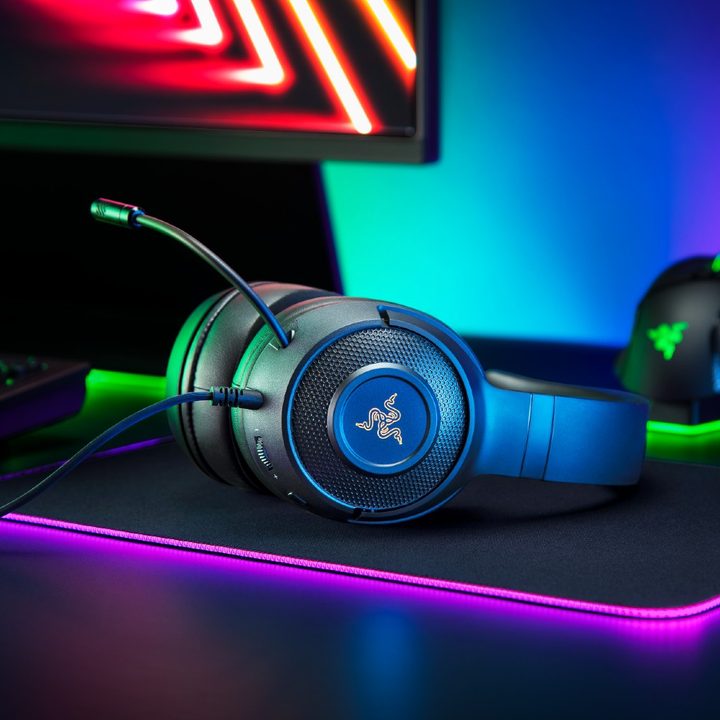
The Kraken V3 gaming headset on a black table.
Image used with permission by copyright holder

This is the only wireless model from the Kraken range, and Razer says it can last up to 44 hours with the haptics and lighting turned off. Turn them on, and the battery life slips to a measly 11 hours. It’s a headset that can vibrate on your head, after all.

Both the Hypersense and Pro versions support adjustable RGB lighting zones through Razer’s Synapse software, and they also support Razer Chroma, so you can sync them with your other peripherals. All models come with a wind filter for the mic, taking some notes from the Razer Blackshark V2 — aka one of the best gaming headsets you can buy.

The Kraken V3 HyperSense and Kraken V3 Pro are two of several products Razer announced at its annual RazerCon event. The company also brought out PC components for the first time ever, and it launched the crazy Zephyrus mask that made its debut at CES.

Jacob Roach
Former Lead Reporter, PC Hardware
Jacob Roach is the lead reporter for PC hardware at Digital Trends. In addition to covering the latest PC components, from…
Claude Opus 5 is here, and Anthropic says it can rival Fable 5 in some tasks
Major software engineering improvements put Opus 5 closer to Anthropic’s top model
Claude Opus 5 logo

Anthropic has launched Claude Opus 5, its latest frontier AI model for coding, research, business work, and other complex tasks. The company says it delivers a major performance jump over Claude Opus 4.8 while keeping the same API price. Anthropic also claims it comes close to Claude Fable 5 on some coding and computer-use tests while costing far less per task.

Opus 5 is available across Claude’s apps and API. It is now the default model for Claude Max subscribers and the strongest option included with Claude Pro.

Read more
Humans actually prefer talking to an AI than a support person, says gas giant as it cuts jobs
British Gas cuts 1,300 support jobs as its CEO points to changing customer habits
Executive, Person, Electronics

Centrica, owner of British Gas, is cutting 1,300 call centre jobs, and its chief executive says changing customer behaviour is the main reason. The company plans to remove 800 roles as part of a “targeted deployment of AI tools,” on top of the 500 cuts announced last month. Customer service teams in Glasgow, Edinburgh, Cardiff, Leicester, Stockport, and Leeds will be affected over the next two years.

Some positions will disappear when employees leave and are not replaced, while the remaining cuts will come through redundancies. Trade unions have warned that Centrica’s AI investment will hand hundreds of human jobs to chatbots.

Read more
Intel just pulled its 14A production schedule forward by a year
Risk production for 14A is now planned for late 2027
Intel Core Ultra Desktop CPU

Intel has moved up the schedule for its next-generation 14A (1.4-nanometer) manufacturing process, giving its foundry turnaround an important new target.

During Intel’s Q2 2026 earnings call, CEO Lip-Bu Tan said 14A risk production for internal products is now planned for the second half of 2027. High-volume production is expected to begin in 2028. This is earlier than the previous timeline, when Intel was expected to begin risk production in 2028 and move to volume production in 2029.

Read more