1. Home
  2. Computing
  3. Legacy Archives

Microsoft losing browser share as IE9 gains traction

Add as a preferred source on Google

New data from Net Applications suggests that while Microsoft’s overall share of the worldwide Web browser market continues to shrink, Windows Vista and Windows 7 users are increasingly embracing Internet Explorer 9. According to Net Applications, Internet Explorer 9 accounted for some 7.46 percent of all Internet Explorer users during the month of April—and for the last day of April that share measured almost 10 percent. The figure is more than double Internet Explorer 9’s usage during March, which measured some 3.6 percent.
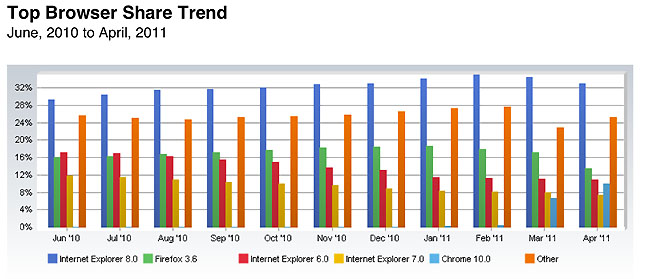
Net Applications browser share (April 2011)
Image used with permission by copyright holder

However, at the same time, Microsoft’s overall share of the browser market continues to slip, dropping from 55.9 percent in March to 55.1 percent in April across all versions of Internet Explorer. Overall, Google Chrome and Apple’s Safari browser outpaced the overall growth in the Web, with Chrome stepping up from an 11.6 percent share in March to 11.9 percent in April, and Apple’ Safari growing from 6.6 percent to 7.2 percent in the same time period. Mozilla Firefox dropped a bit from 21.8 percent to 21.6 percent—despite the introduction of Firefox 4—but continues to have a commanding lead on the number-two position behind Internet Explorer. Overall, Firefox accounted for 5.4 percent of the Web browser market.

Recommended Videos

Collectively across all versions, Microsoft’s Internet Explorer continues to dominate the browser market, and while over 33 percent of Internet users in April were using IE8, nearly 11 percent worldwide were still using Internet Explorer 6, a decade-old version of the browser notorious for poor standards support and security loopholes. Although Microsoft is outright pleading with users to upgrade to a more-modern browser, Internet Explorer 6 remains a significant impediment to new Web standards and developing modern Web services—even though an increasing number of high-profile sites and services are no longer supporting IE6. Microsoft itself isn’t help matters in some ways: Internet Explorer 9 does not support Windows XP.

Geoff Duncan
Former Contributor
Geoff Duncan writes, programs, edits, plays music, and delights in making software misbehave. He's probably the only member…
Topics
Apple’s M6 chip isn’t even here yet, but you’ll see M7 Macs early in 2027
Apple is reportedly already accelerating its next-generation silicon roadmap, even before the M6 has launched.
Apple MacBook

The M6 chip is still expected to debut later this year, but Apple may already be preparing for what comes next. According to Mark Gurman's latest report for Bloomberg, the company is aiming to introduce its first M7-powered devices as early as the first half of 2027, hinting at a much faster silicon refresh than many expected.

M7 could arrive alongside new Macs and iPads

Read more
The entry-level MacBook Pro could get a design refresh in 2027, and it’s about time
Five years on the same chassis, and now both tiers of the MacBook Pro are getting a new look at once.
MacBook Pro in space grey sitting on a desk.

Apple has a new MacBook Pro lined up for launch early next year, according to Bloomberg. The company will introduce a 14-inch laptop in the first half of 2027. 

The biggest surprise, however, will be a brand-new design language. The outlet describes it as "a revamped entry-level MacBook Pro, code-named K104."

Read more
Study finds humans will talk to AI ghosts of the dead as reincarnations, and it’s pretty grim
The first AI ghost study is in. The results are about as complicated as you'd expect.
VR Headset, Person, Face

A new study from the University of Colorado Boulder confirms something that sounds both impressive and concerning. People find interacting with AI simulations of their dead loved ones deeply meaningful, and most will come away wanting to do it again.

The researchers call it a "generative ghost," which is a clear reference to generative AI, but I’d still prefer to call it unsettling.

Read more