  1. Home
  2. Mobile
  3. Legacy Archives

Comscore finds BlackBerry taking a beating

Add as a preferred source on Google

Although some market watchers are publishing numbers that Google’s Android mobile operating system may have plateaued in terms of marketshare, research firm Comscore finds that Android did very well for itself in the three months ending April 2011, with an overall 5.2 increase in its share to a total of 36.4 percent. Apple also did well for itself, pushing its share of the smartphone market up 1.23 percent to an even 26 percent for the three-month period. And those gains came at the expense of everyone else, with RIM in particularly taking a hard blow with a 4.7 percent decline—sinking to 25.7 percent—over the same three-month period.

Microsoft and HP/Palm also saw net declines in share, to 6.7 percent and 2.6 percent, respectively.
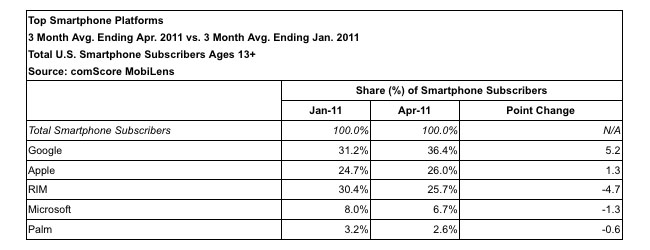
Comsore smartphone platform share feb-apr 2011
Image used with permission by copyright holder

Overall, Comscore finds that some 74.6 million people in the United States owned smartphones during the three months ending April 2011, an increase of some 13 percent from the three-month period ending in January 2011. Overall for the same period, some 234 million Americans aged 13 or over owned used sort of mobile device.

Recommended Videos

Text messaging remains far and away the dominant form of non-voice use for a mobile phone, with 68.8 percent of subscribers reporting the sent text messages to another phone during the three-month period. Some 39.1 percent of mobile users reported using a Web browser during the same period, more than a third (37.8 percent) downloaded apps, and 28 percent accesses a social networking service of blog. Interestingly, only 26.2 percent reported playing games, and only 18 percent reported listening to music.

Comscore reports Samsung was the top mobile phone manufacturer for the three-month period, accounting for 24.5 percent of the market, with LG in second place with a 20.9 percent share. Motorola ranked third with 15.6 percent, and Apple and RIM rounded out the top five with 8.3 percent and 8.2 percent of the market, respectively. Interestingly, among manufacturers only LG and Apple saw net gains for the three-month period: LG was up 0.1 percent, while Apple was up 1.3 percent.

Geoff Duncan
Former Contributor
Geoff Duncan writes, programs, edits, plays music, and delights in making software misbehave. He's probably the only member…
The best phones in 2026: our 14 favorite smartphones right now
We tested phones across all price brackets so that you can make the best pick based on your needs and budget.
Google Pixel 10 Pro Fold vs Galaxy Z Fold 7 cameras

Choosing the right smartphone in 2026 is no easy task. Apple and Android manufacturers now have strong options at almost every price, while better cameras, longer battery life, improved software support, new AI features, and more refined foldable designs have made the market more competitive than ever. But picking one is not easy, especially if your budget is tight, or you are just legitimately concerned about getting the best value for your money and need a reliable daily driver for long-term usage.

We have tested and compared the leading smartphones available today, looking beyond the spec sheet to see how they actually perform in daily use. Camera quality, battery life, performance, display quality, software, design, and long-term value all play a part in our recommendations. Whether you are looking for a powerful flagship, a dependable budget phone, a compact device, or a foldable, this guide should help narrow down your choices.

Read more
Snapchat Planets Meaning: Order, Rankings, and How Friend Solar System Works
Snapchat Planets turns your best friends list into a solar system, and yes, your orbit says a lot
Snapchat Planets being shown on the Snapchat app on iPhone.

Snapchat+ includes several exclusive features, but few have generated as much curiosity as Snapchat Planets. Part of the app's Friend Solar System, it transforms your Best Friends list into a planetary ranking, assigning each of your top eight friends a planet based on how often you interact.

From Mercury, which represents your closest friend, to Neptune, which represents your eighth closest, the system offers a quick visual snapshot of your interactions. But what do the different planets actually mean, and how does Snapchat decide who gets which one?

Read more
How to use WhatsApp Web
We'll show you how to use WhatsApp on your desktop or laptop
WhatsApp Web

As one of the most popular messaging services, you’ve already heard of WhatsApp. From its humble beginnings in 2009—two years before Apple introduced iMessage—to its acquisition by Facebook (now Meta) in 2014, WhatsApp has become the dominant messaging platform around the globe.

In recent years, it's grown even more potent with new features like video messages, self-destructing voice messages, the ability to edit sent messages, and more. We even finally got an WhatsApp iPad app in May 2025.

Read more