  1. Home
  2. Emerging Tech
  3. Legacy Archives

Stanford researchers develop transparent batteries

Add as a preferred source on Google
Image used with permission by copyright holder

When it comes to abandoning fossil fuels and discussing the future of energy, few technologies garner more attention than batteries. Simply, like most technologies, they need to become smaller and more efficient to play a significant role in changing our usage of power.

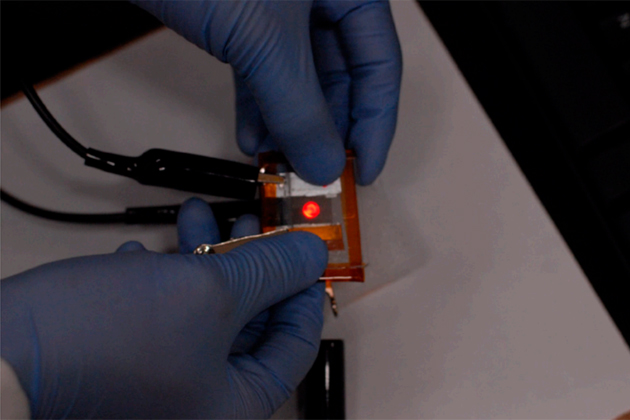
But what about batteries becoming transparent? Researchers at Stanford University have developed a battery that allows about 60 percent of light to pass through its structure. If you are a materials and chemistry buff, you can read the exact methodologies and compounds they used in their paper in the Proceedings of the National Academy of Science.

Recommended Videos

In layman’s terms, the team reworked the components of the electrodes into a very thin, square meshwork-like structure. Most other components of the batteries could be replaced with transparent materials, but not the electrodes; no workable materials for electrodes can be made translucent.

Yet, the human eye can only perceive objects 50 to 100 microns wide. So the researchers managed to get the threads of the electrode meshwork down to about 35 microns in width and stack them on top of one another. The changes did sacrifice some power; these batteries are only about half as powerful as a lithium-ion battery of roughly the same size.

At first pass, one might say; “I can barely find batteries in a drawer at home. Why would I want them transparent?”

The hope for these batteries is that they can be utilized for future transparent devices, such as screens or visual aides that require power but also need complete transparency to retain their optimal functionality. While 60-percent transparency is not 100 percent, with further work and development, the researchers believe they will be able to improve and optimize the design.

Caleb Garling
Former Digital Trends Contributor
Google Flow Music Spaces is becoming an all-in-one AI music studio
The latest update brings song editing, stem splitting, image generation, lyrics, and video creation into a single workspace.
Google Flow Music Featured

The company has announced a major update for Flow Music Spaces, bringing a suite of new AI-powered creative tools directly into collaborative workspaces. Instead of jumping between different apps or sessions, users can now generate and edit songs, split audio stems, create images, write lyrics, and even generate videos without leaving a Space.

What's new in Flow Music Spaces?

Read more
A Florida pastor asked ChatGPT if he was okay. It nearly got him killed.
When "just relax and recover" turns out to be the worst medical advice you could get.
ChatGPT on iPhone

Scott Winters, a pastor from Florida, is suing OpenAI after ChatGPT allegedly gave him what his lawsuit calls "extremely dangerous" medical advice, advice that nearly cost him his life.

What happened to the pastor?

Read more
Scientists made robots curious like toddlers, and it helped them learn language twice as fast
Give a robot curiosity, and it starts learning language (and misbehaving) just like a toddler.
robots and kids photo

Scientists have been trying to figure out how kids pick up language so fast for decades, and a new study out of the Okinawa Institute of Science and Technology (OIST) might have cracked part of the puzzle: curiosity.

Researchers built a virtual robot with a brain-inspired neural network and set it loose in a simulated 3D world full of shapes, colors, and simple commands like "push left magenta dumbbell." 

Read more