  1. Home
  2. Emerging Tech
  3. Legacy Archives

Viral video: Digital dance crew Team iLuminate blows everyone’s minds

Add as a preferred source on Google
team-iluminate
Image used with permission by copyright holder

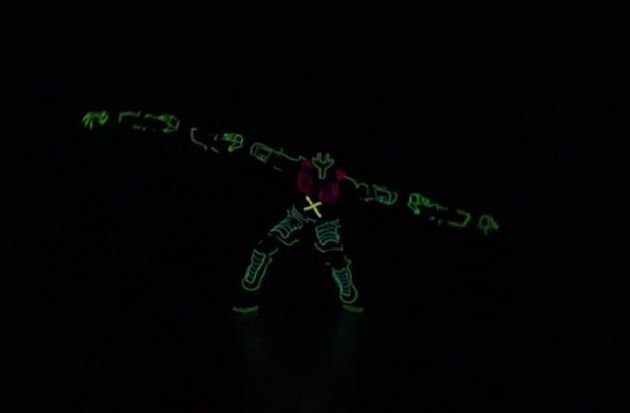
NBC’s “America’s Got Talent” is still a ways away from deciding the winner of this season’s competition. But if today’s viral video line up is any indication, the Internet already has its champion: the massively talented dance crew Team iLuminate.

What makes Team iLuminate so staggeringly unique is the crew’s use of the iLuminate wearable lighting system. Developed by Miral Kotb, a dancer, Columbia University-educated software engineer, and iPhone app maker, the iLuminate system uses wearable lightweight LEDs and electroluminescent wire (el-wire), which are attached to the dancers’ outfits, and controlled via with computer or a custom iPhone app.

Recommended Videos

The system turns the lights on and off to correspond with the music, as the choreographer desires. When all other lights are shut off, the effect it produces is nothing short of amazing. After seeing Tuesday night’s performance, Howie Mandel, one the “America’s Got Talent” judges, couldn’t contain his excitement, saying that Team iLuminate was “by far — by far — the best thing I have seen on this show.” The other two judges, Piers Morgan and Sharon Osbourne, were equally generous with their compliments.

In addition to having a software engineer on its team, the Team iLuminates further bolstered its nerd-cred by using a dubstep rendition of the Jenova Project theme music from Final Fantasy VII as one of the songs in Tuesday night’s performance.

Kotb and crew have plans to bring the iLuminate system to the masses with the soon-to-launch uLuminate mobile app for iPhone, iPad and Android devices. We don’t know much about the app thus far, but according to the app’s website, it will enable a user to “light yourself up from a handheld device.”

In the mean time, check out Team iLuminate’s two “America’s Got Talent” performances below.

August 2 performance:

May 31 performance

Andrew Couts
Features Editor for Digital Trends, Andrew Couts covers a wide swath of consumer technology topics, with particular focus on…
Amazon is full of copycats and shady brands. This Chrome extension lets you avoid them.
Advertisement, Poster, Text

Shopping on Amazon used to be simple. You searched for a product, compared a few familiar brands, and checked out. These days, it often feels like you're scrolling through an endless parade of names that look like someone leaned on a keyboard before hitting publish. That's exactly the problem Knockoff is trying to solve.

Created by developer Josh Pigford, the Chrome extension doesn't promise to expose counterfeit products or magically tell you what's good. Instead, it tackles something arguably more annoying: the flood of unfamiliar, mass-produced brands that dominate Amazon search results.

Read more
AI agent reportedly carried out an entire ransomware attack on its own
AI didn't just write malware. It apparently clocked in for work.
Cybersecurity

Cybersecurity researchers say they have documented what could be the first ransomware attack carried out almost entirely by an autonomous AI agent, marking a significant shift in how cyberattacks could be conducted in the future. According to cloud security firm Sysdig, they have uncovered a ransomware operation dubbed JadePuffer that appears to have relied on a large language model (LLM) agent to perform nearly every stage of the attack without continuous human intervention.

If confirmed, the incident suggests AI is moving beyond writing malicious code and into actively planning, adapting, and executing cyberattacks in real time.

Read more
The Washington Post predicted how tech will advance 50 years ago and the success rate is humbling
The Washington Post predicted 2026 tech in 1976. It got a lot right.
Representative Image

Fifty years ago, when floppy disks were cutting-edge and the personal computer revolution had barely begun, The Washington Post attempted a remarkably ambitious exercise: predict what life in 2026 would look like. Some of those predictions now read like science fiction. Others feel surprisingly ordinary because they have become part of everyday life.

In a retrospective published for America's 250th anniversary, the newspaper revisited science editor Thomas O'Toole's 1976 article Inventing the Future, comparing its forecasts with today's technological reality. The results reveal that while predicting exact timelines is nearly impossible, identifying long-term scientific trends can be remarkably accurate.

Read more