

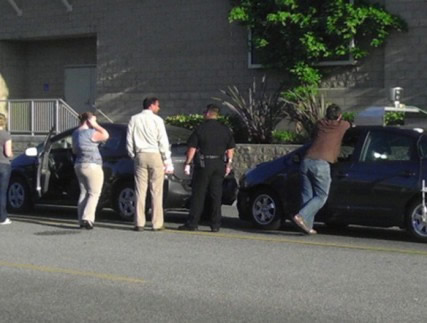
Due to a Jalopnik reader’s quick reflexes with a mobile phone camera earlier this week, one of Google’s self-driving Prius automobiles got caught rear-ending another Prius. This caused a chain-reaction that resulted in two Honda Accords and a second Toyota Prius to be rear ended. However, Google claims that the manual driving mode was enabled and a human driver is to blame for the accident. Legally, the cars must have a human behind the wheel at all times to take control of the vehicle in case of failure by the self-driving mechanism. According to Google, the cars have logged over 160,000 miles without incident when driving in the automatic mode.
 The launch of Google’s self-driving cars came late last year. Google equipped an Audi TT and six Toyota Prius cars with a large rotating sensor mounted to the top of the vehicle. The sensor builds a constantly changing three-dimensional map of the surroundings and relies on a video camera to watch for roving pedestrians, bicycles zipping by and the different colors in a stop light. At launch, Google stressed the superiority of the navigation data compared to the narrow view of a human driver as well as the tendency of a human driver to become distracted behind the wheel.
There’s no law in California banning the use of self-driving vehicles and Google has used the Golden state for the majority of testing. The cars have mostly been tested on the Google campus in Mountain View, but have been driven across landmarks like the Golden Gate Bridge as well. Google also got support from Nevada in June of this year. Nevada became the first state to pass a law legalizing the use of self-driving cars. The new law allows the Department of Transportation to stipulate insurance requirements, safety regulations and designate testing areas around the state.


