1. Home
  2. Space
  3. News

See the crater scar left on Mars by an ancient impact

Add as a preferred source on Google

The surface of Mars is dotted with craters, created when asteroids, meteoroids, or comets smashed into the planet and caused large impact marks. Unlike Earth, which has relatively few impact craters because of its tectonic processes, on Mars, these craters remain for billions of years.

An image of one such crater was captured from orbit by the European Space Agency (ESA)’s Mars Express spacecraft on April 25, 2022, and was just recently released. The image shows a large crater, nearly 19 miles across, in a region called Aonia Terra.
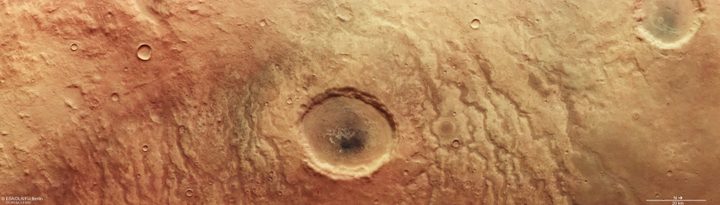
This image from ESA’s Mars Express shows part of the scarred and colourful landscape that makes up Aonia Terra, an upland region in the southern highlands of Mars.
This image from ESA’s Mars Express shows part of the scarred and colorful landscape that makes up Aonia Terra, an upland region in the southern highlands of Mars. ESA/DLR/FU Berlin, CC BY-SA 3.0 IGO

The landscape around the crater shows channels gouged into the surface, which were likely created when water flowed in rivers across Mars billions of years ago. “The channels appear to be partly filled with a dark material, and in some places, seem to actually be raised above the surrounding land,” ESA writes. “There are a variety of possible explanations for this. Perhaps erosion-resistant sediment settled at the bottom of the channels when water flowed through them. Or perhaps the channels were filled in with lava later on in Mars’ history.”

Recommended Videos

The image was taken using Mars Express’s High Resolution Stereo Camera (HRSC), and is a true-color image meaning it shows what a human eye would see. The data collected was also used to create a 3D terrain model, which allowed researchers to generate a view of the crater from a different angle as well:
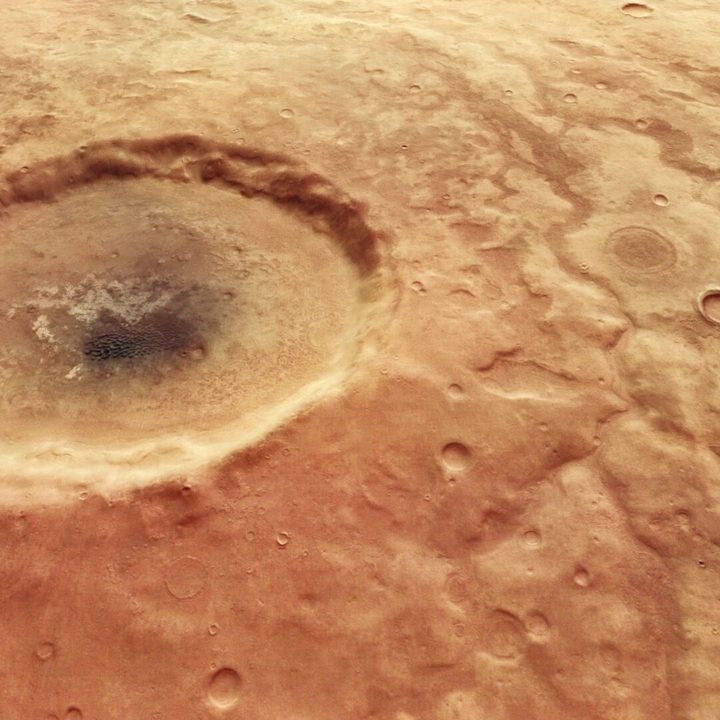
The scarred and colorful landscape that makes up Aonia Terra, an upland region in the southern highlands of Mars.
This oblique perspective view of part of the scarred and colorful landscape that makes up Aonia Terra, an upland region in the southern highlands of Mars, was generated from the digital terrain model and the nadir and color channels of the High Resolution Stereo Camera on ESA’s Mars Express. ESA/DLR/FU Berlin, CC BY-SA 3.0 IGO

Studying impact craters is important as it allows scientists to estimate the geological ages of various features on the planet. The Aonia Terra region in the southern hemisphere is an excellent place for such research as it boasts many large craters, including the Lowell crater which is over 120 miles across.

The Lowell crater is named after Percival Lowell, an astronomer in the 1800s who famously thought that he observed canals on Mars, leading to an explosion of interest in the idea of life on Mars among the public. Although his theories were disproven and his observations turned out to be optical illusions, Lowell continues to have an influence both in science fiction writing and on science thanks to his passion for building observatories.

Georgina Torbet
Georgina has been the space writer at Digital Trends space writer for six years, covering human space exploration, planetary…
NASA is investing $590 million in private contractors to build humanity’s first Moon outpost
NASA is counting on private companies to land its Moon Base dream.
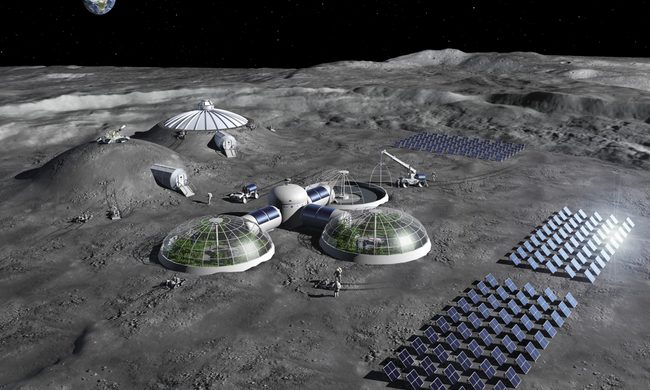
Artist impression of a Moon Base concept, with solar arrays for energy generation, greenhouses for food production, and habitats shielded with regolith.

Building a permanent base on the Moon sounds like science fiction, but NASA is making it feel a lot more real. The agency just handed $590 million in contracts to three private companies for four uncrewed lunar lander missions launching in late 2028.

These missions are part of Phase 1 of NASA's broader $30 billion Moon Base program, which needs to deliver landers, rovers, and scientific cargo up there before astronauts eventually move in. These efforts are closely tied NASA's Artemis program, which sent humans on a lunar flyby in April for the first time since the Apollo era.

Read more
Getting to Mars may require a pit stop in orbit, and NASA just tested the nozzle to make that happen
A gas pump nozzle for spacecraft sounds simple. It is not, and that's what makes this test worth paying attention to.
Architecture, Building, Factory

Getting a spacecraft to Mars or beyond requires an enormous amount of fuel, most of which has to be hauled from Earth, adding to the overall cost and weight of the spacecraft. NASA has been working on a different approach, one that could be more efficient and effective.

It wants to refuel a spacecraft in orbit before heading out for the mission. What’s even more interesting is that the space agency just finished testing a component that could make that possible: a cryocoupler.

Read more
Elon Musk’ Starlink could soon offer mobile services as a US carrier
Showcase of T-Mobile Starlink service on an iPhone.

Elon Musk’s Starlink has already changed how millions of people access the internet, especially in places where traditional broadband struggles to reach. Now, the satellite internet service could be preparing for an even bigger leap — becoming your mobile carrier.

According to a Financial Times report, SpaceX has told investors it’s considering launching a retail Starlink mobile service in the US. Instead of simply partnering with wireless carriers, the company could begin selling mobile plans directly to consumers, putting it in direct competition with Verizon, AT&T, and T-Mobile.

Read more