Intel has now officially released its first desktop discrete graphics card from the Arc Alchemist lineup, the A380. Right off the bat, the A380 also receives its first custom version with higher clock speeds, manufactured by Gunnir.
The entry-level GPU is positioned to be the rival to AMD’s Radeon RX 6400. The bad news is that you likely won’t be able to get your hands on Intel’s first graphics card for a while yet.
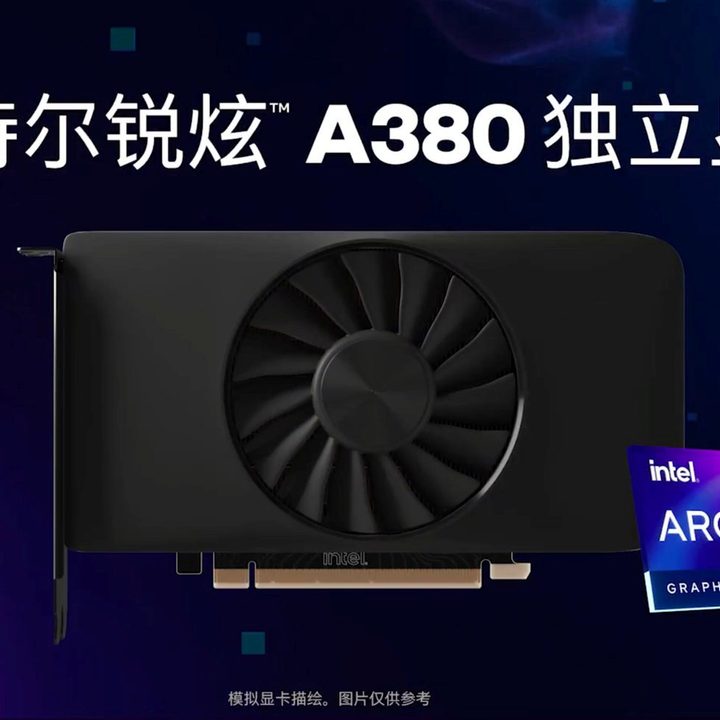
Some of us were beginning to think it would never happen, but here we are — after numerous delays, Intel is officially rolling out its first discrete gaming GPU based on the Xe-HPG architecture.
Following the launch of the Arc series on laptops, Intel’s new standalone graphics card keeps the specifications rather modest, but the price is set low enough to match them. Gunnir has quickly followed up Intel’s announcement with news of its own — the Arc A380 is also arriving in a custom flavor, dubbed the A380 Photon, with a dual-fan setup and a factory overclock. Let’s take a look at how these two GPUs compare.
The Intel Arc A380 features the full configuration of the ACM-G11 GPU and comes with 8 Xe-Cores. It has a base clock of 2000MHz, a memory bandwidth of 192GB/s, and 6GB of GDDR6 memory clocked at 16Gbps across a 96-bit memory bus. It doesn’t consume a lot of power, as the TDP has been set to a default of 75 watts.
Intel’s version of the Arc GPU, pictured above, has a simple design with a single fan setup. In all fairness, that should suffice — the GPU is being compared to the AMD Radeon RX 6400, also sporting just one fan. Although the A380 can’t hope to compete against the best GPUs in terms of specifications or performance, Intel still promises to deliver enough power to keep the gamers going.
Intel claims that the card can support a “fluid 1080p gaming experience at 60 frames per second (fps) and above” in several popular, less-demanding titles. This includes games like League of Legends, Naraka: Bladepoint, PUBG: Battlegrounds, and Moonlight Blade. The card’s gaming capabilities are aided by the full range of DirectX 12 Ultimate features, complete with hardware-accelerated ray tracing. The GPU will also support Intel XeSS, which is Intel’s A.I.-based super sampling technology — something similar to Nvidia’s DLSS.
Although Intel mainly focuses on selling the A380 as a gaming GPU, it also highlights that it can be used for content creation. It will support hardware AV1 encoding acceleration as well as HEVC and H.264 for encoding and decoding. The GPU is said to support up to four 4K 120Hz HDR displays or up to two 8K 60Hz displays, as well as a maximum of 360Hz in 1080p and 1440p.
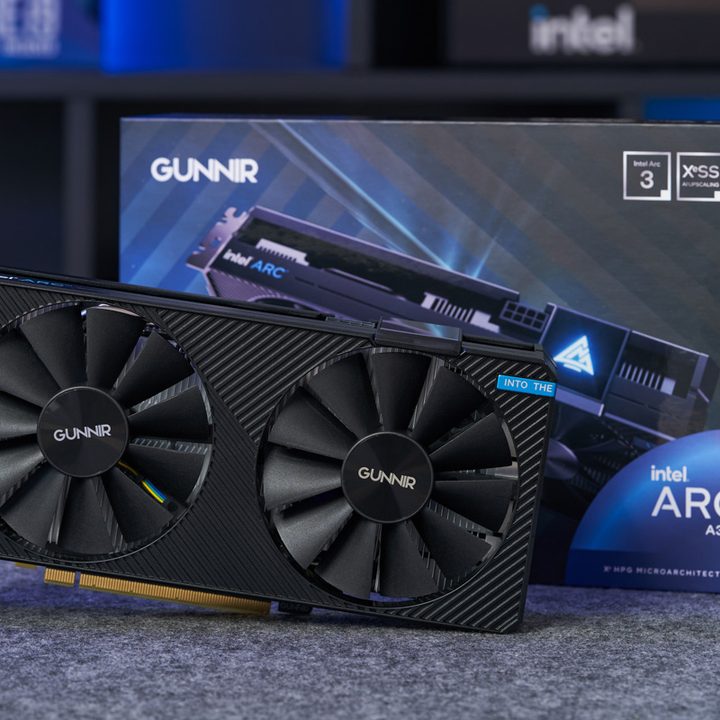
Gunnir’s custom version of Intel Arc A380 is an interesting model. With a dual-fan setup, the A380 Photon should deliver an increase in performance over the basic Intel GPU. It comes with three 2GB GDDR6 memory modules, each clocked at 15.5Gbps, which is actually slower than the reference model. However, it should be faster than the A380 due to an increase in the maximum clock speed — Gunnir brings up the numbers to 2450MHz. The TBP has also been increased to 92 watts. The GPU comes with a single 8-pin power connector and four display connectors: One HDMI 2.0 and three DisplayPort.
While Gunnir is yet to reveal the pricing of the custom A380, Intel has already lifted the veil of suspense. For the time being, the Arc A380 is priced at 1,030 Chinese yuan, which translates to around $153. Unfortunately, the GPU will only be available in China to start with. Intel’s rollout plan begins with original equipment manufacturers who will put the Arc A380 in custom PC builds. Later on, the card will be available on the DIY market for those who want to build their own PC, and it will also be released in other regions.