1. Home
  2. Computing
  3. News

Looks like Apple invented a dual Pro Display XDR stand

Add as a preferred source on Google

What monitor could be more expensive than Apple’s Pro Display XDR? How about two of them? According to an Apple patent watchdog, Apple has invented a dual display stand with the ability to perfectly balance two Pro Display XDR screens without getting in the way.

Patently Apple discovered patent 11371644 had been granted by the U.S. Patent and Trademark Office. The patent reveals a stand with two legs, a rotating shaft across the top from where two Pro Display XDR monitors can hang, and a rack-and-pinion rotating shaft to keep both monitors perfectly aligned to each other.
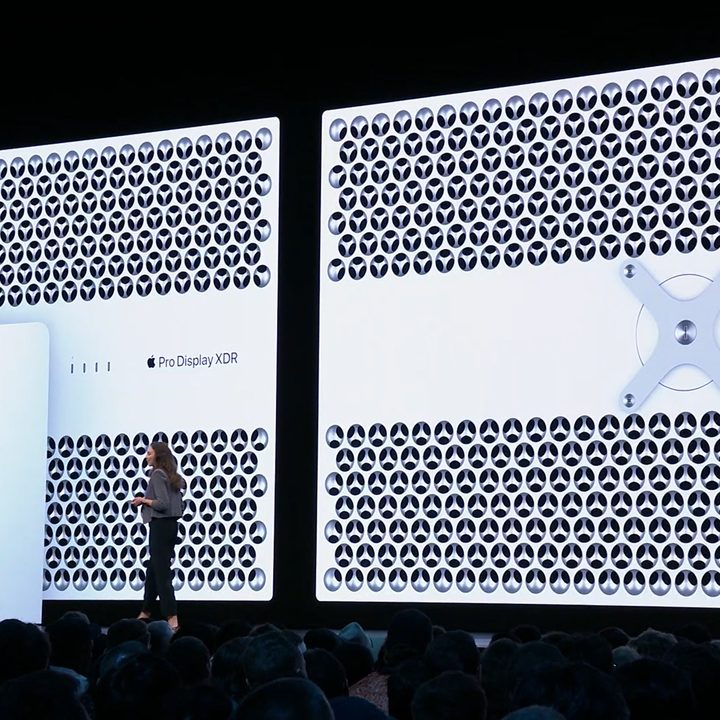
A person onstage at an Apple event with two Pro Display XDR monitors behind them, with the rear of the monitors in view.
Image used with permission by copyright holder

Most people use individual stands for their dual-monitor setup, and these stands can get in the way. Then there’s the issue of getting the monitors aligned just right, a frustrating task for professionals. Apple’s new patent purports to solve these problems with the dual-display stand.

Recommended Videos

“Computer device designers often desire to control positioning of a computer monitor or similar display at whatever height and orientation are best suited for the needs of the user,” Apple wrote in the patent background. “While various existing display stands provide tilt, rotation, and vertical height adjustment of monitors, these features often come at the expense of being convenient and natural to use.”

The dual display keeps its two legs tucked away behind the screens, while the connecting shaft keeps both monitors at the same height and tilt. There are rollers riding on rails inside the shaft to maintain perfect spacing between the monitors.

Another interesting addition to the stand is a universal joint that synchronizes the rotation of both segments of the main shaft. This allows the user to invert the stand into a V shape without disturbing the alignment of the monitors on either end of the shaft.

Finally, the stand includes a friction engine, suggesting the entire device is motorized and could potentially be controlled directly from a Mac.

Apple’s current Pro Display XDR stand costs over $1,000. Although it perfectly balances the big display, most of the cost is aesthetic. We don’t know what Apple will charge for a dual-display XDR stand but we’re confident it will be prohibitive.

Of course, the XDR line isn’t made for regular consumers. Professionals, studios, and design agencies are the users of an XDR dual-display stand. With powerful new MacBook Pros about to hit the market later this year, it seems Apple has professionals on its mind.

Nathan Drescher
Former Computing Writer
Nathan Drescher is a freelance journalist and writer from Ottawa, Canada. He's been writing about technology from around the…
Gemini Notebook’s new Collections arrive just as Google turns it into a bigger workspace
Google is cleaning up notebook organization as the former NotebookLM expands across Gemini and Search
Gemini Notebook branding on a MacBook

Google has barely finished renaming NotebookLM, and it’s already addressing one of the headaches that comes with building a large research library.

Collections are rolling out to all Gemini Notebook users, giving them a way to group related notebooks while keeping everything visible under My Notebooks. The dashboard gets some structure without asking users to rearrange the library they’ve already built.

Read more
Samsung’s humanoid robot ambitions are real, but factories come first
Samsung’s new robotics division has humanoids in its sights, although its immediate business is far more practical factory automation
Robot Touch Human Finger

Samsung wants a place in the humanoid race, but its new robotics push begins with machines built for factories rather than homes.

The CEO-led RX robotics division will initially focus on manufacturing robots. Samsung has separately identified humanoids as a priority, although it hasn’t announced a commercial model or explained where one fits into the division’s immediate plans.

Read more
WhatsApp’s Liquid Glass redesign is finally coming to Mac after months of waiting
WhatsApp's Mac app is getting Apple's Liquid Glass-inspired makeover
WhatsApp

WhatsApp has been steadily adopting Apple's new design language across its apps, but Mac users have largely been left watching from the sidelines. That is finally beginning to change.

The messaging platform has started rolling out its Liquid Glass redesign for the WhatsApp Mac app, bringing the desktop experience much closer to what iPhone and iPad users have been seeing over the past few months. The update introduces a refreshed interface with redesigned navigation elements, updated menus, and a cleaner layout that aligns with Apple's latest software aesthetic. According to WABetaInfo, the rollout has begun through the latest Mac App Store update and is currently reaching a limited number of users.

Read more