1. Home
  2. Computing
  3. News

This smart desk’s built-in OLED screen looks like science fiction

Add as a preferred source on Google

Startup company Lumina, maker of its 4K AI-based webcam, has announced a new programmable-height computer desk that also has a built-in screen and its own operating system, Lumina OS. While an embedded display might sound a bit silly, Lumina thinks it could actually have an impact on productivity.

Sit-stand desks have been around for a while now, and push-button raising and lowering is nothing new. Where Lumina has innovated is by making the height adjustment programmable.
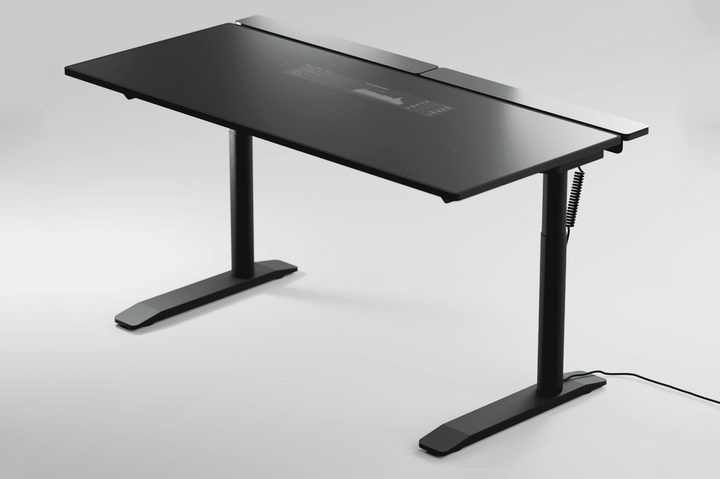
The Lumina Desk has a programmable height so you can sit or stand.
Image used with permission by copyright holder

That means you can set a schedule for this smart desk to raise and lower to encourage more standing while ensuring that you don’t overdo it and strain your back. Lumina’s software for Windows and Mac allows start and end times to be programmed in. The range runs from 30 to 47 inches in height.

Recommended Videos

That’s all well and good, but what’s most unusual and interesting about the Lumina Desk is its built-in screen. A bright OLED display is embedded into the surface of the desk and Lumina didn’t skimp on the specifications.

The Lumina desk with a few computing devices on it.
Image used with permission by copyright holder

It’s rated at 1,200 nits maximum intensity and has a scratch-resistant covering and fingerprint-resistant oleophobic coating. The 24-inch display is centered with a bit of room at the front and back for your keyboard and monitor. The desk surface is 5 feet long by 2.5 feet deep. It will be possible to install apps on the Lumina Desk, such as Google Calendar, Slack, Spotify, and more.

Lumina clarifies that the screen does not support touch, so as to avoid objects on the desk accidentally interacting with the screen.
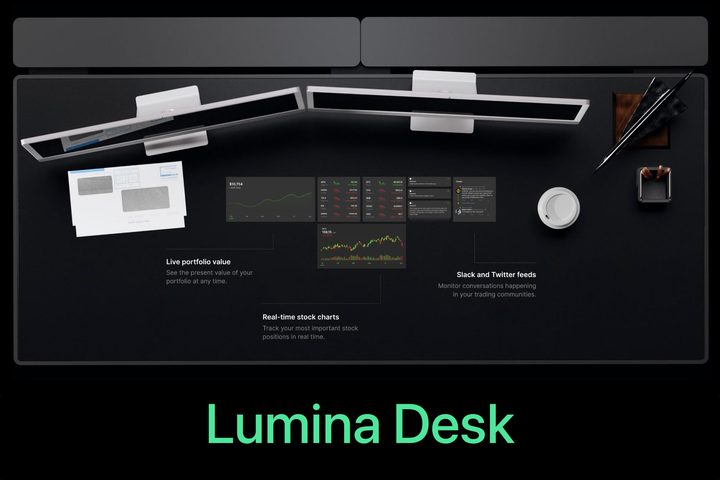
The Lumina Desk has an embedded display and can run apps.
Image used with permission by copyright holder

As if that wasn’t enough, the Lumina Desk also incorporates wireless charging across the entire surface as well as 6 power outlets and 6 USB-C sockets in a hidden panel at the rear. The USB-C ports can supply a total of 120 watts of power and up to 30 watts to any single port. The wireless charging supports two Qi-compatible devices, delivering up to 100 watts to each.

This is definitely one of the most interesting smart desk announcements we’ve seen. Lumina hasn’t revealed pricing information yet but is taking reservations so you can be among the first to get the Lumina Desk.

Alan Truly
Alan Truly is a Writer at Digital Trends, covering computers, laptops, hardware, software, and accessories that stand out as…
Apple’s M6 chip isn’t even here yet, but you’ll see M7 Macs early in 2027
Apple is reportedly already accelerating its next-generation silicon roadmap, even before the M6 has launched.
Apple MacBook

The M6 chip is still expected to debut later this year, but Apple may already be preparing for what comes next. According to Mark Gurman's latest report for Bloomberg, the company is aiming to introduce its first M7-powered devices as early as the first half of 2027, hinting at a much faster silicon refresh than many expected.

M7 could arrive alongside new Macs and iPads

Read more
The entry-level MacBook Pro could get a design refresh in 2027, and it’s about time
Five years on the same chassis, and now both tiers of the MacBook Pro are getting a new look at once.
MacBook Pro in space grey sitting on a desk.

Apple has a new MacBook Pro lined up for launch early next year, according to Bloomberg. The company will introduce a 14-inch laptop in the first half of 2027. 

The biggest surprise, however, will be a brand-new design language. The outlet describes it as "a revamped entry-level MacBook Pro, code-named K104."

Read more
Study finds humans will talk to AI ghosts of the dead as reincarnations, and it’s pretty grim
The first AI ghost study is in. The results are about as complicated as you'd expect.
VR Headset, Person, Face

A new study from the University of Colorado Boulder confirms something that sounds both impressive and concerning. People find interacting with AI simulations of their dead loved ones deeply meaningful, and most will come away wanting to do it again.

The researchers call it a "generative ghost," which is a clear reference to generative AI, but I’d still prefer to call it unsettling.

Read more