Bose has revealed the newest version of its flagship noise-canceling wireless earbuds, the QuietComfort Earbuds II. They’re significantly smaller than their predecessors and feature a new algorithm that constantly adjusts to your individual hearing profile, as well as your surroundings. Bose says they provide the best ANC performance of any headphone, whether in earbud or headset formats.
The QuietComfort Earbuds II are a bit more expensive than the first version — $299 versus $279 — and almost $50 more than Apple’s second-gen AirPods Pro wireless earbuds, which were announced on the same day and offer very similar features. You can starting September 7 on Bose.com in Triple Black. They will begin shipping on September 15 and a Soapstone color is expected to be available later in 2022.

The first version of the QuietComfort Earbuds are still one of our most-recommended wireless earbuds, especially for their superb noise cancellation — a Bose specialty — but they are also among the largest wireless earbuds and their charging case is quite bulky. Their large size meant that Bose had to incorporate silicone earhooks into the design of the earbuds’ eartips in order to provide people with a stable and secure fit. Unfortunately, there’s no way to wear the earbuds without the earhooks.
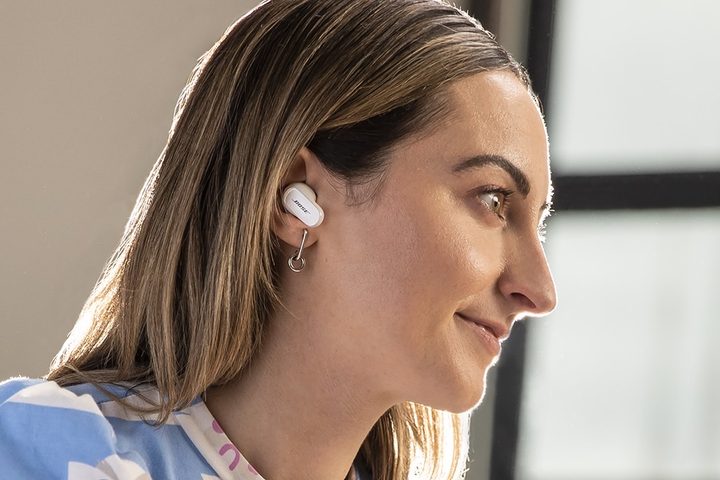
The new version seems to go a long way toward improving this situation. Bose claims the new buds are one-third smaller than their predecessors and they’re slightly lighter too: just under 0.25 ounces each compared to 0.3 ounces. They use a different anchoring system, which is now divided into two parts — eartips and something Bose calls stability bands. Each comes in three sizes. To ensure a good fit has been achieved, the Bose Music app has a built-in fit test, similar to what Apple uses for the AirPods Pro.

The other big change is the way the earbuds are tuned. Bose has introduced a new feature it calls CustomTune that uses a test tone combined with microphones to analyze how your individual ears respond to sound frequencies. It then makes adjustments to the earbuds’ tuning accordingly. This test is conducted every time you take the earbuds out of their case and insert them into your ears, but takes less than half a second, according to the company.
Bose claims that because CustomTune figures out how the presence of an earbud affects the way you hear sound, it can improve sound quality, but also the earbuds’ noise cancellation and transparency modes. Other companies, like Nura, have used similar principles to improve their products, but Bose says it’s using a different, proprietary technique for CustomTune.
The QuietComfort Earbuds II continue to offer ActiveSense, which automatically guards for loud noises while you’re in transparency mode in order to protect your hearing as you go about your day.
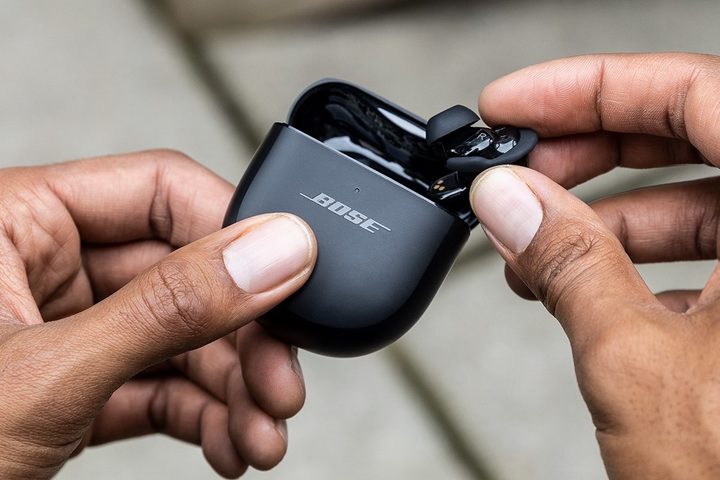
There are now twice as many microphones as on the previous model, for a total of eight mics, and Bose says that both noise cancellation and call quality have been improved as a result. There’s also an updated noise-removal algorithm for better voice pickup.
Battery life per charge is the same at a claimed six hours, but the charging case now holds three full charges instead of two, for an increased total playtime of 24 hours, instead of the previous 18. Unfortunately, the charging case is no longer capable of recharging itself wirelessly via a Qi-standard charging pad, something the first version was able to do. It is, however, much smaller and Bose says it’s pocketable, which we really couldn’t say about the first version.
Water resistance is also the same as before — IPX4, which should be enough protection for workouts or rainy days — and Bose has kept the same touch controls for access to most major functions like playback, active noise cancellation, and calls. For now, Bluetooth Multipoint is not supported, however, Bose is using a Bluetooth 5.3 Qualcomm chipset that can be upgraded via firmware over time to offer features like Multipoint, lossless audio, LE Audio, and other enhancements.