1. Home
  2. Emerging Tech
  3. Legacy Archives

Robotic suit enables paraplegic to walk again

Add as a preferred source on Google

A woman who was paralysed from the waist down in a skiing accident has walked again with the aid of a robotic suit.

The Ekso device was demonstrated for the first time in Europe on Friday at the London International Technology Show. The bionic legs detect small movements in the upper body of the wearer and then translates these into strides.

Recommended Videos

Paralysed in 1992, Amanda Boxtel was given the chance to try out Ekso at the technology show. She told the Telegraph that after walking with the aid of the robotic suit, she returned to her hotel room and cried. She described them as “life changing.” 

“To walk with my knees bent, heels striking the ground again is just amazing,” she said. “If I had this at home, I’d use it every day. To enjoy the simple pleasures of being able to reach up to a top cupboard in my kitchen would be fabulous. At a cocktail party, rather than looking up at nostrils and chins, I’d be able to stand eye to eye.”

She added, “Our bodies are meant to be up and moving, not sitting around in a wheelchair, stagnant.”
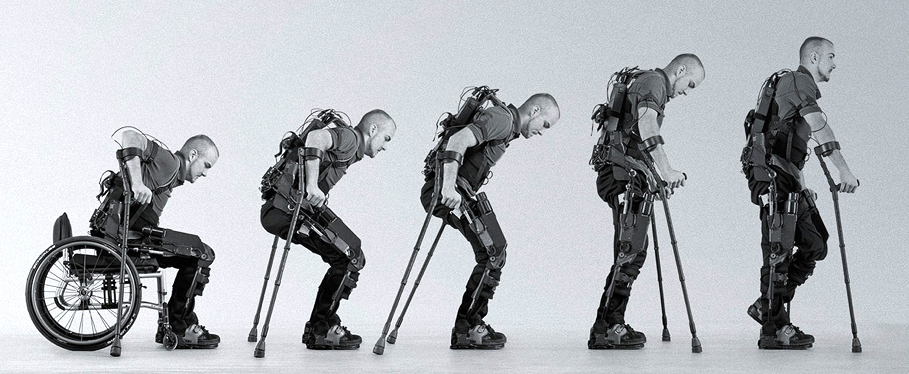
Image used with permission by copyright holder

Eythor Bender, chief executive officer of Berkeley-based Ekso Bionics in California, said the robotic suit was born out of an idea to give soldiers on the battlefield superhuman strength. After coming up with a design, researchers then decided to adapt it to make it useful for people with spinal problems.

“We want to enhance their independence and freedom of movement and with Ekso they now have the option to stand and walk for the first time since their injury,” said Bender.

Bender explained how sensors in the suit detect a person’s movements. A computer translates these and drives special motors located under the knees and hips to move the person forward.

The Ekso robotic suit, while expensive at around $160,000 (£100,000), would be a great tool for places such as rehabilitation centers. And if the cost can be brought down, it might one day enable paraplegics everywhere to enjoy a more independent and mobile life.

Trevor Mogg
Contributing Editor
Not so many moons ago, Trevor moved from one tea-loving island nation that drives on the left (Britain) to another (Japan)…
Claude can now join your Slack channels and work alongside your team
Laptop running Claude Fable

For years, AI assistants have been siloed. You open ChatGPT, Claude, Gemini, or Copilot, type a prompt, get an answer, and move on. Anthropic's new Claude Tag feature takes a different approach. Instead of making employees jump into a separate AI chat every time they need help, it brings Claude directly to where many teams already spend their day: Slack.

Add Claude to a channel, grant it access to needed tools, and tag @Claude for help — whether analyzing data, writing reports, reviewing code, or investigating incidents. But Claude Tag isn't just another chatbot integration. Its key differentiator is that Anthropic positions it as a digital coworker for your team, enabling seamless collaboration where multiple users can jointly interact with the same AI within their work environment.

Read more
Getty Images accused AI of wholesale theft. It’s now an official ChatGPT image partner.
Advertisement, Shop, Clothing

The AI industry's most fascinating stories often come from unlikely alliances, and this is certainly one of them. Getty Images, a company that has spent years raising concerns about how AI models are trained and how creative work is used, is now officially partnering with OpenAI.

The new agreement will allow Getty Images' licensed content to appear across ChatGPT's search and discovery experiences. That means users may begin seeing Getty's professionally licensed photos and visual assets integrated into ChatGPT responses, adding more visual context to searches and AI-generated answers. Getty says the goal is to make AI-powered search more useful and trustworthy by relying on high-quality, licensed content rather than the murky sourcing practices that have sparked countless debates across the AI industry.

Read more
Timekettle’s new X1 Meeting Hub does real-time translation for 50 people and fits in your pocket
Fifty participants, five languages, one 199-gram hub, and no booth required.
Electronics, Screen, Computer Hardware

Professional conference interpretation setups are notoriously painful. Dedicated booths, trained interpreters, bulky hardware, and a bill at the end of every month that makes you rethink whether the meeting was even required in the first place. 

Timekettle wants to collapse all of that into a single hub that weighs 199 grams (less than modern flagship smartphones). The company just launched the X1 Meeting Interpreter Hub. 

Read more