1. Home
  2. Space
  3. News

NASA’s Orion spacecraft splashes down after journey around moon

Add as a preferred source on Google

NASA’s Orion spacecraft has splashed down in the Pacific Ocean, marking the end of the Artemis I mission around the moon. The spacecraft entered the ocean off the California coast at 12:40 p.m. ET (9:40 a.m. PT) on Sunday, December 11.

The Orion spacecraft and the rocket that launched it, the Space Launch System, have now completed this first uncrewed test flight ahead of future crewed missions which will take astronauts around the moon on Artemis II, and to the lunar surface on Artemis III. The flight lasted 25 days and saw Orion travel more than 1.4 million miles into a distant orbit around the moon, performing two close flybys on the way out and on the return journey.
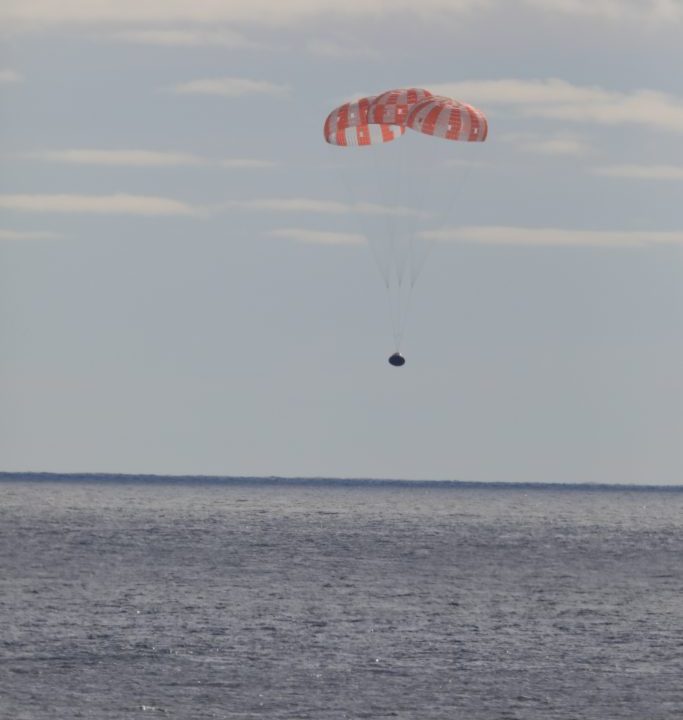
NASA’s Orion spacecraft for the Artemis I mission splashung down in the Pacific Ocean.
At 12:40 p.m. EST, Dec. 11, 2022, NASA’s Orion spacecraft for the Artemis I mission splashed down in the Pacific Ocean after a 25.5 day mission to the Moon. Orion will be recovered by NASA’s Landing and Recovery team, U.S. Navy and Department of Defense partners aboard the USS Portland ship. NASA/Kim Shiflett

“The splashdown of the Orion spacecraft – which occurred 50 years to the day of the Apollo 17 Moon landing – is the crowning achievement of Artemis I. From the launch of the world’s most powerful rocket to the exceptional journey around the Moon and back to Earth, this flight test is a major step forward in the Artemis Generation of lunar exploration,” said NASA Administrator Bill Nelson in a statement. “It wouldn’t be possible without the incredible NASA team. For years, thousands of individuals have poured themselves into this mission, which is inspiring the world to work together to reach untouched cosmic shores. Today is a huge win for NASA, the United States, our international partners, and all of humanity.”

Recommended Videos

To make the splashdown, as it approached planet Earth Orion separated its crew module, where astronauts would stay, from its service module, which houses the main propulsion system. As it entered the atmosphere, the spacecraft’s heat shield experienced temperatures of up to 5,000 degrees Fahrenheit and it used its parachutes to slow from almost 25,000 mph to just 20 mph as it hit the water.

Now, recovery teams are collecting Orion to return it to NASA’s Kennedy Space Center in Florida to check its condition and to collect data from the many sensors inside. So far, it looks like the spacecraft has handled the deliberately forceful stresses of this test flight.

“Orion has returned from the Moon and is safely back on planet Earth,” said Mike Sarafin, Artemis I mission manager. “With splashdown we have successfully operated Orion in the deep space environment, where it exceeded our expectations, and demonstrated that Orion can withstand the extreme conditions of returning through Earth’s atmosphere from lunar velocities.”

Georgina Torbet
Georgina has been the space writer at Digital Trends space writer for six years, covering human space exploration, planetary…
China’s answer to SpaceX’s reusable rockets literally catches boosters in a net
SpaceX catches boosters on legs. China just used a net.
Ammunition, Missile, Weapon

SpaceX's playbook for recovering a rocket booster generally involves legs, a precisely controlled vertical landing, and either a concrete pad or a drone ship. 

China just managed to pull off something similar, but in a slightly different way, and on July 10, it tested the method as well.

Read more
Dimming the sun sounds unhinged, but this new study on El Niño makes a surprisingly good case for it
A natural test case, Australia's worst-ever wildfire season, suggests the idea deserves serious consideration.
Nature, Outdoors, Sky

When I first saw "scientists propose dimming the sun," I rolled my eyes. It sounds like a science fiction movie cooked up after watching many climate documentaries. But a new study, published on July 8, 2026, in the journal Science Advances, seems to have a genuinely compelling argument.

A Super El Niño is currently forming in the Pacific, feared to be the most intense in decades. It could escalate floods, wildfires, and extreme heat events worldwide. However, Researchers at UC San Diego's Scripps Institution of Oceanography, led by climate scientists Kate Ricke and Jessica Wan, are now proposing one of the most interesting solutions I’ve come across.

Read more
You can now walk through space and gaze into a black hole at this VR exhibit
Smithsonian Starstruck lets you drift past dying stars and see the origin point of the universe for as little as $18 a person.
Smithsonian Starstruck featured

Most planetarium shows ask you to sit still and look up. The Smithsonian's new VR exhibit takes a different approach, letting visitors walk through the vast expanse of the universe, drifting past stars, planets, and a black hole to get a physical sense of its true scale.

A $29 ticket to the edge of the galaxy

Read more