1. Home
  2. Space
  3. News

See Hubble’s take on the famous and beautiful Carina Nebula

Add as a preferred source on Google

The Hubble Space Telescope recently captured a scene made famous by its sibling, the James Webb Space Telescope. One of the first images released from Webb showed the Carina Nebula, a particularly striking structure of dust and gas located in an area of the Milky Way called the Carina-Sagittarius arm. Recently, Hubble has imaged Carina as well, snapping an image of a small section of this famous nebula.

Compared to Webb’s image of Carina, which was taken in the infrared wavelength, Hubble’s image is more pastel. Although Hubble operates primarily in the visible light wavelength and Webb operates in the infrared, in this case, Hubble used its infrared capabilities to peer through the dust of the nebula and see its structure.
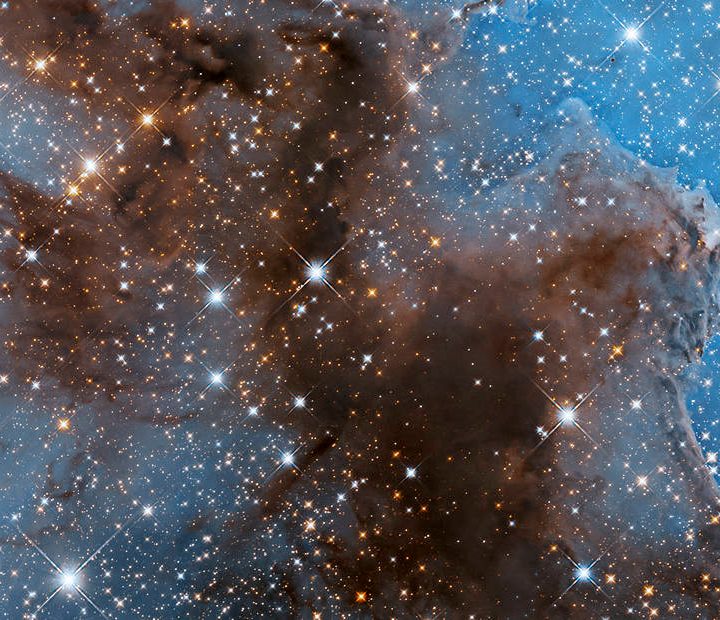
This sparkling new image depicts a small section of the Carina Nebula.
This sparkling new image depicts a small section of the Carina Nebula, one of the NASA Hubble Space Telescope’s most-imaged objects. The Carina Nebula, NGC 3372, is an enormous cloud of gas and dust home to several massive and bright stars, including at least a dozen that are 50 to 100 times the mass of our Sun. NASA, ESA, and A. Kraus (University of Texas at Austin); Processing: Gladys Kober (NASA/Catholic University of America)

“It is an emission nebula, meaning that the intense radiation from its stars ionizes the gas and causes it to glow,” Hubble scientists explain. “That gas is widely and thinly spread out over a large area, earning it the added designation of a diffuse nebula. Carina is a dynamic area of the sky with bursts of star formation occurring alongside star death. As stars form and produce ultraviolet radiation, their stellar winds disperse the gas and dust around them, sometimes forming dark, dusty cloaks and sometimes creating empty patches for the stars to become clearly visible.”

Recommended Videos

Hubble has visited Carina before, like this image taken in 2007 or another taken in 2010. Each image focuses on a different area of the nebula, bringing together different wavelengths from visible light to infrared and ultraviolet, in order to bring out different features of the scene like dust, gas, and stars.

At 300 light-years across, the nebula is vast, with many different areas showing off scientifically interesting regions like those which are busy with star formation.

Georgina Torbet
Georgina has been the space writer at Digital Trends space writer for six years, covering human space exploration, planetary…
China’s answer to SpaceX’s reusable rockets literally catches boosters in a net
SpaceX catches boosters on legs. China just used a net.
Ammunition, Missile, Weapon

SpaceX's playbook for recovering a rocket booster generally involves legs, a precisely controlled vertical landing, and either a concrete pad or a drone ship. 

China just managed to pull off something similar, but in a slightly different way, and on July 10, it tested the method as well.

Read more
Dimming the sun sounds unhinged, but this new study on El Niño makes a surprisingly good case for it
A natural test case, Australia's worst-ever wildfire season, suggests the idea deserves serious consideration.
Nature, Outdoors, Sky

When I first saw "scientists propose dimming the sun," I rolled my eyes. It sounds like a science fiction movie cooked up after watching many climate documentaries. But a new study, published on July 8, 2026, in the journal Science Advances, seems to have a genuinely compelling argument.

A Super El Niño is currently forming in the Pacific, feared to be the most intense in decades. It could escalate floods, wildfires, and extreme heat events worldwide. However, Researchers at UC San Diego's Scripps Institution of Oceanography, led by climate scientists Kate Ricke and Jessica Wan, are now proposing one of the most interesting solutions I’ve come across.

Read more
You can now walk through space and gaze into a black hole at this VR exhibit
Smithsonian Starstruck lets you drift past dying stars and see the origin point of the universe for as little as $18 a person.
Smithsonian Starstruck featured

Most planetarium shows ask you to sit still and look up. The Smithsonian's new VR exhibit takes a different approach, letting visitors walk through the vast expanse of the universe, drifting past stars, planets, and a black hole to get a physical sense of its true scale.

A $29 ticket to the edge of the galaxy

Read more