  1. Home
  2. Space
  3. News

NASA’s Lunar Flashlight mission hindered by thruster issue

Add as a preferred source on Google

A briefcase-sized satellite on its way to the moon is experiencing difficulties with its thrusters. NASA’s Lunar Flashlight spacecraft is a small uncrewed satellite designed to search the moon’s south pole for surface ice using near-infrared lasers.

Launched in December last year using a SpaceX Falcon 9 rocket, the satellite was deployed along with a private Japanese moon mission which includes a rover built by the UAE. Lunar Flashlight is still on its way to the moon as part of its four-month planned journey, however, the thruster issue could impede its progress. The plan is for it to enter an orbit called a near-rectilinear halo orbit, an efficient lunar orbit that requires little fuel to maintain.
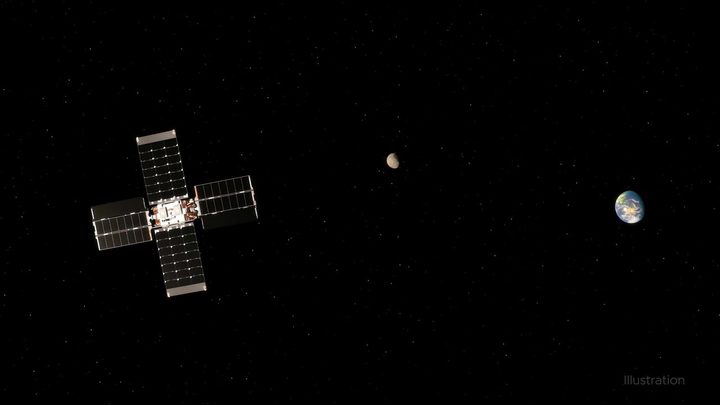
This illustration shows NASA’s Lunar Flashlight carrying out a trajectory correction maneuver with the Moon and Earth in the background. Powered by the small satellite’s four thrusters, the maneuver is needed to reach lunar orbit.
This illustration shows NASA’s Lunar Flashlight carrying out a trajectory correction maneuver with the Moon and Earth in the background. Powered by the small satellite’s four thrusters, the maneuver is needed to reach lunar orbit. NASA/JPL-Caltech

NASA announced that three of the spacecraft’s four thrusters are currently “underperforming,” leading to reduced thrust. Although the spacecraft is still in communication with Earth via the Deep Space Network and is otherwise healthy, the thruster issue could make it difficult for it to perform the required maneuvers to get into lunar orbit.

Recommended Videos

The issue was first noticed a few days after launch. While in its current phase of travel, called the cruise phase, the spacecraft only needs to fire its thrusters in occasional short pulses of a few seconds duration. But starting in early February, it will need to fire the thrusters regularly to make trajectory corrections.

Engineers have been performing tests on the ground to examine the problem which seems to be due to obstructions in the fuel line. The obstructions are stopping enough fuel from reaching the thrusters, making them fire with less force than they should.

To attempt to clear the obstructions, the team plans to fire the thrusters for a longer duration during trajectory corrections maneuvers. If this doesn’t work, the team is also working on a backup plan to make the maneuvers using the currently available thrust.


Georgina Torbet
Georgina has been the space writer at Digital Trends space writer for six years, covering human space exploration, planetary…
Space is becoming Bezos and Musk’s next data center site, and we have every reason to worry
The AI boom is coming for the night sky
How Vast's space station will look in orbit.

AI data centers already consume vast amounts of electricity and water on Earth, so Silicon Valley has begun looking somewhere considerably more spacious... literally.

Elon Musk's SpaceX and Jeff Bezos' Blue Origin, along with several other companies, have proposed enormous constellations of satellites designed to operate as orbital data centers. However, environmental groups and former space officials are now warning that putting them into orbit at the proposed scale could have severe consequences for Earth's atmosphere and the night sky.

Read more
The first possible exomoon is here, and it makes our Moon look hilariously tiny
Scientists may have found the first exomoon, except this one is the size of Jupiter
This artist’s concept depicts a potential volcanic moon between the exoplanet WASP-49 b, left, and its parent star. New evidence indicating that a massive sodium cloud observed near WASP-49 b is produced by neither the planet nor the star has prompted researchers to ask if its origin could be an exomoon.

We have already discovered more than 6,000 planets outside of our immediate neighborhood. Yet, finding a moon orbiting one of those distant worlds has proved considerably harder. Astronomers may finally have something close to the real deal, but this particular object stretches the word “moon” almost beyond recognition.

Using the European Southern Observatory’s Very Large Telescope in Chile, researchers detected strong evidence for a moon-like object in the CD-35 2722 system. Further observations are still necessary to confirm the discovery, but it could become the first confidently detected natural satellite outside our solar system. There is still one tiny complication though. This moon is apparently massive.

Read more
China’s answer to SpaceX’s reusable rockets literally catches boosters in a net
SpaceX catches boosters on legs. China just used a net.
Ammunition, Missile, Weapon

SpaceX's playbook for recovering a rocket booster generally involves legs, a precisely controlled vertical landing, and either a concrete pad or a drone ship. 

China just managed to pull off something similar, but in a slightly different way, and on July 10, it tested the method as well.

Read more
