1. Home
  2. Space
  3. News

Astronomers create epic map of more than 1 billion galaxies

Add as a preferred source on Google

Recently an international collaboration of astronomers released the most accurate map yet of all the matter in the universe, to help to understand dark matter, and now this is being joined by the largest two-dimensional map of the entire sky, which can help in the study of dark energy. A data release from the Dark Energy Spectroscopic Instrument (DESI) Legacy Imaging Survey shared the results from six years of scanning almost half of the sky, totaling one petabyte of data from three different telescopes.
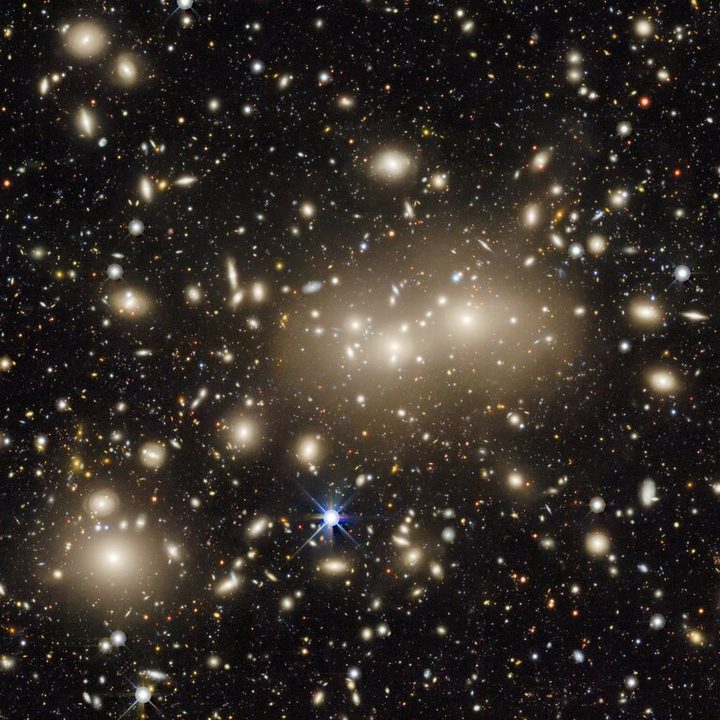
This is an image centered on a relatively nearby galaxy cluster dubbed Abell 3158.
This is an image centered on a relatively nearby galaxy cluster dubbed Abell 3158; light from these galaxies had a redshift value of 0.059, meaning that it traveled approximately 825 million years on its journey to Earth. The image is a small part of the DESI Legacy Imaging Surveys — a monumental six-year survey covering nearly half the sky. DESI Legacy Imaging Survey/KPNO/NOIRLab/NSF/AURA; Image processing: T.A. Rector (University of Alaska Anchorage/NSF’s NOIRLab, Jen Miller, M. Zamani & D. de Martin (NSF’s NOIRLab)

The reason that such large-scale data is required to study dark energy and dark matter is that these can only be detected due to their effects on ordinary matter — so researchers need to look at many galaxies to track how these otherwise unseen forces are adding mass or affecting the interaction between galaxies. This particular map was created to help scientists identify 40 million target galaxies which will be studied as part of the DESI Spectroscopic Survey.

Recommended Videos

To make the map as comprehensive as possible, the researchers included data taken in the near-infrared wavelength as well as the visible light wavelength. That is important as the light from distant galaxies appears redshifted, or shifted toward the red end of the spectrum, due to the expansion of the universe. “The addition of near-infrared wavelength data to the Legacy Survey will allow us to better calculate the redshifts of distant galaxies, or the amount of time it took light from those galaxies to reach Earth,” explained one of the researchers, Alfredo Zenteno of NSF’s NOIRLab, in a statement.

The map should be useful to astronomers in other fields as well, such as those looking in the radio or X-way wavelengths, as it can help pinpoint the sources of these other emissions.

“Anyone can use the survey data to explore the sky and make discoveries,” said Arjun Dey, an astronomer with NSF’s NOIRLab. “In my opinion, it is this ease of access which has made this survey so impactful. We hope that in a few years, the Legacy Surveys will have the most complete map of the entire sky, and provide a treasure trove for scientists well into the future.”


Georgina Torbet
Georgina has been the space writer at Digital Trends space writer for six years, covering human space exploration, planetary…
Space is becoming Bezos and Musk’s next data center site, and we have every reason to worry
The AI boom is coming for the night sky
How Vast's space station will look in orbit.

AI data centers already consume vast amounts of electricity and water on Earth, so Silicon Valley has begun looking somewhere considerably more spacious... literally.

Elon Musk's SpaceX and Jeff Bezos' Blue Origin, along with several other companies, have proposed enormous constellations of satellites designed to operate as orbital data centers. However, environmental groups and former space officials are now warning that putting them into orbit at the proposed scale could have severe consequences for Earth's atmosphere and the night sky.

Read more
The first possible exomoon is here, and it makes our Moon look hilariously tiny
Scientists may have found the first exomoon, except this one is the size of Jupiter
This artist’s concept depicts a potential volcanic moon between the exoplanet WASP-49 b, left, and its parent star. New evidence indicating that a massive sodium cloud observed near WASP-49 b is produced by neither the planet nor the star has prompted researchers to ask if its origin could be an exomoon.

We have already discovered more than 6,000 planets outside of our immediate neighborhood. Yet, finding a moon orbiting one of those distant worlds has proved considerably harder. Astronomers may finally have something close to the real deal, but this particular object stretches the word “moon” almost beyond recognition.

Using the European Southern Observatory’s Very Large Telescope in Chile, researchers detected strong evidence for a moon-like object in the CD-35 2722 system. Further observations are still necessary to confirm the discovery, but it could become the first confidently detected natural satellite outside our solar system. There is still one tiny complication though. This moon is apparently massive.

Read more
China’s answer to SpaceX’s reusable rockets literally catches boosters in a net
SpaceX catches boosters on legs. China just used a net.
Ammunition, Missile, Weapon

SpaceX's playbook for recovering a rocket booster generally involves legs, a precisely controlled vertical landing, and either a concrete pad or a drone ship. 

China just managed to pull off something similar, but in a slightly different way, and on July 10, it tested the method as well.

Read more