  1. Home
  2. Space
  3. News

Digital Trends may earn a commission when you buy through links on our site. Why trust us?

Amazon to build $120M facility at Kennedy for internet-from-space project

Add as a preferred source on Google
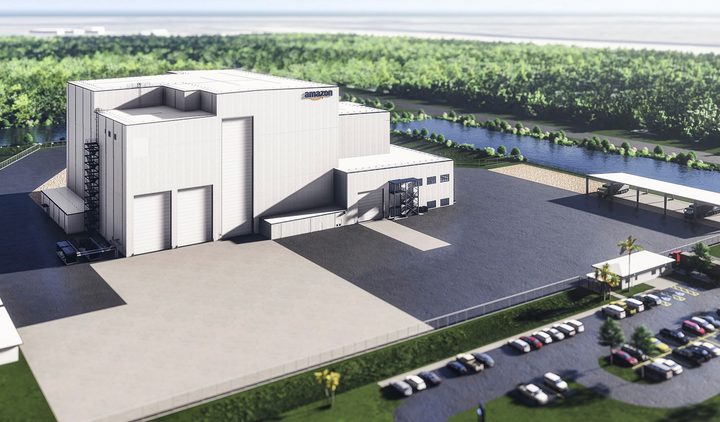
Amazon's new Project Kuiper facility in Florida.
Amazon

Amazon has a bold plan to take on SpaceX’s internet-from-space Starlink service, but there’s plenty of preparation work to be done before it can begin commercial operations.

Like Starlink, Amazon’s Project Kuiper service will be powered by several thousand small satellites in low-Earth orbit designed to provide fast, affordable broadband to unserved and underserved communities around the world.

Recommended Videos

Moving toward its goal, the company recently announced that it will invest $120 million in a satellite-processing facility at Space Florida’s Launch and Landing Facility at the Kennedy Space Center.

The 100,000-square-foot facility will prepare and integrate the satellites with a United Launch Alliance (ULA) or Blue Origin rocket in the final step prior to being blasted into space from the nearby Cape Canaveral launch site.

“We have an ambitious plan to begin Project Kuiper’s full-scale production launches and early customer pilots next year, and this new facility will play a critical role in helping us deliver on that timeline,” said Steve Metayer, vice president of Kuiper Production Operations.

Metayer added: “We look forward to adding more talent to our skilled operations and manufacturing team. These employees will play an important part in our mission to connect tens of millions of customers worldwide.”

Amazon said it’s planning to launch two prototype satellites in the coming months to test its network and subsystems.

The company will also start satellite production at a facility in Kirkland, Washington, before the end of this year. Once built, the satellites will be sent to Amazon’s new satellite-processing facility in Florida for final preparations ahead of launch. The site will have a 100-foot-tall clean room that’s able to accommodate the payload fairing of new heavy-lift rockets like Blue Origin’s New Glenn and ULA’s Vulcan Centaur.

In March, Amazon unveiled the terminals that Project Kuiper customers will use to connect to the internet service. Amazon said at the time that it wanted a design that offered something “smaller, more affordable, and more capable” than those offered by the likes of SpaceX for Starlink, though pricing details for the hardware and service have yet to be revealed.

Trevor Mogg
Contributing Editor
Not so many moons ago, Trevor moved from one tea-loving island nation that drives on the left (Britain) to another (Japan)…
China’s answer to SpaceX’s reusable rockets literally catches boosters in a net
SpaceX catches boosters on legs. China just used a net.
Ammunition, Missile, Weapon

SpaceX's playbook for recovering a rocket booster generally involves legs, a precisely controlled vertical landing, and either a concrete pad or a drone ship. 

China just managed to pull off something similar, but in a slightly different way, and on July 10, it tested the method as well.

Read more
Dimming the sun sounds unhinged, but this new study on El Niño makes a surprisingly good case for it
A natural test case, Australia's worst-ever wildfire season, suggests the idea deserves serious consideration.
Nature, Outdoors, Sky

When I first saw "scientists propose dimming the sun," I rolled my eyes. It sounds like a science fiction movie cooked up after watching many climate documentaries. But a new study, published on July 8, 2026, in the journal Science Advances, seems to have a genuinely compelling argument.

A Super El Niño is currently forming in the Pacific, feared to be the most intense in decades. It could escalate floods, wildfires, and extreme heat events worldwide. However, Researchers at UC San Diego's Scripps Institution of Oceanography, led by climate scientists Kate Ricke and Jessica Wan, are now proposing one of the most interesting solutions I’ve come across.

Read more
You can now walk through space and gaze into a black hole at this VR exhibit
Smithsonian Starstruck lets you drift past dying stars and see the origin point of the universe for as little as $18 a person.
Smithsonian Starstruck featured

Most planetarium shows ask you to sit still and look up. The Smithsonian's new VR exhibit takes a different approach, letting visitors walk through the vast expanse of the universe, drifting past stars, planets, and a black hole to get a physical sense of its true scale.

A $29 ticket to the edge of the galaxy

Read more