1. Home
  2. Space
  3. News

Digital Trends may earn a commission when you buy through links on our site. Why trust us?

Here’s where NASA will land astronauts on the moon

Add as a preferred source on Google
Promotional image for Tech For Change. Person standing on solar panel looking at sunset.
This story is part of Tech for Change: an ongoing series in which we shine a spotlight on positive uses of technology, and showcase how they're helping to make the world a better place.

A new image of the moon’s far side shows the region selected for the landing of NASA’s Artemis III mission, which aims to return humans to the lunar surface for the first time in over 50 years. The mission will be to the moon’s south pole, a region of particular scientific interest because it is thought to host water ice in permanently shadowed craters.

NASA has partnered with National Geographic to release a mosaic image of the Shackleton Crater, located at the moon’s south pole. The image of the crater was captured using NASA’s ShadowCam instrument on the Korea Pathfinder Lunar Orbiter spacecraft, with additional images of the surrounding area coming from the Lunar Reconnaissance Orbiter. It’s one of the permanently shadowed craters in the region, meaning it could potentially hold water ice. The crater is also close to several of the potential landing sites.
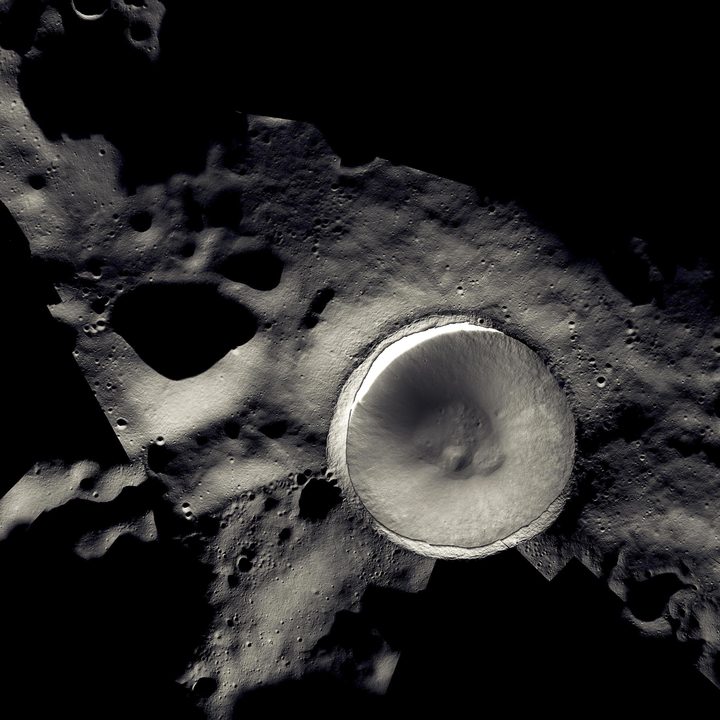
Shrouded in permanent darkness, the interior of Shackleton crater near the moon’s south pole is revealed in this stunning mosaic. The crater itself was captured by ShadowCam, a NASA instrument designed to peer into the shadowy parts of the lunar surface that has been orbiting the moon for almost a year on the South Korean spacecraft Danuri. The surrounding areas were imaged by the Lunar Reconnaissance Orbiter Camera. Portions of three of the 13 potential landing regions for astronauts during Artemis III can be seen in this image.
Shrouded in permanent darkness, the interior of Shackleton Crater near the moon’s south pole is revealed in this mosaic. The crater itself was captured by ShadowCam, a NASA instrument designed to peer into the shadowy parts of the lunar surface that has been orbiting the moon for almost a year on the South Korean spacecraft Danuri. The surrounding areas were imaged by the Lunar Reconnaissance Orbiter Camera. Portions of three of the 13 potential landing regions for Artemis III astronauts can be seen in this image. Mosaic by NASA, Korea Aerospace Research Institute, Arizona State University

Water ice is rare on the moon as it most often evaporates when the surface it is on faces the sun. However, there are some impact craters around the south pole that the sun’s rays never reach, making them permanently shadowed. It is thought that water ice could persist in these craters, which gives the opportunity for both scientific research and practical resource gathering for crewed missions.

Recommended Videos

“If there is water ice there, then that water ice can be recovered and it can be used for astronaut consumables, it can be used to shield astronauts from harmful space radiation, and the water can be used for rocket propellant,” David Kring, a planetary scientist at the Lunar and Planetary Institute, told National Geographic.

Last year, NASA shared the 13 candidate locations for the Artemis III landing, all of which are close to the lunar south pole and shown below:
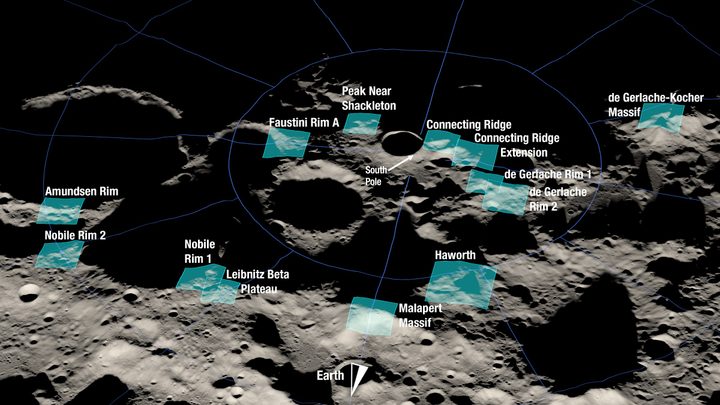
Shown here is a rendering of 13 candidate landing regions for Artemis III. Each region is approximately 9.3 by 9.3 miles (15 by 15 kilometers). A landing site is a location within those regions with an approximate 328-foot (100-meter) radius.
Shown here is a rendering of 13 candidate landing regions for Artemis III. Each region is approximately 9.3 by 9.3 miles (15 by 15 kilometers). A landing site is a location within those regions with an approximate 328-foot (100-meter) radius. NASA

Ahead of Artemis III, which is scheduled for 2025, NASA plans to first send a crewed mission around the moon called Artemis II and a lunar rover called VIPER that will search for ice deposits. Both of those missions are set for launch next year.

Georgina Torbet
Georgina has been the space writer at Digital Trends space writer for six years, covering human space exploration, planetary…
China’s answer to SpaceX’s reusable rockets literally catches boosters in a net
SpaceX catches boosters on legs. China just used a net.
Ammunition, Missile, Weapon

SpaceX's playbook for recovering a rocket booster generally involves legs, a precisely controlled vertical landing, and either a concrete pad or a drone ship. 

China just managed to pull off something similar, but in a slightly different way, and on July 10, it tested the method as well.

Read more
Dimming the sun sounds unhinged, but this new study on El Niño makes a surprisingly good case for it
A natural test case, Australia's worst-ever wildfire season, suggests the idea deserves serious consideration.
Nature, Outdoors, Sky

When I first saw "scientists propose dimming the sun," I rolled my eyes. It sounds like a science fiction movie cooked up after watching many climate documentaries. But a new study, published on July 8, 2026, in the journal Science Advances, seems to have a genuinely compelling argument.

A Super El Niño is currently forming in the Pacific, feared to be the most intense in decades. It could escalate floods, wildfires, and extreme heat events worldwide. However, Researchers at UC San Diego's Scripps Institution of Oceanography, led by climate scientists Kate Ricke and Jessica Wan, are now proposing one of the most interesting solutions I’ve come across.

Read more
You can now walk through space and gaze into a black hole at this VR exhibit
Smithsonian Starstruck lets you drift past dying stars and see the origin point of the universe for as little as $18 a person.
Smithsonian Starstruck featured

Most planetarium shows ask you to sit still and look up. The Smithsonian's new VR exhibit takes a different approach, letting visitors walk through the vast expanse of the universe, drifting past stars, planets, and a black hole to get a physical sense of its true scale.

A $29 ticket to the edge of the galaxy

Read more