Anker’s popular sub-brand Nebula has been gaining a reputation for making some excellent projectors, and today the company added to its lineup with two new portable offerings. The soda-can sized Capsule 3 and the slightly bigger and more powerful Mars 3 Air will retail for $550 and $600, respectively, and will be available on November 20.
In a new development for Nebula, the two new projectors run on the Google TV platform, instead of the older, similar, and more common Android TV that is in many projectors today. And surprisingly for portable projectors, they both come with Netflix built in, with Nebula claiming that they are “the first pair of portable LED projectors displaying high-res content from Netflix in full 1080p resolution.”
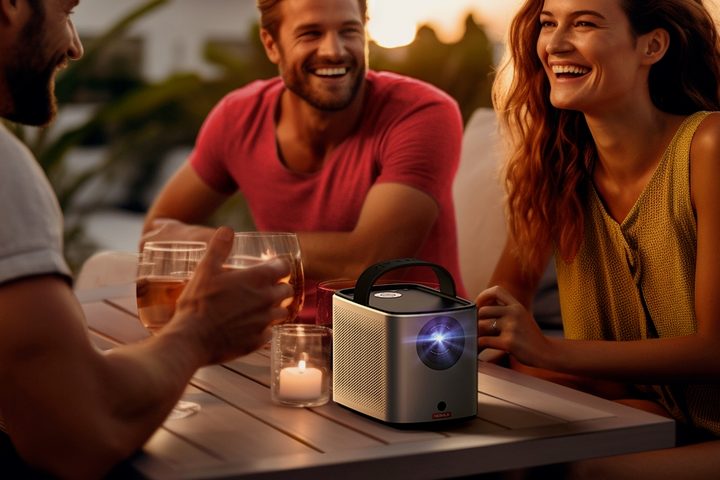
The Mars 3 Air is similar in form and features to Nebula’s Mars II Pro — it has a large, single lens on the front, top-mounted physical controls, and carrying strap across the top — but with some improvements under the hood. The Mars 3 Air is a DLP projector that features 400 ANSI lumens of brightness, as well as Full HD 1080p resolution that can throw an image up to 120 inches in size.
And like many of Nebula’s projectors, there’s intelligent autofocus and automatic keystone adjustment that will adjust for up to 40 degrees plus or minus of vertical and horizontal angle correction. That means that you can aim the Mars 3 Air at the wall or a screen at some pretty unforgiving angles and the projector will straighten out and level the image so you can watch. Automatic screen fit is here, too, as well as automatic object avoidance, which dims the projector when someone walks in front of it to protect your eyes.

Being bigger than the Capsule 3 means that there’s room for a pair of 8-watt Dolby Digital-capable speakers, but you can also connect to external speakers or a set of wired headphones via a 3.5mm AUX port. The 3.75-pound projector can also be used as a Bluetooth speaker and offers up to eight hours of music playback time from its 64.8 watt-hour battery and up to 2.5 hours of movie playtime on a charge, which happens in three hours via DC cable. Lastly, there’s an HDMI port on the back for connecting other streaming devices like an Apple TV or Roku (should you not prefer Google TV), gaming consoles, DVD players, or even a computer. There’s also a USB-A port should you have a thumb drive to connect.
The super-portable Nebula Capsule 3, on the other hand, has many of the same features as the Mars 3 Air, but in a 1.87-pound package. With a less-powerful 200 ANSI lumens, the Capsule 3 also displays at 1080p and features the same screen size, autofocus, and automatic keystone specs, as well as screen-fit and object avoidance.
A single, 8-watt Dolby Digital speaker provides the sound, which should be OK in small spaces, but there’s also an AUX output for connecting external speakers. The Capsule 3’s 52Wh battery also offers up to 2.5-hours of movie time and the same eight hours of Bluetooth music listening, but it uses USB-C for charging in the same three hours. HDMI and USB-A ports are here, too, and the Capsule 3 has a tripod screw on the bottom for easy mounting (the Mars 3 Air has this, too).


- 1. The back panel of the Nebula Mars 3 Air
- 2. The top panel of the Nebula Mars 3 Air
- 3. The back of the Nebula Capsule 3
- 4. The top of the Nebula Capsule 3
Both the Nebula Mars 3 Air ($600) and Capsule 3 ($550) Google TV projectors will be available in the U.S. on November 20 from the Nebula website and Amazon.