U.S. drivers will save $68 billion in fuel costs by 2030 thanks to the Obama administration’s Corporate Average Fuel Economy (CAFE) standard, according to a report by the Natural Resources Defense Council.
Last year, the Obama administration proposed a plan for CAFE standards for each auto manufacturer to reach 54.5 miles per gallon by 2025. The NRDC, which is a non-profit organization, estimates that the average American driver will enjoy a savings of about $4,400 over the lifespan of their car thanks to those increased fuel efficiency and greenhouse-gas-emissions standards.
With gasoline prices around $4.00 per gallon, and continued instability in oil-producing regions such as the Middle East, the report explains how many Americans are already seeking ways to help alleviate the impact on their budgets. A major component of that is purchasing more fuel-efficient vehicles.
Fuel economy has become such an important factor for new buyers, and it would appear automakers too are paying close attention. More efficient engines are paramount not only to meeting stringent standards proposed by the government, but key in attracting new and return customers as well.
Aside from purchasing a hybrid or electric vehicle, the study points to the wide array of vehicle manufactures already implementing new fuel-saving technology into existing models in preparation for the increased standards. Ford has implemented its EcoBoost engine technology into cars like the Focus, Fusion, and Taurus, while General Motor’s e-Assist, found on various models including the mid-size Malibu, also aids in improving overall fleet fuel-efficiency.
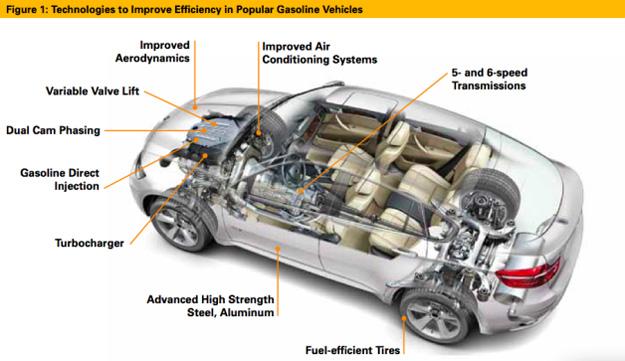
According to NRDC, there are already 57 models sold in the U.S. now that can be considered “fuel efficient,” up from 27 models in 2009. Some of those include the Nissan Versa, Toyota Yaris, Ford Fiesta, and Chevrolet Sonic, all of which get over 30 miles per gallon.
“This study should put to rest any notion that drivers have to sacrifice anything [in order] to get more miles to the gallon,” said Alan Baum, principle with Baum and Associates who contributed to the analysis, in a statement. “From pickups to SUVs to minivans to cars…the internal combustion engine is far from dead; it’s just going through a major makeover.”
To help illustrate their point, the report shows how a six-cylinder 2010 Ford Explorer would achieve about 16 mpg, while four-cylinder 2012 Explorer is rated at about 23 mpg, potentially saving owners $5,700 over five years of driving when all is said and done.
Of course, it’s difficult to guess what average fuel prices will sit at nearly twenty years from now, but according the NRDC’s report, the states that will benefit the most from the government proposed standards are Texas ($7.8 billion), California ($7.3 billion), and Florida ($6.7 billion).
To read the full report, click here.
[Image credit: Shutterstock/Monkey Business Images]