

When I first started playing Baldur’s Gate 3, I was immediately hooked by its engrossing (and gross) story, meaty CRPG systems, and the most personable cast of companions I’ve seen in the genre in quite some time. I knew I was about to sink months of my life into the 100-hour adventure. Things didn’t go according to plan.
The nature of my job meant that I had to move on to Armored Core VI: Fires of Rubicon at the height of my obsession. Though I wouldn’t have much time to put in long play sessions, I resolved to pick away at it throughout the year on Steam Deck. It was a critical error on my part, as I’d quickly learn that the enormous RPG is perhaps the worst commute game on the planet. It felt like I could barely accomplish anything in 30 minutes. Long, turn-based battles would often take up an entire train ride and sometimes I’d simply lose any progress I made to an untimely death. I grew frustrated, wondering why I was having so much trouble finding my way back to a game I loved.
It took a few months to accept the truth: I couldn’t play Baldur’s Gate 3 casually, because it’s not a casual game. It’s an all-consuming journey to another realm that demands your full attention. Developer Larian Studios created a stunning passion project, one that requires a reciprocal relationship from its players. When your heart’s not in, it can be an arduous RPG that feels like it’s not respecting your time. But when you fully give yourself to its alluring world, Baldur’s Gate 3 is the kind of special experience that makes it a clear choice for our 2023 Game of the Year.
Role-playing in the Forgotten Realms
On paper, Baldur’s Gate 3 sounds like the definition of niche. It’s a complicated, 100-hour-long computer RPG built off a specific Dungeons & Dragons rulebook. Its predecessor, Baldur’s Gate 2, came out over 20 years ago and wasn’t exactly a household name among gamers heading into 2023. It’s a turn-based RPG that came during the same year where an industry-leading franchise ditched that style of gameplay for real-time action. That’s not to mention that the project began its life as a Google Stadia exclusive. There’s probably another dimension out there where this exact same game launches to the sound of crickets.
All of that context is important to unraveling why Baldur’s Gate 3 is such a massive hit in spite of the odds — and it doesn’t take very long to piece it together. The adventure kicks off in an arresting manner thanks to a thrilling cinematic that’s as entertaining as any Hollywood movie. Mind flayers, wriggling eye parasites, a dragon-filled chase scene through portals — it’s a grand opening that gives a full sense of the world in five minutes.
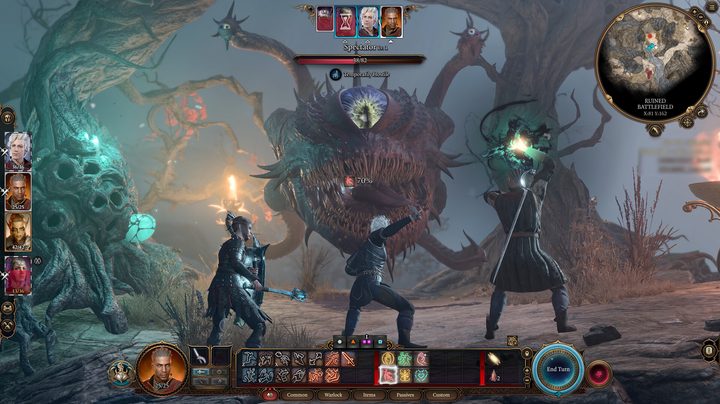
Larian Studios keeps up the momentum from there. It’s not long until players put the game’s deep choice systems to the test by deciding whether or not to spare a sentient brain. It’s a bizarre, gross, and hilarious sequence, but more importantly, it’s one that quickly establishes that there are real consequences to every decision. In my opening, a failed attempt to kill the bugger would come back to haunt me shortly thereafter. It was the first of many distinct stories I could retell when sharing experiences with my friends.
Baldur’s Gate 3 is full of those moments, and that’s largely what’s in its secret sauce. How did you choose to clear a cave-in? What was your reaction when you caught a vampire secretly trying to slurp your blood at night? Did you accidentally end the entire game a whole act early by nuking the world? The adventure hinges on questions like this that radically change each playthrough. It’s one of the few games that captures the freedom and flexibility of a tabletop RPG, even if its digital game master isn’t as reactive as a human.
That strength can be its weakness too. If you’re not the kind of person who loves experimenting, Baldur’s Gate 3 can be tough to get the hang of. Turn-based battles will feel like long, dull affairs you have to push through to get to the story. A similar conundrum pops up in this year’s The Legend of Zelda: Tears of the Kingdom, an experience that’s exponentially more enjoyable the more you tinker with its Ultrahand building system. Baldur’s Gate 3 demands that you stretch the limits of your imagination in order to forge your own distinct legend in the Forgotten Realms.
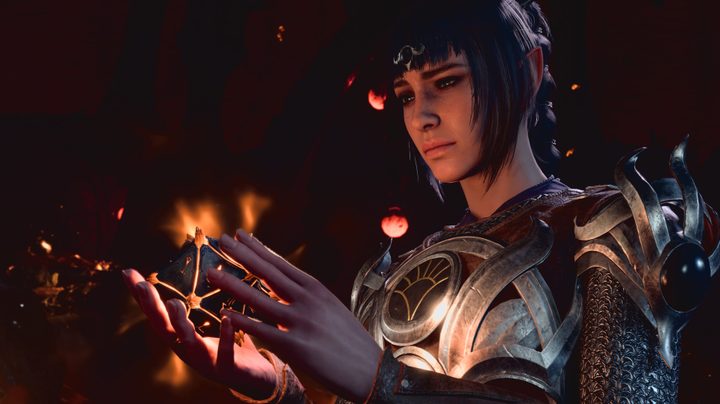
Even in my moments where I couldn’t quite get there, I could still see how well it was clicking for those who could. Videos of people scaling castle walls by stacking boxes sky high showed me just how much was possible. I gleefully watched on as my peers lusted over companions like Astarion and Shadowheart. Tips and tricks were shared through social media like people were posting on old message boards. There’s no mass multiplayer component to Baldur’s Gate 3, but the community that built up around it made me feel like I was part of an MMO.
Like last year’s Elden Ring, Baldur’s Gate 3 is a game you play with your full heart. You have to be willing to mess around, make mistakes, and share your successes like a good pub tale. It’s a true role-playing game in every sense of the term, and you’ll only see the magic if you transform yourself into a full-time resident of the Forgotten Realms.