  1. Home
  2. Computing
  3. Gaming
  4. News

AMD’s new integrated graphics might beat popular Nvidia GPU

Add as a preferred source on Google

For five years straight, Nvidia’s GTX 1060 was the most popular graphics card for gamers. But now, AMD might be able to match it with only integrated graphics.

Fresh information around AMD’s upcoming desktop APUs, specifically the Ryzen 5 8600G, has emerged to give us a fair idea of how the upcoming processor and integrated graphics could shape up. Recently leaked Geekbench benchmark scores not only offer a performance metric, but the listing also reveals crucial specifications about the upcoming chip.

Recommended Videos

The upcoming Ryzen 5 8600G could arrive with the Radeon 760M integrated graphics chip clocked at 2.8GHz and featuring eight compute units and 512 GPU shader cores. Paired with two sticks of 16GB DDR5-6000 memory, the 8600G achieved a score of 30,770 points in the Vulkan benchmark, while in the OpenCL test, it scored 24,842 points.

As pointed out by Tom’s Hardware, benchmark scores of the Radeon 760M are almost as good as Nvidia’s GeForce GTX 1060. Granted that the GTX 1060 launched almost seven years ago, but it is important to note that AMD has managed to deliver the same performance using significantly less power. Essentially, it would mean this integrated GPU will be capable of running certain modern games at 1080p at 60 frames per second (fps), which would be very impressive.

For many years, the GTX 1060 was the standard bearer for entry level PC gaming, topping the Steam survey charts from 2017 to 2022. It would be a massive win for AMD to deliver graphics at this level, but we’ll have to wait for more official information before we know what its capabilities are for sure.
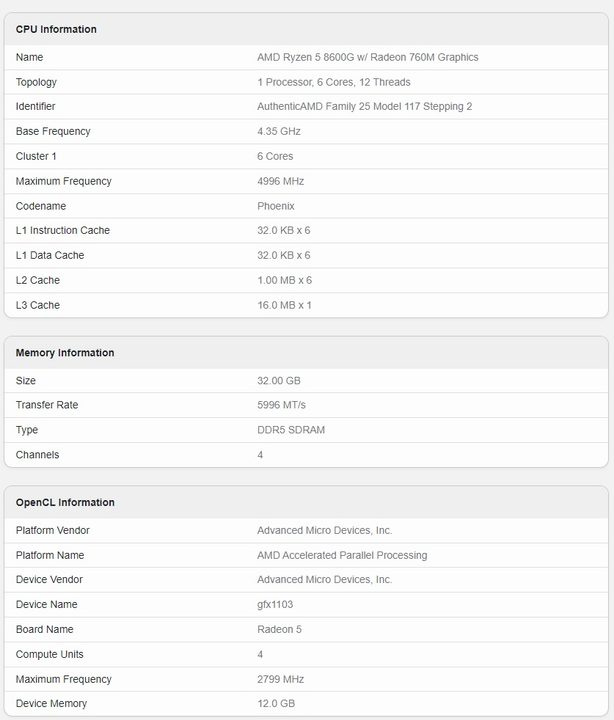
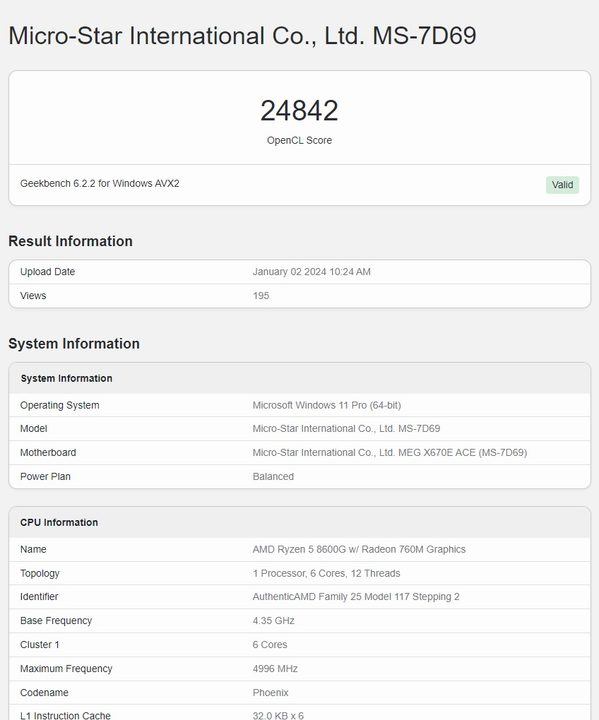
Screenshot of the leaked Geekbench benchmark scores of the upcoming AMD Ryzen 8600G. Screenshot of the leaked Geekbench benchmark scores of the upcoming AMD Ryzen 8600G.

The benchmark listing also confirms that the upcoming Ryzen 5 8600G may feature six cores, 12 threads, and a boost clock of 4.996GHz. This is almost the same configuration as the Ryzen 5 7600, with the only difference being the lower boost clock speed.

It is also expected that the Ryzen 7 8700G will be making use of AMD’s Radeon 780M, which could deliver up to 50% better performance. While we don’t have a confirmed date or release schedule for the upcoming Ryzen 8000G series of desktop processors, Gigabyte spilled the beans about it in November.

Upon releasing a new AGESA beta BIOS for its X670, B650, and A620 motherboards last year, the company had accidentally mentioned the following in its announcement: “The forthcoming AM5 next-gen APU will be launched at the end of January 2024.” Since CES is just around the corner, we could see AMD making some sort of announcement there and eventually releasing the chips by the end of this month.

Kunal Khullar
Kunal Khullar is a computing writer at Digital Trends who contributes to various topics, including CPUs, GPUs, monitors, and…
Parents worry AI is becoming a crutch for their kids while schools struggle to keep up, survey finds
Only 1 in 3 schools has AI guidelines as nearly 50% parents grow anxious about kids leaning on AI too much.
a boy using iPhone

Kids are using AI for their homework, and half of their parents are not sure that's a good thing. Deloitte's 2026 Back-to-School Survey, which polled 1,207 parents of K-12 students, found that 49% worry their child relies on AI too much.

The findings suggest AI adoption is moving far faster than the policies meant to guide it, leaving many parents unsure how these tools are being used in education.

Read more
Samsung wants to put its own chip in your next PC and it’s all about speeding up AI chores
Samsung Custom Chip

Samsung may be plotting a new entry into the PC chip business. A new report from the Korea Economic Daily says Samsung’s System LSI division is developing a dedicated AI accelerator for PCs called Gaia. The company has reportedly supplied early samples to Lenovo and HP for performance testing, with mass production potentially beginning as early as 2027.

Prominent Samsung leaker Ice Universe described the project as the company’s return to the PC processor market after roughly 13 years. However, the details point toward something slightly different from a traditional laptop processor. Gaia might be a specialized companion chip designed to handle artificial intelligence workloads rather than a complete replacement for an Intel, AMD, or Qualcomm CPU.

Read more
AI image generators have escaped nightmare fingers and entered the fake premium era
Meta Muse, Gemini, and ChatGPT can now make clean, usable images. They also keep making reality look like a product render with feelings.
Terminal, Railway, Train

I expected this comparison to be uglier. Meta Muse, Gemini Nano Banana 2, and ChatGPT Images 2.0 sounded like a perfect setup for plastic faces, mangled hands, fake products, and posters written in haunted alphabet soup. Instead, they were mostly competent, which somehow made the whole thing more suspicious.

These aren’t identical tools wearing different logos. Meta pitches Muse Image as a social image model living inside Meta AI and its apps. Google frames Nano Banana 2 around speed, editing, and Gemini’s broader knowledge. OpenAI sells ChatGPT Images 2.0 on text rendering, visual control, and stronger prompt handling. Different ambitions, same polished little showroom.

Read more