
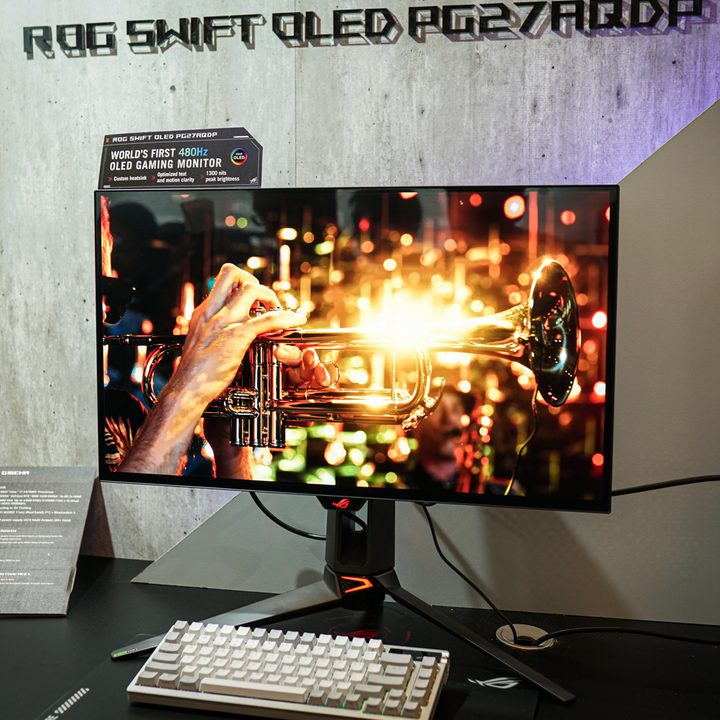
Well, I didn’t see that one coming.
Asus may have brought the first true 480Hz OLED gaming monitor to CES 2024. The ROG Swift PG27AQDP is a 1440p resolution OLED monitor that comes with a staggering 480Hz refresh rate — that alone tells you what you need to know about this beast.
LG did announce its own 480Hz gaming monitor last week, but it uses a dual refresh rate mode to get 480Hz at 1080p (which Asus also has in a different monitor that I mention down below). But 480Hz at 1440p is something we’ve never seen before — until now.
The monitor uses an OLED panel — in particular, an MLA OLED panel from LG. It’s different from the QD-OLED monitors we’ve seen like the Odyssey OLED G8 or Alienware 32, with MLA OLED usually taking a back seat in brightness. Asus is making some bold claims about that brightness, though. The company says it can hit 1,300 nits of peak brightness, which is the highest spec we’ve seen yet. Samsung’s QD-OLED monitors are rated for 1,000 nits, for example. That higher brightness means better HDR performance to match the infinite contrast of OLED.
It’s not clear if other brands will have a monitor packing this same panel, but at least right now, Asus is the only one we’ve seen so far. Not even LG Electronics itself seems to currently have something quite like this.

The ROG Swift PG27AQDP is definitely the star of the show here, but Asus also announced two other impressive-looking OLED monitors to go alongside it. The first, the Swift OLED PG32UCDP, is a 32-inch dual-refresh rate monitor that can switch between 4K 240Hz and 1080p 480Hz at the press of a button. In terms of specs, it’s the same panel as the LG UltraGear 34GS95QE.
Similarly, Asus also hasits bigger sibling: the Swift PG39WCDM, a 39-inch monitor with that same claim of a peak brightness of 1,3000 nits. This one matches what LG announced with its UltraGear 39GS95QE, which features an aggressive 800R curve, a 21:9 aspect ratio, a 3440 x 1440 resolution, and a 240Hz refresh rate. The Swift PG39WCDM comes with a built-in Smart KVM switch that lets you control two devices seamlessly.
Asus claims that same 1,300 nits of peak brightness on these two monitors as well, along with a 0.03 millisecond response time and AMD FreeSync Premium Pro.
There’s some important information we don’t currently know about these three ROG monitors. Most importantly, the pricing is unknown. How exactly the the PG27AQDP in particular will stack up against the competition depends a lot on that price, as will the release date. QD-OLED panels have a leg up over these monitors with the second-gen Alienware monitors right on our doorstep.
Still, there’s no question the ROG PG27AQDP is one of the most exciting products we’ve seen at CES so far.


