  1. Home
  2. Space
  3. News

SpaceX has set a new date for Axiom-3 crewed rocket launch

Add as a preferred source on Google

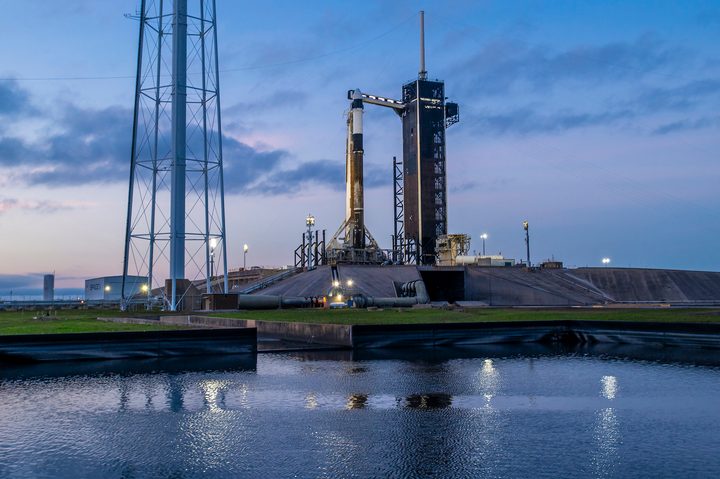
The Axiom 3 mission waiting to launch.
The Falcon 9 rocket that will carry the Axiom 3 crew to space. SpaceX

NASA’s third private launch to the International Space Station (ISS) has been moved from Wednesday to Thursday to give SpaceX more time to complete pre-launch checkouts and data analysis on the Falcon 9 rocket and Crew Dragon capsule.

Recommended Videos

The Axiom-3 mission, organized by Texas-based Axiom Space, was originally set to get underway on Wednesday afternoon, but earlier in the day, SpaceX announced it was delaying launch from the Kennedy Space Center in Florida by about 24 hours.

If the new schedule holds, SpaceX’s Falcon 9 rocket will blast off the launchpad at 4:49 p.m. ET (1:49 p.m. PT) on Thursday. The early stages of the mission, as well as the crew’s arrival at the ISS early on Saturday morning, will be live-streamed. Digital Trends has all the information you need to watch the broadcast.

The Axiom-3 crew members are European Space Agency project astronaut Marcus Wandt of Sweden; commander Michael López-Alegría, a dual citizen of both the U.S. and Spain; pilot Walter Villadei of Italy; and mission specialist Alper Gezeravcı of Turkey. López-Alegría and Villadei have been to orbit before, but it’s the first such trip for Wandt and Gezeravcı.

During their time aboard the orbital outpost, the Axiom-3 crew will live alongside the current seven-person crew, conducting more than 30 science experiments and participating in more than 50 outreach events via video link with various groups and organizations back on Earth.

It will be the first crewed launch from U.S. soil since SpaceX’s Crew-7 mission, which got underway in August 2023.

This is Axiom Space’s third privately funded mission to the space station following launches in April 2022 and May 2023, and it will be the first all-European private astronaut mission heading to space.

The weather on the Space Coast is looking good for Thursday, so barring any last-minute technical issues, the crew should get away as planned. If you’re planning to check out the live stream, be sure to keep an eye on SpaceX’s social media feed for any changes to the launch schedule between now and then.

Trevor Mogg
Contributing Editor
Not so many moons ago, Trevor moved from one tea-loving island nation that drives on the left (Britain) to another (Japan)…
China’s answer to SpaceX’s reusable rockets literally catches boosters in a net
SpaceX catches boosters on legs. China just used a net.
Ammunition, Missile, Weapon

SpaceX's playbook for recovering a rocket booster generally involves legs, a precisely controlled vertical landing, and either a concrete pad or a drone ship. 

China just managed to pull off something similar, but in a slightly different way, and on July 10, it tested the method as well.

Read more
Dimming the sun sounds unhinged, but this new study on El Niño makes a surprisingly good case for it
A natural test case, Australia's worst-ever wildfire season, suggests the idea deserves serious consideration.
Nature, Outdoors, Sky

When I first saw "scientists propose dimming the sun," I rolled my eyes. It sounds like a science fiction movie cooked up after watching many climate documentaries. But a new study, published on July 8, 2026, in the journal Science Advances, seems to have a genuinely compelling argument.

A Super El Niño is currently forming in the Pacific, feared to be the most intense in decades. It could escalate floods, wildfires, and extreme heat events worldwide. However, Researchers at UC San Diego's Scripps Institution of Oceanography, led by climate scientists Kate Ricke and Jessica Wan, are now proposing one of the most interesting solutions I’ve come across.

Read more
You can now walk through space and gaze into a black hole at this VR exhibit
Smithsonian Starstruck lets you drift past dying stars and see the origin point of the universe for as little as $18 a person.
Smithsonian Starstruck featured

Most planetarium shows ask you to sit still and look up. The Smithsonian's new VR exhibit takes a different approach, letting visitors walk through the vast expanse of the universe, drifting past stars, planets, and a black hole to get a physical sense of its true scale.

A $29 ticket to the edge of the galaxy

Read more