  1. Home
  2. Computing
  3. News

Disney just reinvented the VR treadmill, and it looks amazing

Add as a preferred source on Google
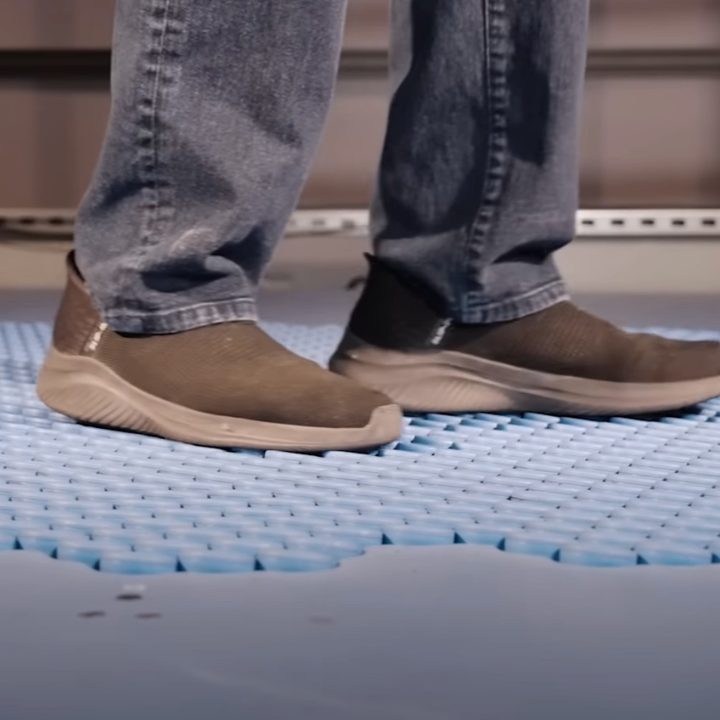
The feet of someone walking on Disney's Holotile technology.
Disney

Disney casually broke the news of an exciting-sounding breakthrough to reinvent movement in VR. The HoloTile is an omnidirectional, multiplayer treadmill floor that could solve a huge problem with VR gaming and the metaverse: connecting body movement to the virtual world.

Solutions to this problem so far have been clunky, either opting for a tethered treadmill or going free-roam in large rooms, where running into other players or walls is a problem.

Recommended Videos

Disney’s solution is unique, appearing to be small balls that rotate to match your foot movement. There’s no need for a tether, and more than one person can use the expandable HoloTile VR treadmill. It seems like a perfect solution, though it’s still a work in progress.

In a video demonstration, you can see the people taking small steps, and the HoloTile keeps rolling for a moment after they stop walking. The HoloTile floor can also move objects like a conveyor belt but in any direction. In the video, you’ll see someone waving their hand to control a box as if by magic.

‘HoloTile’ floor for omnidirectional VR experiencespic.twitter.com/xbALAZsUtE

— Massimo (@Rainmaker1973) January 22, 2024

Beyond creating the feeling of movement without actually moving, it also helps deal with real-world objects. The best VR headsets let you walk around in your physical room while your avatar matches that movement in the virtual space you’re seeing. That works great until you bump into a table, a wall, or knock over a lamp.

There are ways of alerting gamers within the headset of a virtual boundary. Mixed reality lets you see your surroundings. That’s one of the most intriguing aspects of Apple’s Vision Pro and Meta’s Quest 3, but large graphic overlays can still obscure portions of your room and break the immersion of the game.

Disney Imagineer Makes History | Disney Parks

Holotile is being developed by Lanny Smoot, the Disney Research Fellow, and Imagineer behind special effects used in the Haunted Mansion and Star Wars lightsabers.

Disney announced Smoot is being inducted into the National Inventors Hall of Fame, becoming the second Disney Imagineer to receive this honor, along with Disney founder Walt Disney, who was honored posthumously for the multiplane camera.

Alan Truly
Alan Truly is a Writer at Digital Trends, covering computers, laptops, hardware, software, and accessories that stand out as…
AI image generators have escaped nightmare fingers and entered the fake premium era
Meta Muse, Gemini, and ChatGPT can now make clean, usable images. They also keep making reality look like a product render with feelings.
Terminal, Railway, Train

I expected this comparison to be uglier. Meta Muse, Gemini Nano Banana 2, and ChatGPT Images 2.0 sounded like a perfect setup for plastic faces, mangled hands, fake products, and posters written in haunted alphabet soup. Instead, they were mostly competent, which somehow made the whole thing more suspicious.

These aren’t identical tools wearing different logos. Meta pitches Muse Image as a social image model living inside Meta AI and its apps. Google frames Nano Banana 2 around speed, editing, and Gemini’s broader knowledge. OpenAI sells ChatGPT Images 2.0 on text rendering, visual control, and stronger prompt handling. Different ambitions, same polished little showroom.

Read more
DuckDuckGo’s browser now blocks the YouTube ads everyone hates
DuckDuckGo adds a Brave-like YouTube ad blocking feature
Text, Aircraft, Airplane

DuckDuckGo has spent the past few months gaining fresh attention as more users look for alternatives to Google’s increasingly AI-heavy Search experience. Now, the privacy-focused company is adding a feature that could make its browser even more tempting for everyday use. DuckDuckGo says its browser can now block most video ads, including those on YouTube, when a video is playing inside the browser.

What’s happening?

Read more
ChatGPT Live could make talking to AI feel straight out of the movies
We might finally get the AI sidekick sci-fi movies promised
Elderly women using ChatGPT live on a smartphone

AI voice assistants have been chasing the sci-fi dream for years, but they still have a hard time holding a conversation with humans. Most voice systems still need clear turns, clean pauses, and a few seconds before they respond. OpenAI is now rolling out GPT-Live, a new voice model for ChatGPT Voice that is designed to make those exchanges feel faster and less scripted.

The main upgrade is what OpenAI calls a full-duplex architecture. In simpler terms, GPT-Live can listen and speak at the same time. It continuously processes what the user is saying while also generating its own response, allowing it to decide when to talk, when to pause, when to keep listening, and when to use a tool.

Read more