  1. Home
  2. Space
  3. News

James Webb Space Telescope celebrated on new stamps

Add as a preferred source on Google

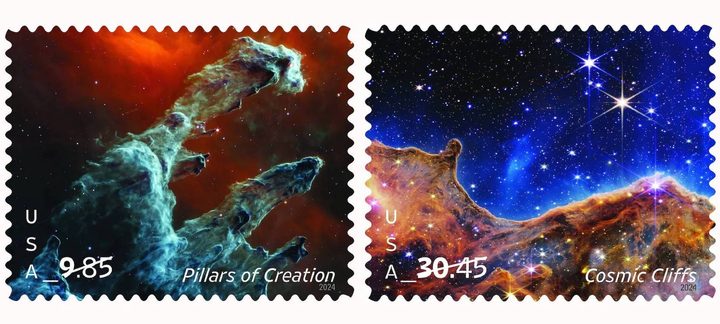
Two new stamps celebrating the James Webb Space Telescope, issued by the USPS in January 2024.
Two new stamps celebrating the James Webb Space Telescope, issued by the USPS in January 2024. USPS

Beautiful images captured by the James Webb Space Telescope have landed on a new set of stamps issued this week by the U.S. Postal Service (USPS).

Recommended Videos

The James Webb Space Telescope is the most powerful and most advanced telescope ever sent to space, and soon after its launch in December 2021, it’s been beaming back stunning imagery and gathering huge amounts of data that’s enabling astronomers to learn more than ever before about distant galaxies.

The USPS’s latest Priority Mail stamps were issued on Monday, January 22, and feature images captured by Webb that include the Pillars of Creation and the Cosmic Cliffs.

The Pillars of Creation image was captured by Webb’s MIRI (Mid-Infrared Instrument). This is a region within the vast Eagle Nebula, which lies some 6,500 light-years from Earth, and the image shows pillars of gas and dust enshrouding stars that are forming very gradually over many millennia.

The other stamp features Webb’s NIRCam (Near-Infrared Camera) image of the Cosmic Cliffs in the Carina Nebula around 7,600 light-years away and reveals emerging stellar nurseries and numerous individual stars.

“NASA’s James Webb Space Telescope is the perfect intersection of science, engineering, and art as it reveals the greatest secrets of our cosmos through the beautiful images it captures,” Nicola Fox, NASA’s associate administrator of the Science Mission Directorate, said on the day of the stamps’ launch.

Fox added: “With these stamps, people across the country can have their own snapshot of Webb’s captivating images — and the incredible science they represent — at their fingertips, and know that they, too, are part of this ground-breaking new era in astronomy.”

This is the second issue of U.S. stamps to celebrate the James Webb Space Telescope after the USPS launched its first set in August 2022, a short while after NASA shared the first images captured by Webb.

That stamp features an artist’s digitally created depiction of the telescope with a dazzling starscape as a backdrop.

Trevor Mogg
Contributing Editor
Not so many moons ago, Trevor moved from one tea-loving island nation that drives on the left (Britain) to another (Japan)…
NASA is investing $590 million in private contractors to build humanity’s first Moon outpost
NASA is counting on private companies to land its Moon Base dream.
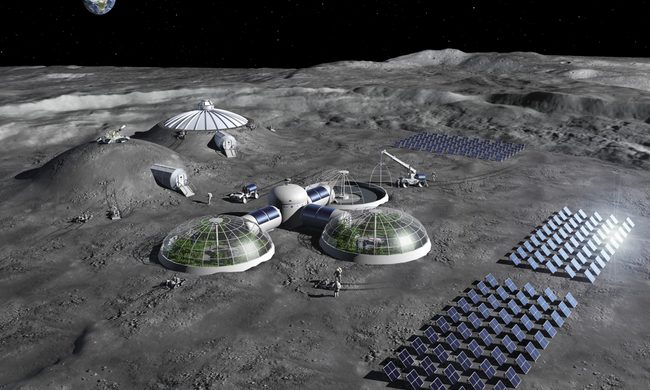
Artist impression of a Moon Base concept, with solar arrays for energy generation, greenhouses for food production, and habitats shielded with regolith.

Building a permanent base on the Moon sounds like science fiction, but NASA is making it feel a lot more real. The agency just handed $590 million in contracts to three private companies for four uncrewed lunar lander missions launching in late 2028.

These missions are part of Phase 1 of NASA's broader $30 billion Moon Base program, which needs to deliver landers, rovers, and scientific cargo up there before astronauts eventually move in. These efforts are closely tied NASA's Artemis program, which sent humans on a lunar flyby in April for the first time since the Apollo era.

Read more
Getting to Mars may require a pit stop in orbit, and NASA just tested the nozzle to make that happen
A gas pump nozzle for spacecraft sounds simple. It is not, and that's what makes this test worth paying attention to.
Architecture, Building, Factory

Getting a spacecraft to Mars or beyond requires an enormous amount of fuel, most of which has to be hauled from Earth, adding to the overall cost and weight of the spacecraft. NASA has been working on a different approach, one that could be more efficient and effective.

It wants to refuel a spacecraft in orbit before heading out for the mission. What’s even more interesting is that the space agency just finished testing a component that could make that possible: a cryocoupler.

Read more
Elon Musk’ Starlink could soon offer mobile services as a US carrier
Showcase of T-Mobile Starlink service on an iPhone.

Elon Musk’s Starlink has already changed how millions of people access the internet, especially in places where traditional broadband struggles to reach. Now, the satellite internet service could be preparing for an even bigger leap — becoming your mobile carrier.

According to a Financial Times report, SpaceX has told investors it’s considering launching a retail Starlink mobile service in the US. Instead of simply partnering with wireless carriers, the company could begin selling mobile plans directly to consumers, putting it in direct competition with Verizon, AT&T, and T-Mobile.

Read more