1. Home
  2. Space
  3. News

Hear the otherworldly sounds of interacting galaxies with this Hubble sonification

Add as a preferred source on Google

When two different galaxies get close enough together that they begin interacting, they are sometimes given a shared name. That’s the case with a newly released image from the Hubble Space Telescope that shows two galaxies, NGC 274 and NGC 275, which are together known as Arp 140. not only is there a new image of the pair, but there’s also a sonification available so you can hear the image as well as see it.
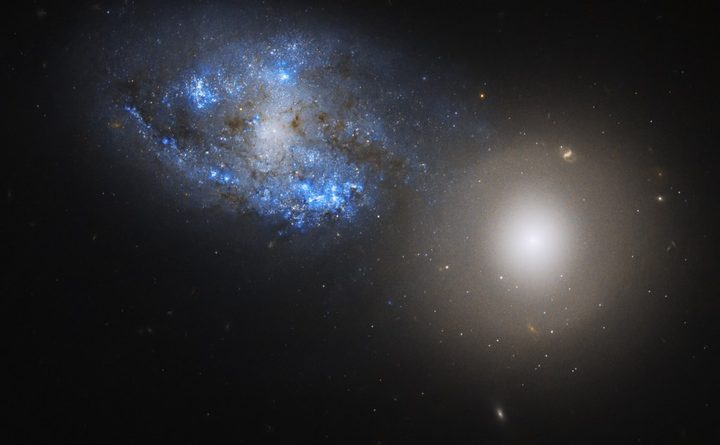
This new NASA Hubble Space Telescope image showcases a resplendent pair of galaxies known as Arp 140.
This new NASA Hubble Space Telescope image showcases a resplendent pair of galaxies known as Arp 140. NASA/ESA/R. Foley (University of California - Santa Cruz)/Processing: Gladys Kober (NASA/Catholic University of America)

Arp 140 consists of a spiral galaxy like our Milky Way on the left, and a lenticular galaxy on the right. Lenticular galaxies have a less orderly structure than spiral galaxies, appearing blob-like or unfocused, which is why this one appears as a hazy white light. A lenticular galaxy is halfway between the ordered shape of a spiral galaxy and the totally unstructured elliptical galaxy. The lenticular galaxy does have a disk shape but no spiral arms. The spiral galaxy shown here is a particular type called a barred spiral galaxy, which has a bright bar across the center where many stars are packed tight.

Sonification of Arp 140

As well as the image, Hubble scientists also released this sonification of Arp 140. The idea is to translate the colors and brightness of the image into sound, to provide a new way to experience the stunning views collected by Hubble and other telescopes.

Recommended Videos

“Scientists sonified the data in this image, assigning pitch to color for the image as a whole (bluer light is higher, redder is lower),” NASA explains. “Pitch is mapped to brightness for the resolved stars and background galaxies, based on their apparent size – objects that appear bigger are lower, and smaller are higher in pitch. Brighter light is louder throughout the image.”

Previous sonifications by NASA have included using images from the James Webb Space Telescope, the Chandra X-ray Observatory, and other Hubble images. They have used different methods of translating color and brightness into pitch, volume, and time, and a similar project has even turned space images into sheet music that can be played.

Scientists working on the sonification have said that they aim to not only give the public a fun new way to engage with NASA imagery but also to make space images accessible to people who are blind or have low vision.

Georgina Torbet
Georgina has been the space writer at Digital Trends space writer for six years, covering human space exploration, planetary…
Space is becoming Bezos and Musk’s next data center site, and we have every reason to worry
The AI boom is coming for the night sky
How Vast's space station will look in orbit.

AI data centers already consume vast amounts of electricity and water on Earth, so Silicon Valley has begun looking somewhere considerably more spacious... literally.

Elon Musk's SpaceX and Jeff Bezos' Blue Origin, along with several other companies, have proposed enormous constellations of satellites designed to operate as orbital data centers. However, environmental groups and former space officials are now warning that putting them into orbit at the proposed scale could have severe consequences for Earth's atmosphere and the night sky.

Read more
The first possible exomoon is here, and it makes our Moon look hilariously tiny
Scientists may have found the first exomoon, except this one is the size of Jupiter
This artist’s concept depicts a potential volcanic moon between the exoplanet WASP-49 b, left, and its parent star. New evidence indicating that a massive sodium cloud observed near WASP-49 b is produced by neither the planet nor the star has prompted researchers to ask if its origin could be an exomoon.

We have already discovered more than 6,000 planets outside of our immediate neighborhood. Yet, finding a moon orbiting one of those distant worlds has proved considerably harder. Astronomers may finally have something close to the real deal, but this particular object stretches the word “moon” almost beyond recognition.

Using the European Southern Observatory’s Very Large Telescope in Chile, researchers detected strong evidence for a moon-like object in the CD-35 2722 system. Further observations are still necessary to confirm the discovery, but it could become the first confidently detected natural satellite outside our solar system. There is still one tiny complication though. This moon is apparently massive.

Read more
China’s answer to SpaceX’s reusable rockets literally catches boosters in a net
SpaceX catches boosters on legs. China just used a net.
Ammunition, Missile, Weapon

SpaceX's playbook for recovering a rocket booster generally involves legs, a precisely controlled vertical landing, and either a concrete pad or a drone ship. 

China just managed to pull off something similar, but in a slightly different way, and on July 10, it tested the method as well.

Read more