1. Home
  2. Space
  3. News

How to watch NASA launch its newest ocean and atmosphere observation satellite tonight

Add as a preferred source on Google

Although NASA is most often associated with sending missions out to observe space, the agency also has a large number of space missions that turn the other way to observe Earth. The newest mission to observe Earth’s atmosphere and oceans, and to provide insight into how these interact with the changing climate, is set for launch early Eastern time on Tuesday, February 6 .

Launch of Mission to Study Earth's Atmosphere and Oceans (Official NASA Broadcast)

If you’d like to watch the launch of this new satellite, then NASA will be live-streaming the launch. We’ve got details on how to watch below.

Recommended Videos

What to expect from the launch

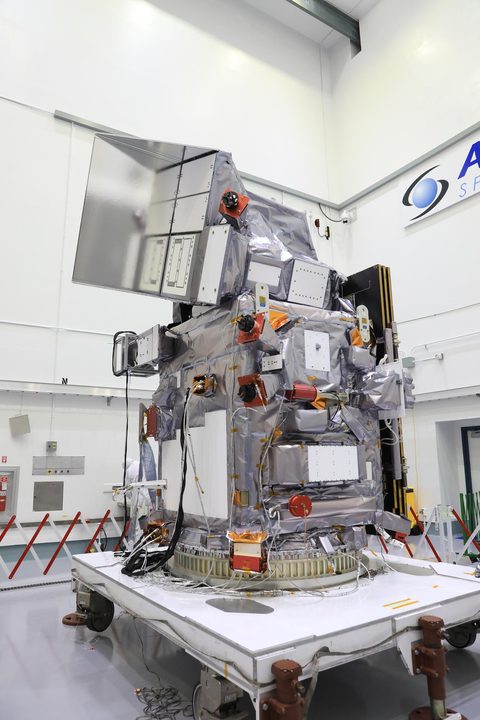
NASA’s Plankton, Aerosol, Cloud, ocean Ecosystem (PACE) observatory is inspected and processed on a spacecraft dolly in a high bay at the Astrotech Space Operations Facility near the agency’s Kennedy Space Center in Florida on Monday, Dec. 4, 2023.
NASA’s Plankton, Aerosol, Cloud, ocean Ecosystem (PACE) observatory is inspected and processed on a spacecraft dolly in a high bay at the Astrotech Space Operations Facility near the agency’s Kennedy Space Center in Florida on December 4, 2023. NASA/Kim Shiflett

The PACE (Plankton, Aerosol, Cloud, ocean Ecosystem) spacecraft will launch from Space Launch Complex 40 at Cape Canaveral Space Force Station in Florida, and be carried by a SpaceX Falcon 9 rocket. The spacecraft will enter an orbit around Earth that always keeps the same position relative to the sun and is called a sun-synchronous orbit.

“An Earth-observing satellite generally wants the sun well overhead during observations,” explained Scott Patano, flight dynamics system development lead for PACE at NASA’s Goddard Space Flight Center, in a statement. This orbit ensures that the measurements taken by the satellite will be consistent, as the sun will be in the same position for each measurement the satellite takes of Earth.

This orbit is also the reason for the late-night launch. By launching after midnight from Florida, the satellite can directly enter its final orbit, where it will cross the equator for the first time close to India at 1 p.m. local time.

That means it’s necessary to launch at a very particular time, but the weather only has a 40% chance of being favorable for a early Tuesday launch. However, if the weather prevents a launch at that time, then launching at the same time early on Wednesday is also possible.

How to watch the launch

The launch is scheduled for 1:33 a.m. ET on Tuesday, February 6 (10:33 p.m. PT on Monday, February 5). Coverage begins at 12:45 a.m. ET (9:45 p.m. PT on Monday). The coverage will be shown live on NASA TV, which you can watch in a variety of ways. You can watch on NASA’s YouTube channel using the video embedded at the top of this page.

If you have a smart TV or want to watch on your smartphone, then you can also watch via the NASA+ app, which is a free download. You can see options for viewing and find out more about downloading the app on the NASA TV webpage.

Georgina Torbet
Georgina has been the space writer at Digital Trends space writer for six years, covering human space exploration, planetary…
China’s answer to SpaceX’s reusable rockets literally catches boosters in a net
SpaceX catches boosters on legs. China just used a net.
Ammunition, Missile, Weapon

SpaceX's playbook for recovering a rocket booster generally involves legs, a precisely controlled vertical landing, and either a concrete pad or a drone ship. 

China just managed to pull off something similar, but in a slightly different way, and on July 10, it tested the method as well.

Read more
Dimming the sun sounds unhinged, but this new study on El Niño makes a surprisingly good case for it
A natural test case, Australia's worst-ever wildfire season, suggests the idea deserves serious consideration.
Nature, Outdoors, Sky

When I first saw "scientists propose dimming the sun," I rolled my eyes. It sounds like a science fiction movie cooked up after watching many climate documentaries. But a new study, published on July 8, 2026, in the journal Science Advances, seems to have a genuinely compelling argument.

A Super El Niño is currently forming in the Pacific, feared to be the most intense in decades. It could escalate floods, wildfires, and extreme heat events worldwide. However, Researchers at UC San Diego's Scripps Institution of Oceanography, led by climate scientists Kate Ricke and Jessica Wan, are now proposing one of the most interesting solutions I’ve come across.

Read more
You can now walk through space and gaze into a black hole at this VR exhibit
Smithsonian Starstruck lets you drift past dying stars and see the origin point of the universe for as little as $18 a person.
Smithsonian Starstruck featured

Most planetarium shows ask you to sit still and look up. The Smithsonian's new VR exhibit takes a different approach, letting visitors walk through the vast expanse of the universe, drifting past stars, planets, and a black hole to get a physical sense of its true scale.

A $29 ticket to the edge of the galaxy

Read more